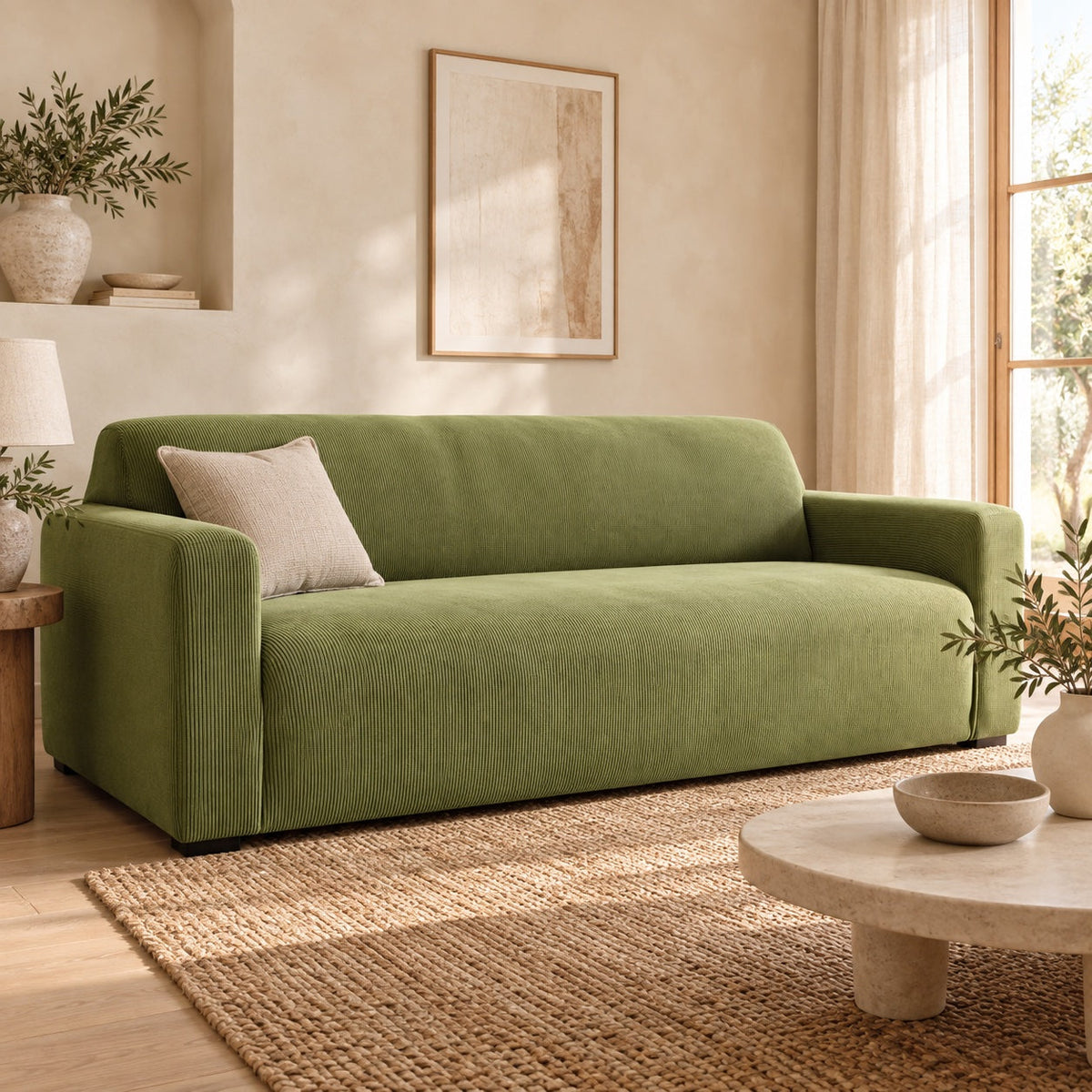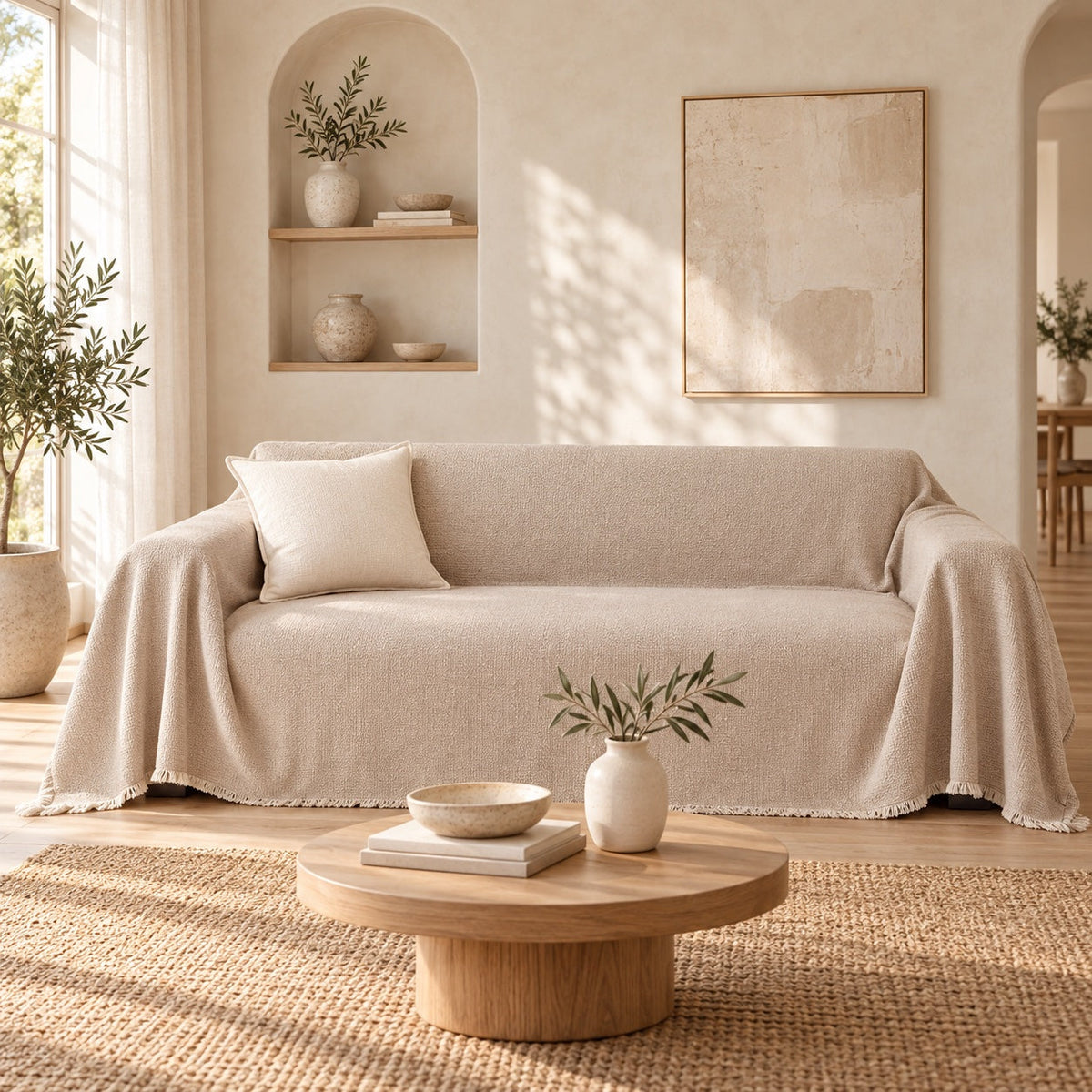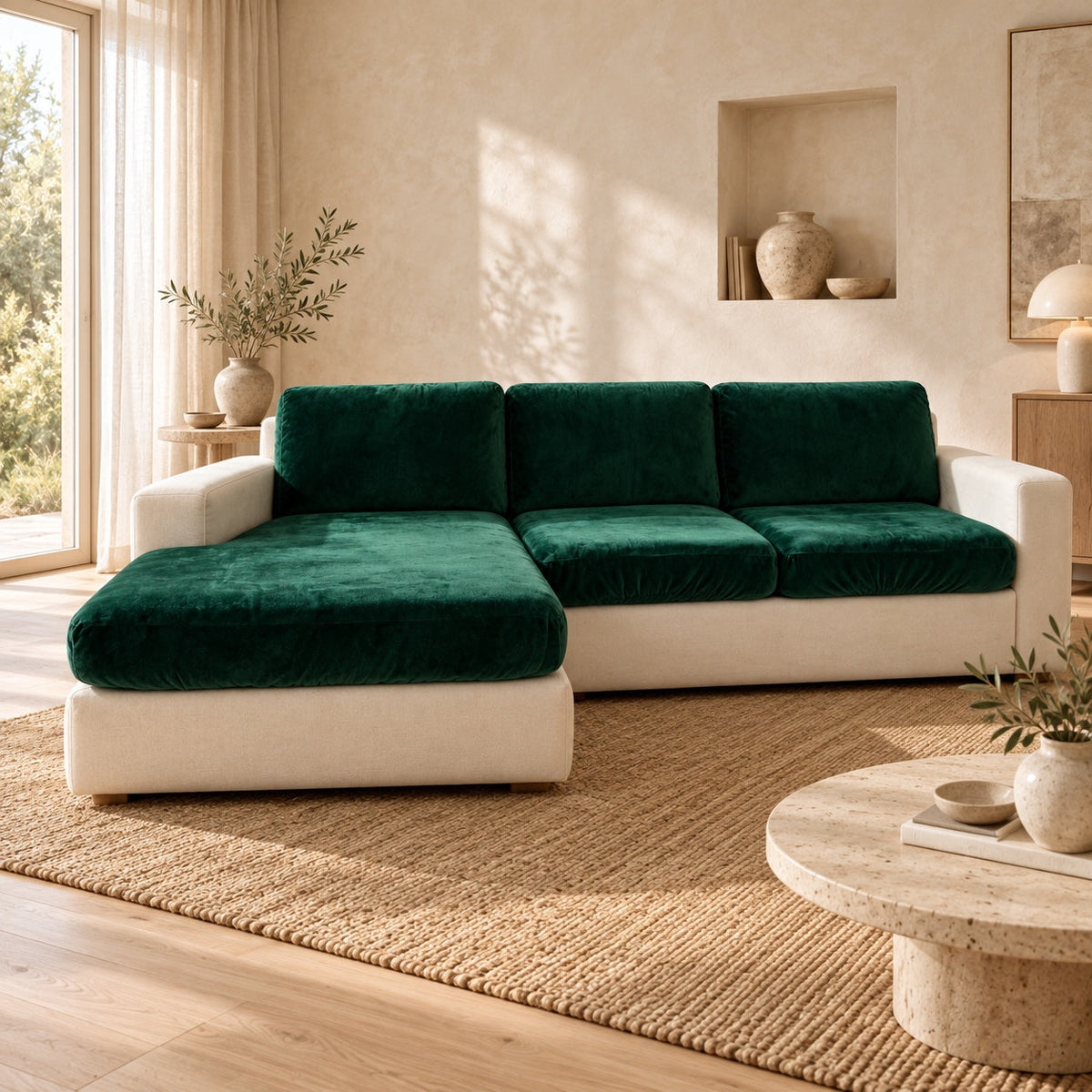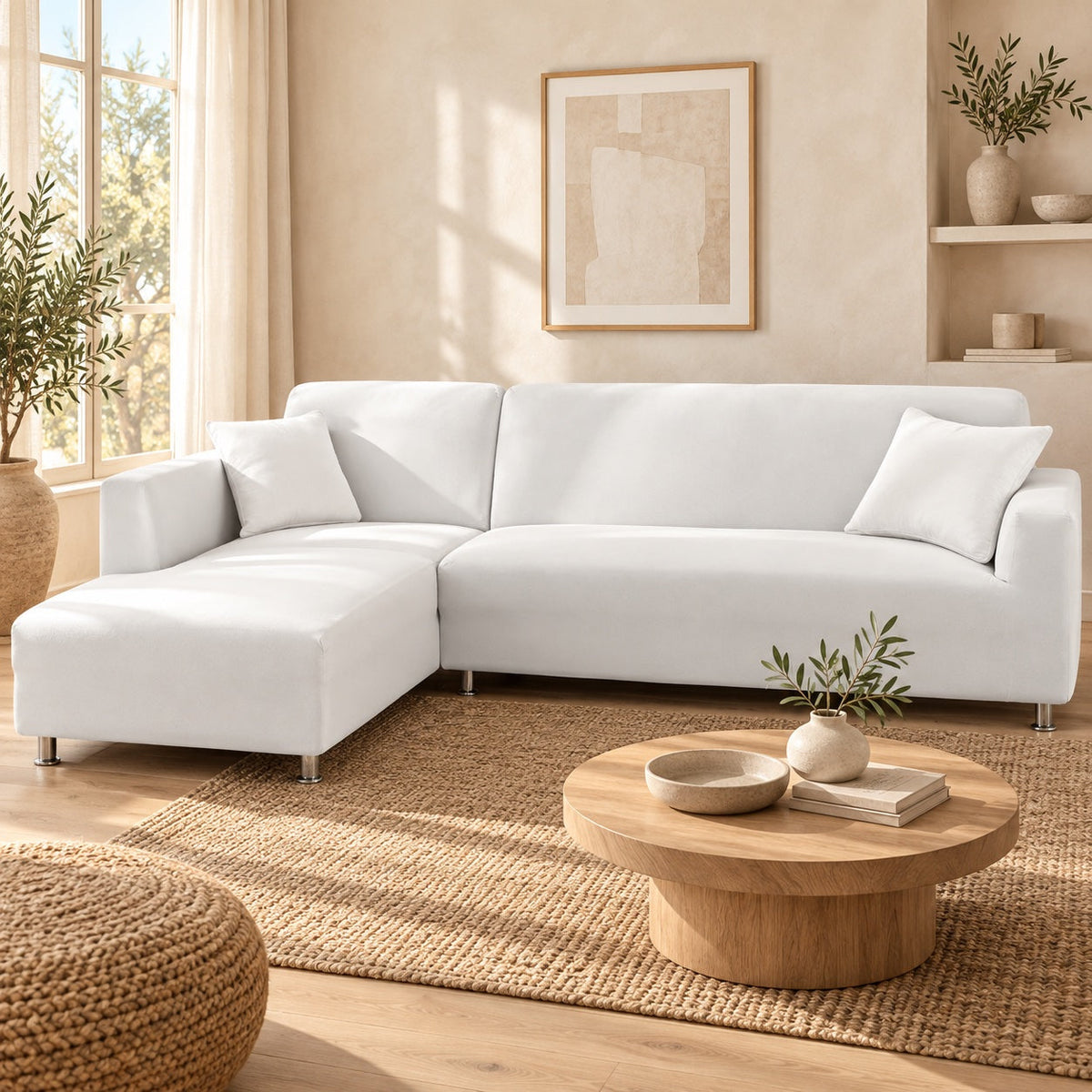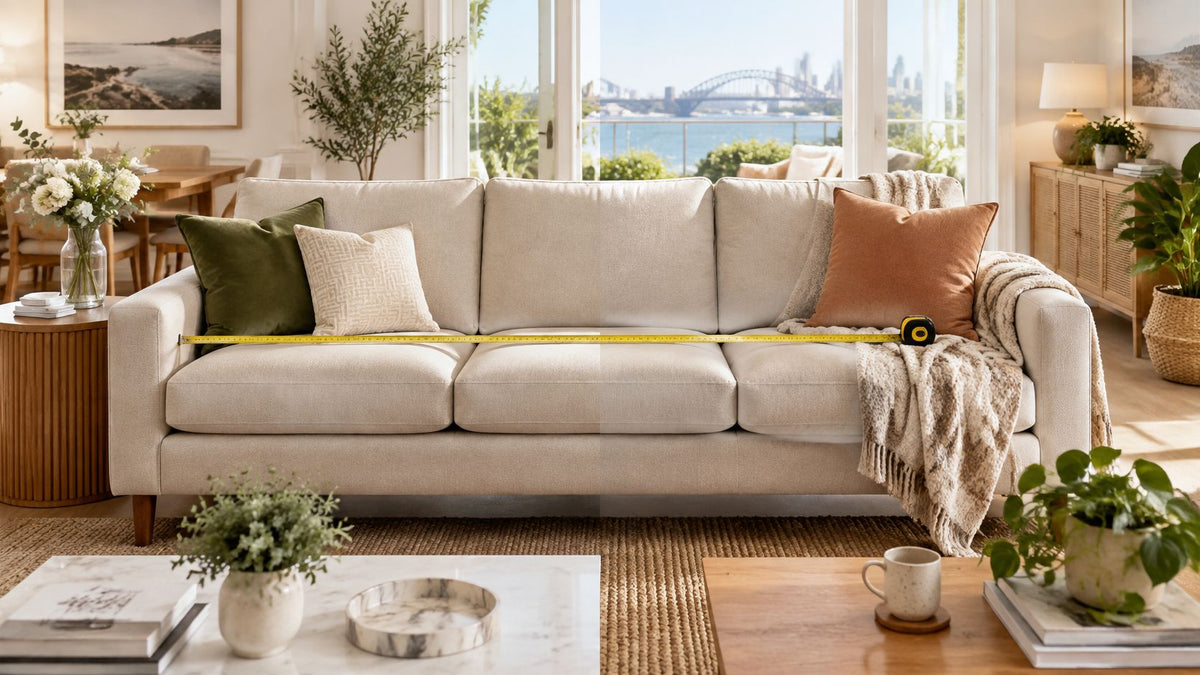
In everyday Australian use, a sofa and a couch are the same piece of furniture, an upholstered seat for more than one person. The words differ in origin and old social connotation, not in function.
Plenty of shoppers still hunt for a difference between sofa and couch as if one name meant a formal piece and the other a casual one. That split belongs to older habits and to sales copy, not to the seat in the lounge room. Change the label and the frame, the cushions and the width stay exactly where they were.
Table of Contents
- Is There Really a Difference Between a Sofa and a Couch?
- Where Do the Words Sofa and Couch Come From?
- Why Did the English Upper Classes Say Sofa, Not Settee?
- Couch, Sofa or Lounge?
- Which Shape Words Actually Change the Product?
- Choose a Cover by Shape and Width, Not by Name
Is There Really a Difference Between a Sofa and a Couch?
In everyday Australian use, a sofa and a couch are the same piece of furniture, an upholstered seat for two or more people, so there is no functional difference and only the word changes.
Think of jumper and sweater. Two names sit on one garment, and the person wearing it doesn't need to know which word the shop printed on the tag. Sofa and couch work the same way. Each word is a label for one format of seating, not a separate way of building it.
The noun on a listing doesn't tell you the frame, the cushion fill or how the back is made. Construction does that job.
The three-seater you watch television on is still the same piece of furniture whether you call it a sofa, couch or lounge.
What the label doesn't decide
A shopper can get stuck on tone. Sofa sounds dressier. Couch sounds like the place you flop after work. Lounge sounds like the room as much as the seat. None of those associations changes the object. A velvet three-seater with wooden legs is still that three-seater if the listing says couch. A soft, deep seat in a family room is still that seat if the listing says sofa.
A listing that looks like two products
Say a retailer runs two photos of the same straight seat. One caption reads "formal sofa" and the other "family couch". The arms, the back height and the outer width are identical. Order both "types" and you unload one piece twice. The mix-up sticks around because older writing did keep the words apart, and some shops still borrow that split to sound more refined. In an Australian lounge room the split doesn't hold. You can say either word to a salesperson, a flatmate or a removalist and be understood.
What still matters, once the name is set aside, is whether people sit upright, stretch out or sleep on it, and how wide the whole thing is from arm to arm. Those facts live in the object.
The trail is short from here. The words grew from different origins, English class habits once loaded one of them, Australian speech mixes couch, sofa and lounge, and only certain shape words change what you buy. A cover, when you want one, is then chosen by width.
Try the swap test on any sentence in your own house. "We need a new sofa" and "We need a new couch" point at the same gap against the wall. Change the shape, from a straight run to an L, or change the width by half a metre, and the purchase changes. Change only the noun, and it doesn't.
Where Do the Words Sofa and Couch Come From?
Couch comes from the Old French coucher, meaning to lie down, and sofa comes from the Arabic suffa, a raised platform or bench that reached English through Turkish and French.
These are dictionary histories, with no further dates attached here. They explain why some writers once kept the words apart, while everyday use has largely merged them.
Two routes, side by side
Couch followed the body. Its original sense was a piece you could recline on, often with one raised end, closer to a daybed than to the square-backed seat most homes use now. Picture someone stretched out rather than perched for conversation, and you have the older couch.
Sofa followed the platform. Suffa named a raised bench. Over time that bench became an upholstered seat with a back and with arms on both sides, the shape people now expect in a sitting room.
| Word | Origin | Original meaning | Original design sense |
|---|---|---|---|
| Couch | Old French coucher | to lie down | a piece to recline on, often with one raised end |
| Sofa | Arabic suffa, reaching English through Turkish and French | a raised platform or bench | a bench that developed into an upholstered seat with a back and arms |
The origins tell you the history of the words, not what a modern seat will look like. A low daybed can be sold as a sofa. A high-backed formal seat can be sold as a couch. The old design sense is a clue to language, not a measuring tape.
Why Did the English Upper Classes Say Sofa, Not Settee?
They said sofa rather than settee because settee was treated as a marker of lower social standing, and Nancy Mitford made that snobbery famous in the 1950s through her writing on class-coded vocabulary.
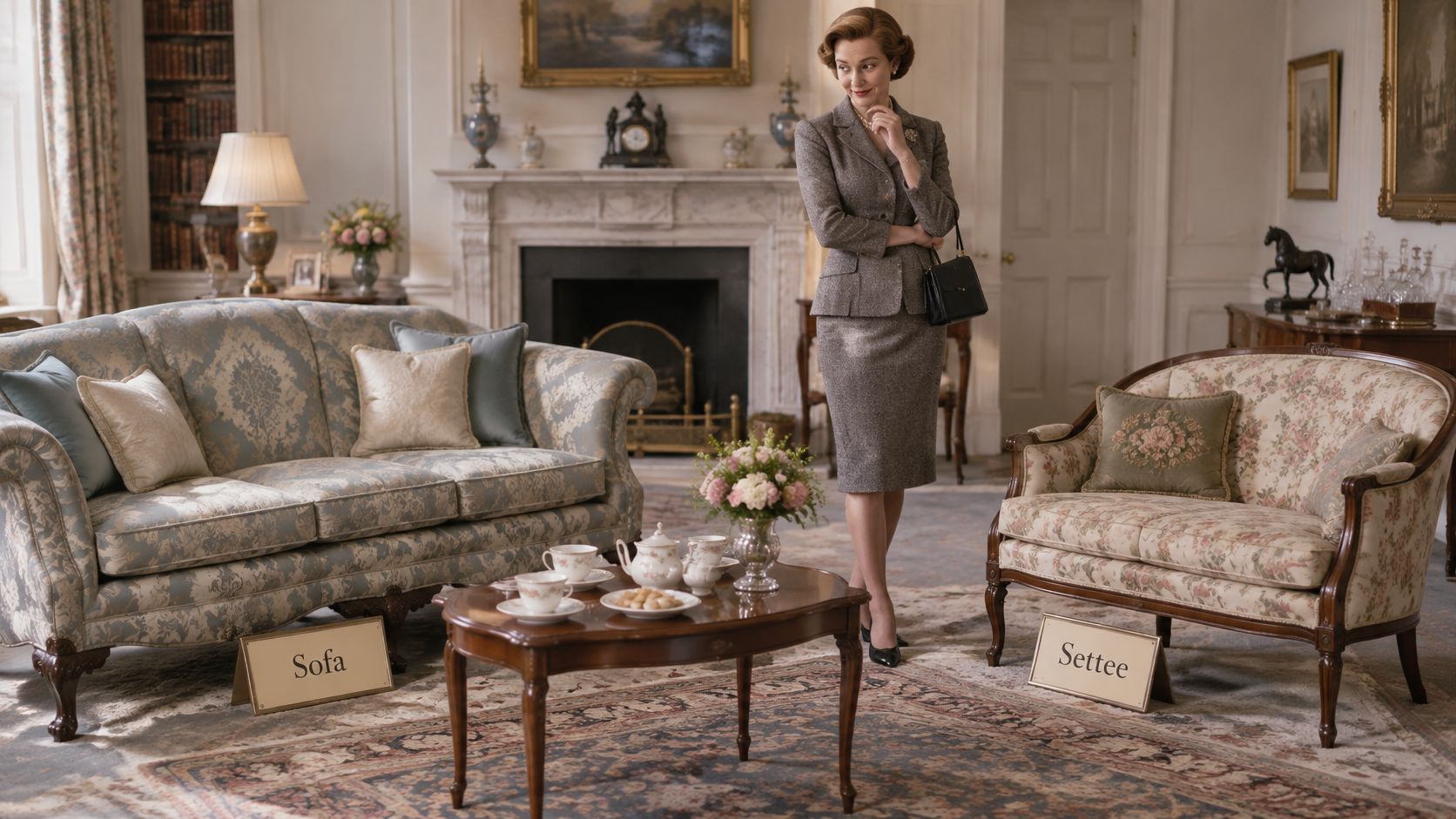
A word can become a signal of background. Speakers then pick the one that places them where they want to be seen. Mitford's writing on class-coded vocabulary put sofa on the approved side and settee on the other. The furniture didn't move. The speaker's self-image did.
That habit travelled out of British drawing rooms and into popular talk, where it turned into a joke about accents and manners. People repeated the pair the way they repeated other class tells, more as a party trick than as a rule of grammar.
A hypothetical household: One family says sofa at dinner while the neighbours say settee, and both groups sit on the same kind of upholstered seat. Nothing in that scene was surveyed or recorded. It is only an illustration of how a word can sort people while the object stays put.
This was a social signal of its time, not a grammatical rule, and it doesn't describe how Australians speak. The snobbery has largely faded, which is why sofa, couch and settee can sit side by side now without anyone keeping score.
Couch, Sofa or Lounge?
In Australia, couch is the everyday word for the piece, lounge is common for both the piece and the room, and sofa is understood and appears in product names and formal writing.
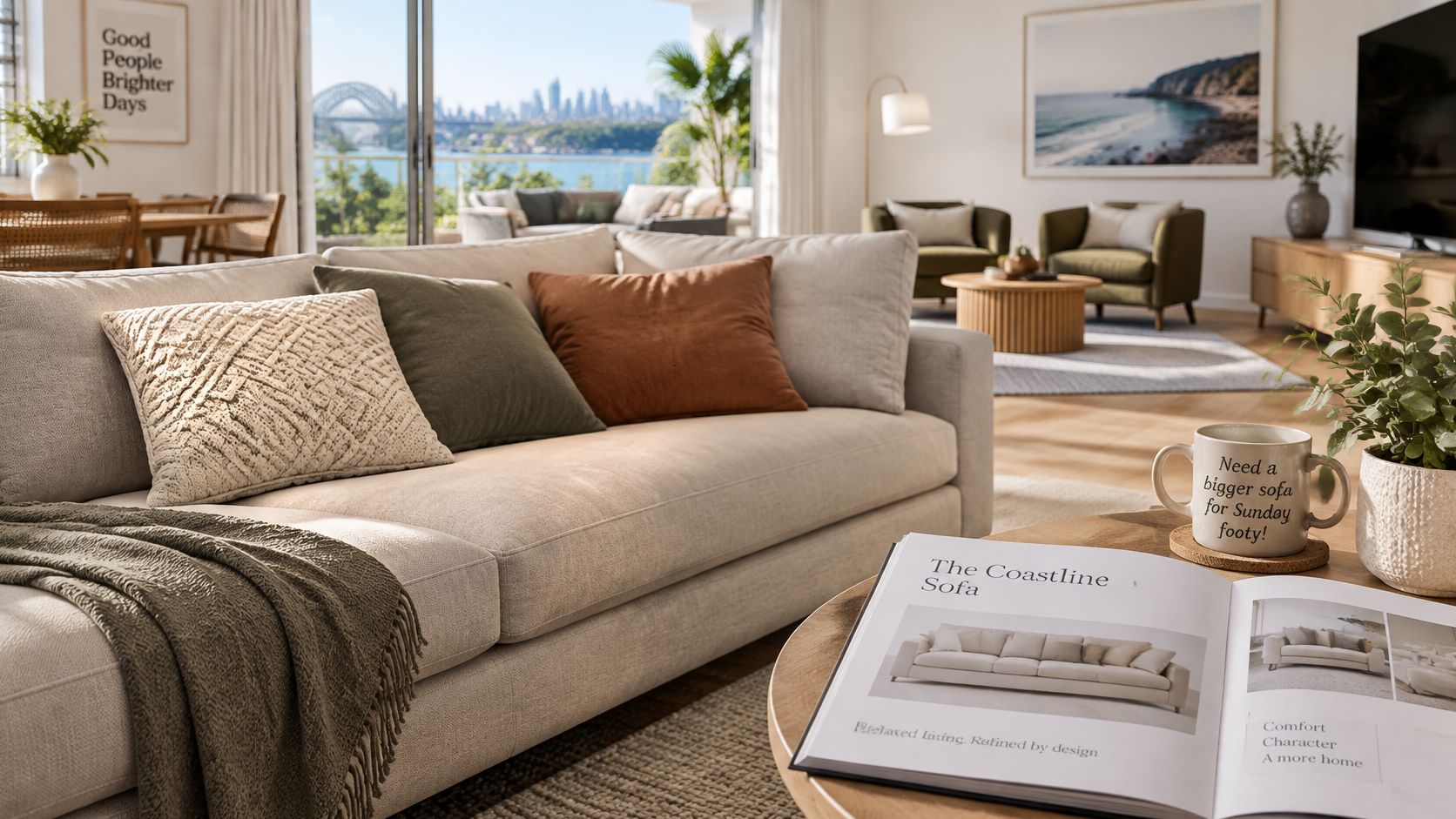
The Auslan dictionary defines a couch as "a long, comfortable seat with a back and arm rests" for two or more people, lists sofa as an English equivalent, and identifies lounge as the Australian English term. The Australian Writers' Centre notes that couch is preferred in Australia while sofa is more common in Britain, and the Macquarie Dictionary treats lounge as meaning a sofa or couch. The three words overlap on the same furniture.
Settee and loveseat still turn up, settee as an older word that is uncommon in everyday talk, and loveseat as a pointer toward a seat for two. Neither one draws a state line. There is no reliable map of who says which word in which state. Households mix them, sometimes inside a single conversation.
Different names don't mean different products. If you want to protect your three seater couch, you still start from the seat in front of you. A photograph and a tape measure tell you more than the noun the household prefers.
Which Shape Words Actually Change the Product?
Two seats can share the name couch and need completely different covers. The split that matters is shape, not vocabulary: L-shaped, sectional, chaise and sofa bed all change what you buy, while sofa, couch, lounge and settee describe the same straight seat.
| Term | Plain meaning | Changes the product? | Note for buyers |
|---|---|---|---|
| Sofa | Upholstered seat for more than one person | No | Name only; judge by width |
| Couch | Same as sofa in everyday use | No | Straight covers are sold as Couch Covers |
| Lounge | Australian word for the seat or the room | No | Same straight-seat formats |
| Settee | Older word for a small sofa | No | Treat as a sofa and measure it |
| Loveseat | Two-person seat | No | Seater labels are not measurements |
| Chesterfield | Deep-buttoned sofa with high arms | Possibly, by arm height | Deep, high arms can change how a straight cover sits |
| Sectional or modular | Several connected pieces | Yes | An L-shaped layout takes an L-Shaped Sofa Cover, one cover per run; there is no module-by-module cover |
| Chaise longue | Seat with an extended lying section | Yes | Usually treated as two parts |
| Sofa bed | Seat that converts to a bed | Yes | Takes a Sofa Bed Cover |
Read the table by shape, not by how formal the piece looks. A loveseat label is not a measurement. A two-seater with deep padded arms can be as wide as a slim-armed three-seater, so the seater word on its own can't pick a size.
The style words need a second look rather than a different product. A chesterfield names a deep-buttoned style with high, rolled arms, and those arms can change how a straight cover sits on the frame. A chaise longue has an extended lying section, and that extension is usually treated as a second part, so check that the shape matches before assuming one cover does the job.
The clearest switch is the corner. An L-shaped lounge is really two seats joined at an angle, and it is covered that way too. You can browse L-shaped sofa covers as a pair of seater sizes, one for each run, rather than as a single straight cover renamed. A sofa bed is the other genuine switch, because the seat has to open into a bed and takes its own cover type.
Choose a Cover by Shape and Width, Not by Name
The deciding facts are the shape of the seat and the distance across it. The household word works like a nickname: handy at home, unreliable at checkout.
Casamé Home sells covers for couches, L-shaped sofas, sofa beds, chairs and recliners, not the furniture itself. The straight range runs from 1 seater up to 4 seater, so “sofa” and “couch” can point to the same cover when the measurements match.
One measurement for a straight seat
Measure in a straight line from the outside of one arm to the outside of the other, then match that figure to the size chart. Where the number sits between two bands, take the larger. For a common family size, find the right sofa width before you choose a band.
| Measured arm-to-arm width | Straight cover size |
|---|---|
| 90 to 130 cm | 1 seater |
| 135 to 175 cm | 2 seater |
| 180 to 220 cm | 3 seater |
| 225 to 300 cm | 4 seater |
The straight cover is sold as a Couch Cover and is chosen by that width, whether the shopper typed sofa or couch. You can see the range in couch covers.
When the shape changes the cover
A corner, L-shaped or chaise longue sofa needs 2 covers, one for each part, with the extra fabric tucked into the gap between the two sections. Measure each run on its own, including armrest tops, inside arm heights and seat, then choose the matching seater sizes within the L-shaped sofa covers.
A sofa bed is chosen by bed format rather than by the word sofa, using the sofa bed covers range. A recliner takes its own cover type, and there is no module-by-module cover for a modular sectional.
A compact timber seat makes the same point in a shop, not only on a cover chart. If you find a mid-century two-seater with slim teak arms, the “two-seater” name still does not give the outer width. Measure the piece you own, then match shape and band.
Casamé Home sells covers for the seat already in the room, whether your household calls it a sofa, a couch or a lounge. Visit Casamé Home, identify the shape, measure the width and pick the matching collection.