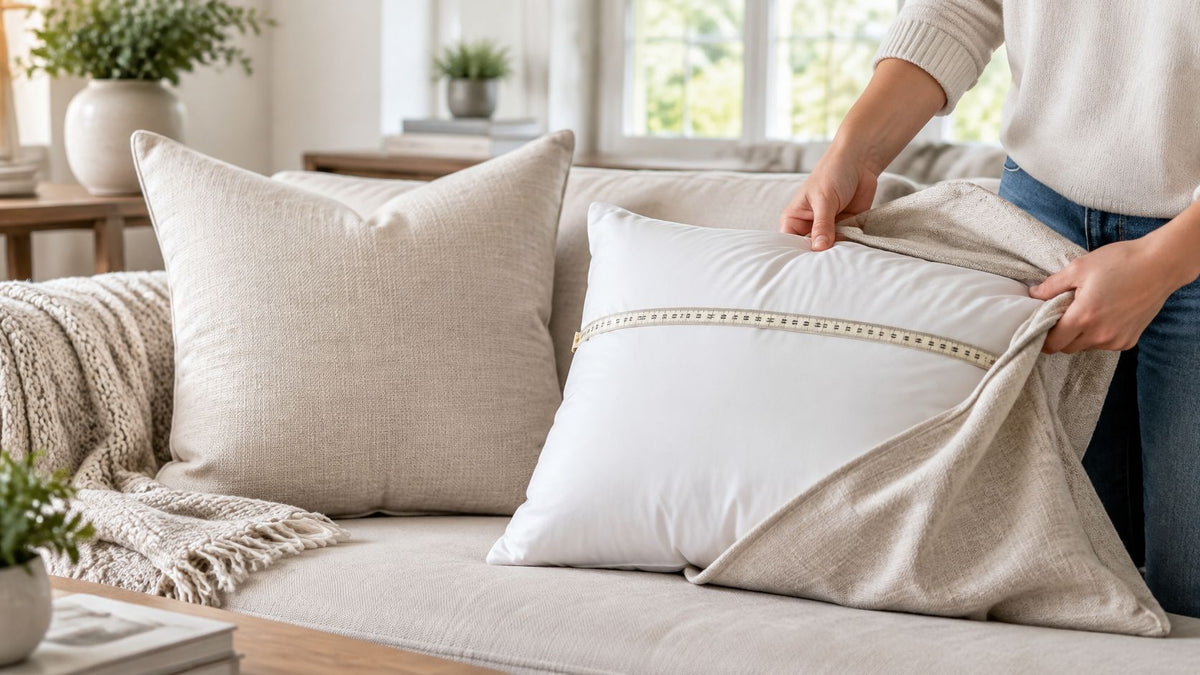
Yes, a new pillow cover goes on the insert you already own as long as the cover matches its size. A 45cm insert fits a 45cm x 45cm cover, and a 50cm x 50cm insert gives the plump look.
Why replace a whole cushion when the part that's faded, stained or wrong for the room is only the outer fabric? Keep the insert, change the cover, and choose that cover by how its fabric behaves over your insert and in your household. That's the practical decision behind pillow covers for throw pillows.
Table of Contents
- Can You Put a New Pillow Cover on a Cushion You Already Own?
- What Size Insert Fits a 45cm Cushion Cover?
- How Do You Get an Insert Into a Cover So It Looks Plump?
- Which Cover Fabric Suits Your Household?
- Which Cushion Covers Do Buyers Order Most?
- How Do You Pair Cushion Covers Without Clashing?
- How Should You Wash a Cushion Cover Without Losing Its Shape?
- Measure Your Insert Before You Order a Cover
Can You Put a New Pillow Cover on a Cushion You Already Own?
Got a cushion where the insert still feels plump but the cover is stained, faded, or just wrong for the room? Swapping the cover is the low-cost fix. In Australia these are usually called scatter cushions, so cushion is the word used here.
A new cover goes straight over the insert you own as long as the two match in size and shape. Treat the insert as the fixed part of the job and choose the cover around it. Check the insert first: press it flat and look at the loft. A cover fixes colour and texture, but a hollow, flattened insert stays flat under any fabric, while a slightly soft insert often reads fuller once a snug cover puts light tension across the face.
If the insert passes that test, our Cushion Covers range is where to look: every one is 45cm x 45cm and square, sold as 1 piece or 2 pieces. We sell the covers only, for the inserts you already own: no inserts or filled cushions, no other sizes or shapes, and no made-to-measure covers. Styles such as the Cordelle and Braelyn cushion covers come in coordinated textures and colours that sit alongside the couch covers and throws. For the seat and back cushions built into the sofa itself, use Couch Cushion Covers, which get measured and fitted differently from a throw pillow.
A tired cover is the cheap part to replace, so it never justifies binning a good cushion.
What Size Insert Fits a 45cm Cushion Cover?
Two insert sizes can go into a 45cm x 45cm cushion cover. A 45cm x 45cm insert gives a neat, relaxed cushion; a 50cm x 50cm insert gives the plumper look, and it's the one I'd start with if full corners matter to you.
Measure the insert, not the old cover
Take the old cover off and lay the insert flat. Measure seam to seam across the flat insert, not over the puff. Over the puff, the tape follows the curve and reads larger than the insert really is, so you can easily talk yourself into the wrong cover size.
Measure both directions. A square insert should read square. If one side reads longer, you've probably got a rectangular insert, and a rectangular or lumbar insert won't sit properly in a square cover whatever the tape says. Check the shape before you order anything.
Practical rule: Measure the insert flat, seam to seam. The old cover and the puffed-up middle both lie to you.
Go one size up, and no further
The rule is one size up. It works the same way as putting a 55cm insert into a 50cm cover: a 50cm x 50cm insert fills a 45cm x 45cm cover right into the corners. A 45cm insert in the same cover still closes properly, but the face has less tension and the cushion sits flatter against the sofa.
Don't push past one size up. A stretch cover will pull over a much bigger pad, but it then sits under permanent tension. The corners stay hollow, the face flattens, and you're squeezing the middle instead of filling the shape.
Insert size against a 45cm x 45cm cover
| Insert size (flat, seam to seam) | Fit in a 45cm x 45cm cover | Look |
|---|---|---|
| 45cm x 45cm | Fits, exact size | Neat but flatter |
| 50cm x 50cm | Fits, one size up (recommended) | Plump; fills the corners |
| Larger than 50cm | Not recommended | Stretch covers may pull over it under permanent tension; corners stay hollow and the face flattens |
Loft belongs to the insert, not the cover. If your insert is tired and flat when it's uncovered, a new cover won't restore it. Judge fill from the corners: pinch each corner of the bare insert, and if the fill has retreated from them, fluff it hard first. If it stays flat after that, the cover choice comes second.
If the flat measurement still reads larger than 50cm, choose a different cover or a different insert rather than forcing the fit.
How Do You Get an Insert Into a Cover So It Looks Plump?
You get an insert into a cushion cover so the cushion looks plump by folding the insert in half like a taco, pushing the folded insert into the cushion cover, working each insert corner into a cover corner before the insert opens, then closing the cushion cover, shaking the cushion firmly and punching each side to settle the fill.
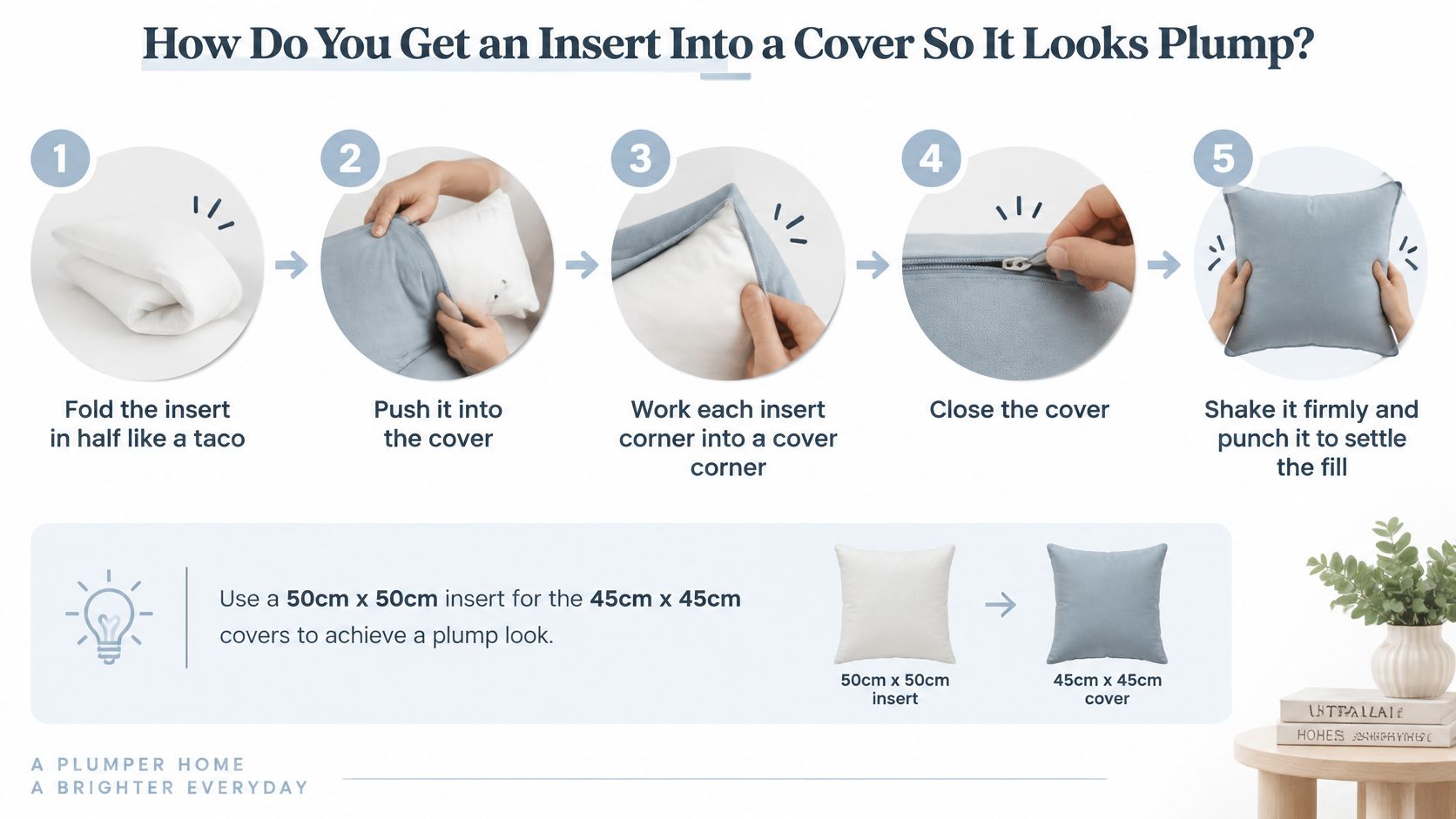
The fitting steps
- Fold the insert in half like a taco, so the insert slides into the cushion cover without dragging its corners.
- Push the folded insert into the cushion cover, keeping it folded until it's well inside.
- Work each corner of the insert into a corner of the cushion cover before letting the insert open out, because the corners are what give a plump look.
- Close the cushion cover with the closure it has. Zip it closed, or fasten the closure on the cover. Don't force it; if it resists, the insert is too large for that cover.
- Give the cushion a firm shake to move the fill out of the crease left by folding.
- Punch each side of the cushion to settle the filling evenly.
- Check the corners of the cushion. If the corners look empty, the insert is too small for the cover, so go one size up next time.
The common slip is skipping step 3. If you let the insert spring open before its corners are placed, the fill bunches in the middle and the cushion looks flat even when the insert is the right size.
A finished cushion has full corners, a smooth face and no lumps of filling at the seams. That's a separate job from work to restore comfort to sagging couch cushions, which is about the couch's own cushions rather than a decorative insert. Here, if the corners won't fill, the insert size is your answer.
Which Cover Fabric Suits Your Household?
The fabric decides how much of your insert's condition shows on the finished cushion. A Classic Stretch Cushion Cover grips the insert and smooths over small lumps, while a jacquard or printed cushion cover takes on the shape of whatever sits inside it.
The Classic Stretch Cushion Cover is the stretch one in the range. It pulls snug and holds a smooth face, so a slightly tired insert still reads plump. Jacquard and printed covers are woven with little give; they show the insert exactly as it is, and a flattened insert shows straight away. If the insert has gone lumpy, I'd put the spend into a fresh insert before choosing a woven cover.
Cover families by how they handle the insert
| Cover family | Stretch or woven | What it does with the insert |
|---|---|---|
| Classic Stretch Cushion Cover | Stretch | Pulls snug over the insert and keeps a smooth face, forgiving a slightly tired insert |
| Jacquard, Diamond Jacquard and Original Jacquard covers | Woven, little give | Takes the shape of the insert, so a flattened insert shows straight away |
| Printed covers such as Cherury, Tonda and Olaves | Woven, little give | Same woven behaviour as jacquard; a tired insert shows through the print |
| Waterproof Cushion Cover (Emerald Green) and Pebble-Textured Waterproof Cushion Cover | Waterproof | Wipes clean, suiting rooms where spills reach the cushions |
| Velvet Cushion Cover | Velvet | Soft pile lies snug over the insert |
Scarlett M., who bought the Cherury Printed Cushion Cover, wrote: "Was a bit unsure about buying a pillow cover online, but this one’s proper lovely!" and "It fits my cushion perfectly and adds a great touch to the living room."
Match the family to the household. A stretch cover forgives an insert that has seen use. Woven jacquard and printed covers reward a fresh insert with a crisp face, and a tight jacquard weave resists pulls better than a loose surface.
If a woven cover resists closing over a 50cm insert, drop to a 45cm insert or switch to a stretch cover; forcing the zip strains the teeth and the seam.
Which Cushion Covers Do Buyers Order Most?
Our store order record for the 12 months to 5 November 2026 covers 425 cushion-cover units ordered. The most-ordered single cushion cover was the Crosshatch Cushion Cover in Eggshell: 65 units, 15 per cent of the cushion-cover units ordered. Second was the Olaves Printed Cushion Cover: 37 units, 9 per cent of the cushion-cover units ordered. Across all its colours, the most-ordered family was the Velvet Cushion Cover: 82 units, 19 per cent of the cushion-cover units ordered.
An order count will not rescue a wrong size. Measure the insert, then pick fabric behaviour: stretch for a forgiving fit over a tired insert, woven for a crisper outline only when the insert has enough filling, waterproof where spills are routine.
How Do You Pair Cushion Covers Without Clashing?
Take a grey sofa with three cushions already on it. Put one patterned cover, one textured cover and one solid cover on those inserts, with at least one colour shared by all three, and the grouping holds together.
The pattern brings the energy, the texture adds depth and the solid gives the eye a place to rest. Drop the solid and everything competes. Drop the pattern and the group can look flat.
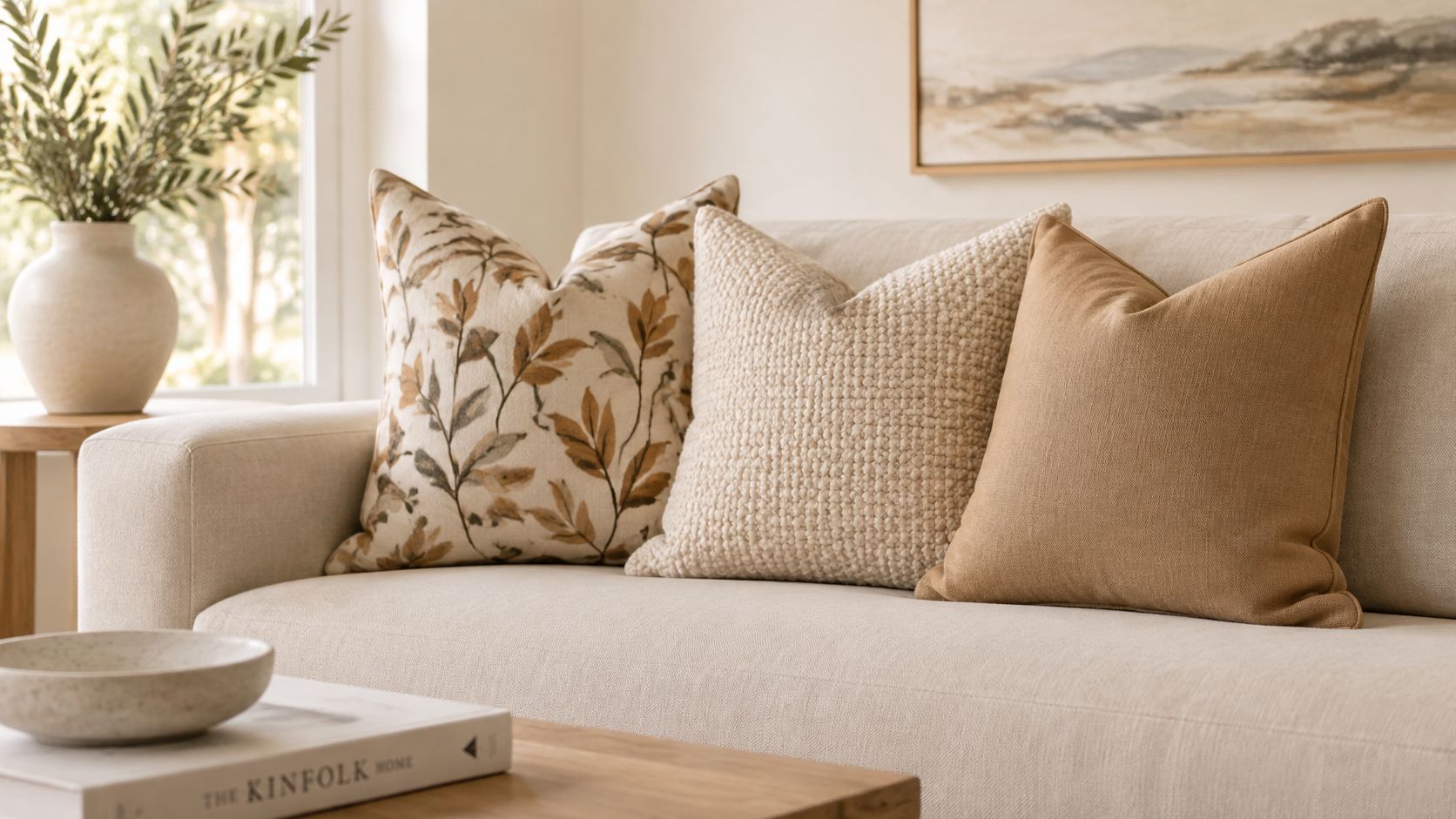
For a grey or beige sofa, I'd pair our Velvet Cushion Cover in Beige with the Jacquard Cushion Cover in Sage Green, then add a printed cushion that repeats green and a warm neutral. The velvet introduces softness, the jacquard gives definition, and the print connects the colours. Both are in the Cushion Covers collection, where every cover is 45cm x 45cm.
The short video below shows the same pattern, texture and solid balance in a room setting.
If the sofa already has a strong pattern, simplify the cushions to plain colours and tonal textures so the cushions don't compete for attention. Since the insert is the fixed item, pick each fabric by how it behaves over the insert you own. A textured cover disguises a lumpy or ageing insert far better than a flat solid, which shows every ridge once the insert has gone slack. You can carry the shared colour through one of our Throw Blankets, and Casamé Home's throw styling guide covers throws with cushions in more depth.
How Should You Wash a Cushion Cover Without Losing Its Shape?
Heat and mechanical action are what damage a cushion cover in the wash, not water. A hot cycle can leave a stretch cover permanently slack, and a tumble dryer is harder on fabric than the wash itself. The method below protects the shell's shape so the insert you already own still fills it properly once it's back inside.
Wash the cover, not the whole cushion
- Remove the cushion cover from the insert before washing, so you're only laundering the fabric shell.
- Wash the cover according to its care label. The label is the reference for that fabric and construction.
- Refit the cover while it's still slightly damp, using the same corner-first method from the fitting section.
- Air-dry the cover where practical and make sure it's fully dry before the cushion goes back into regular use.
For a stretch cover, wash temperature is the deciding factor. Once the fabric's recovery is gone, the face won't sit smooth over the insert again, and a cover that fitted plump when new starts to sag at the corners. Refitting slightly damp also helps the cover dry without set creases. Never iron velvet.
Wash the cover inside out or in a laundry bag, then put it back on the insert while it still holds a little moisture.
Why gentler washing helps the fabric last
Domestic washing releases fibres from common home textiles. A 2016 study of polyester fleece by Pirc and colleagues found that tumble drying released about 3.5 times more fibres than washing. Research also reports fibre loss is generally higher in top-loading machines than in front-loaders because of the more abrasive mechanical action.
That's the practical case for a lower-abrasion cycle, a laundry bag and air-drying where you can. You're reducing mechanical wear on the surface, the seams and any stretch in the fabric, which is what keeps a cover fitting snugly over the same insert after repeated washes.
Measure Your Insert Before You Order a Cover
Because cushion covers go on the inserts you already own, a room can be refreshed for the price of covers alone, and one stained cover can be washed or replaced without touching the rest. That is the whole value of the swap: no new cushions, no spare inserts to store, no matching a full set again.
The tape measure goes on the insert itself, not the cover it came out of, and the condition of that insert matters as much as its size. An insert that has slumped at the corners or gone lumpy through the middle will under-fill any cover, whatever size is printed on the label. If the fill still springs back when you press it, the insert is worth covering.
Our Cushion Covers are all cut to 45cm x 45cm, so the decision comes down to the fit you want from your insert and the fabric that suits your household.
Once your new covers have been through their first wash, run a hand into each corner and pull the fill back into place if it has shifted. After that, the swap is done. Find the cover that fits the insert you already own at Casamé Home.