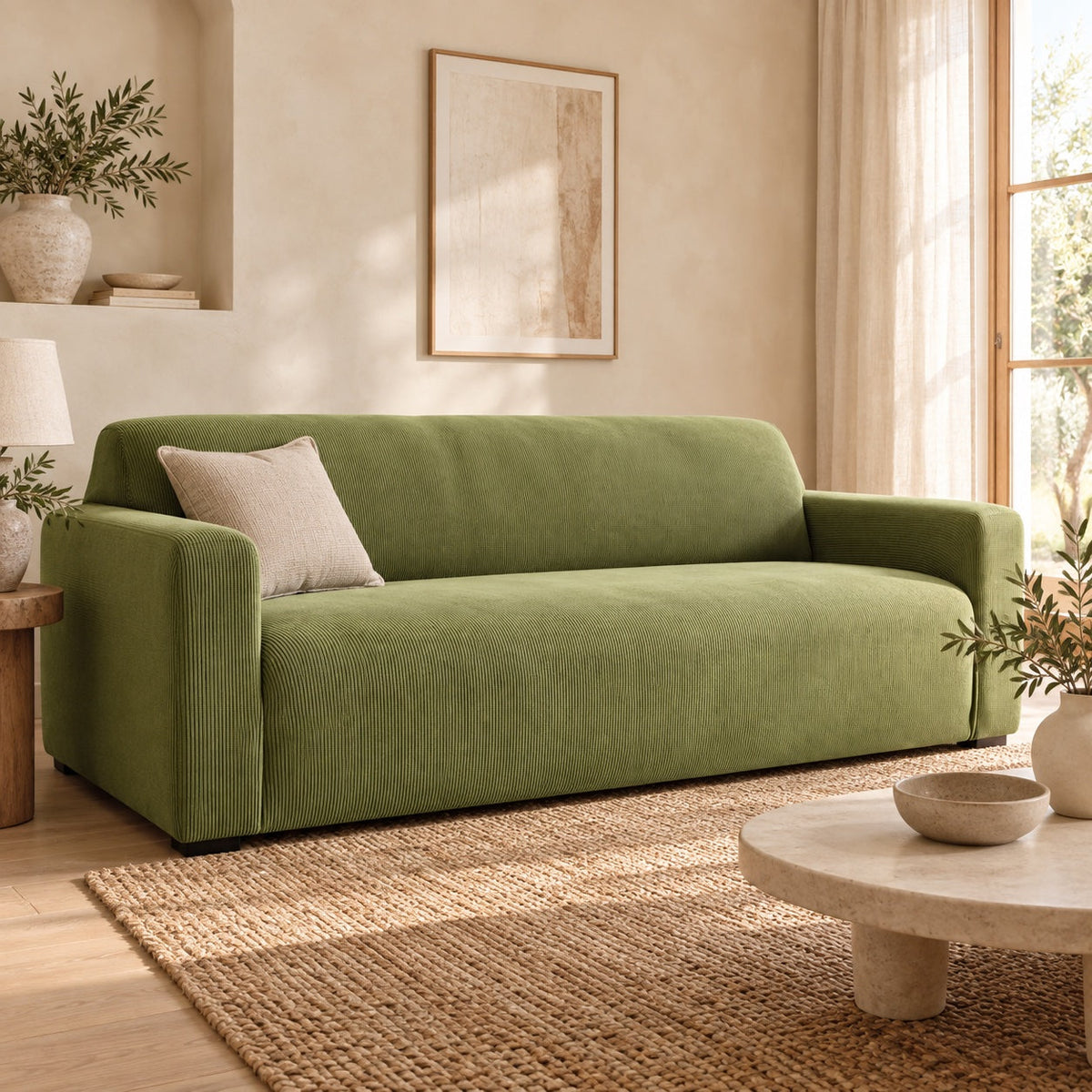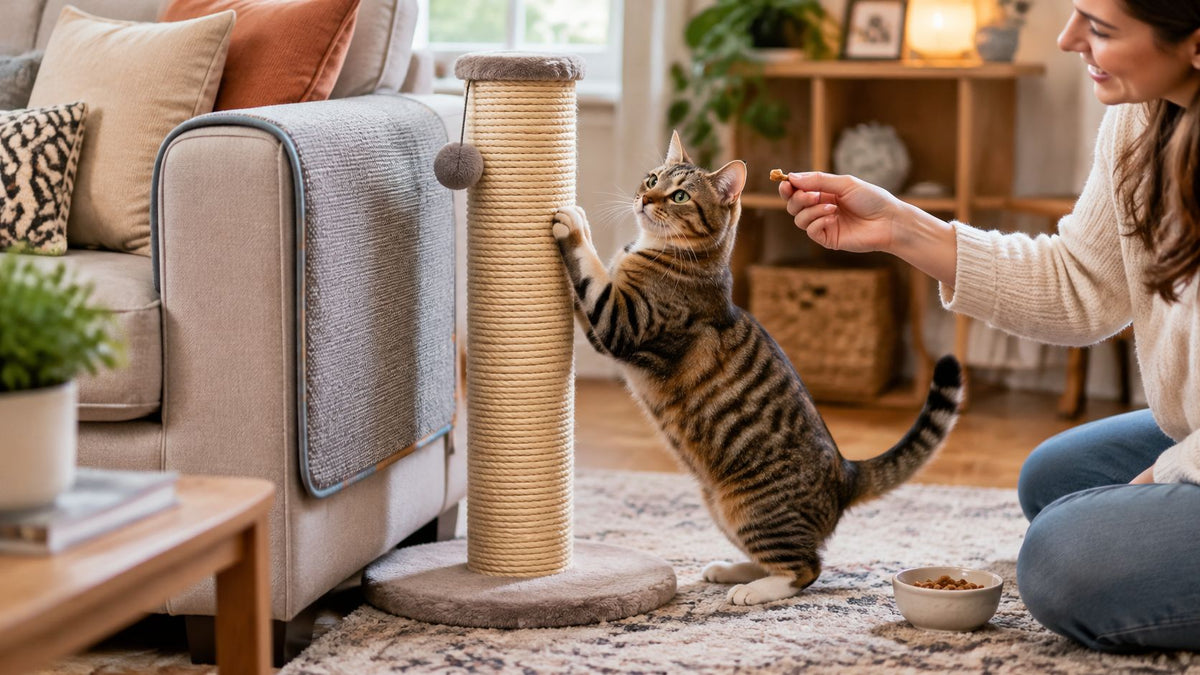
The fix for a scratched couch is more scratching, on a better surface in the same spot. To stop your cat scratching the couch, put a stable scratcher beside the damaged arm, reward its use and temporarily protect the upholstery. A cover can hide damage and take some wear, but it won't teach your cat where to scratch.
Table of Contents
- Why Does My Cat Scratch the Couch Arms and Corners?
- Where Should a Scratching Post Go to Beat the Couch?
- How to Redirect and Reward Your Cat Step by Step
- Which Deterrents Work and Which Only Look Like They Do
- Can a Stretch Cover Stop a Cat Scratching the Couch?
- Should You Repair or Replace a Scratched Couch?
- Common Questions About Stopping Cats Scratching the Couch
Why Does My Cat Scratch the Couch Arms and Corners?
Your cat picked the couch arm on purpose. It scratches there to stretch, shed worn claw sheaths and mark territory, and the couch offers a sturdy surface in a place your cat already uses.
RSPCA Australia identifies claw maintenance, scent marking through glands in the paw pads, and expressing emotions such as anxiety, frustration or excitement as purposes of scratching. Several of those drives can run at once, which explains why blocking access to a favourite arm rarely resolves the whole problem.
The location matters as much as the fabric. A couch arm can support a cat's weight during a long upward stretch. A front corner often sits on a daily route, and a couch beside a sleeping spot is conveniently placed for scratching after waking.
Arms and corners are the first places I check because they give a cat a stable surface to stretch against and mark.
What the damage tells you
Shredded threads down the front of an arm suggest an upward stretch and a satisfying grip. A corner scratched after naps points towards a waking routine. Neither tells you that your cat understands the couch is off limits.
The couch also smells of its people, making it a meaningful place to leave a mark. Scratching deposits scent from the paw pads and leaves a visible sign in the same pass. A coarse or loose weave supplies the catch-and-drag sensation that makes returning worthwhile. Texture matters, but scratching is also normal behaviour, so changing the fabric alone may not solve it.
Practical rule: Treat the damaged arm as information about the scratching surface your cat wants, not evidence that your cat needs firmer discipline.
Read the damage as a specification. The replacement surface needs the same stretch, grip and position, and the upholstery needs protection while the habit transfers. The scratching continues. Only the target changes.
Where Should a Scratching Post Go to Beat the Couch?
Put the scratching post immediately beside or in front of the couch arm or corner your cat already scratches, not in an unused corner of the room. Your cat has chosen a location, so start there.
A scratching surface beside the sofa keeps the alternative on the cat's existing route.
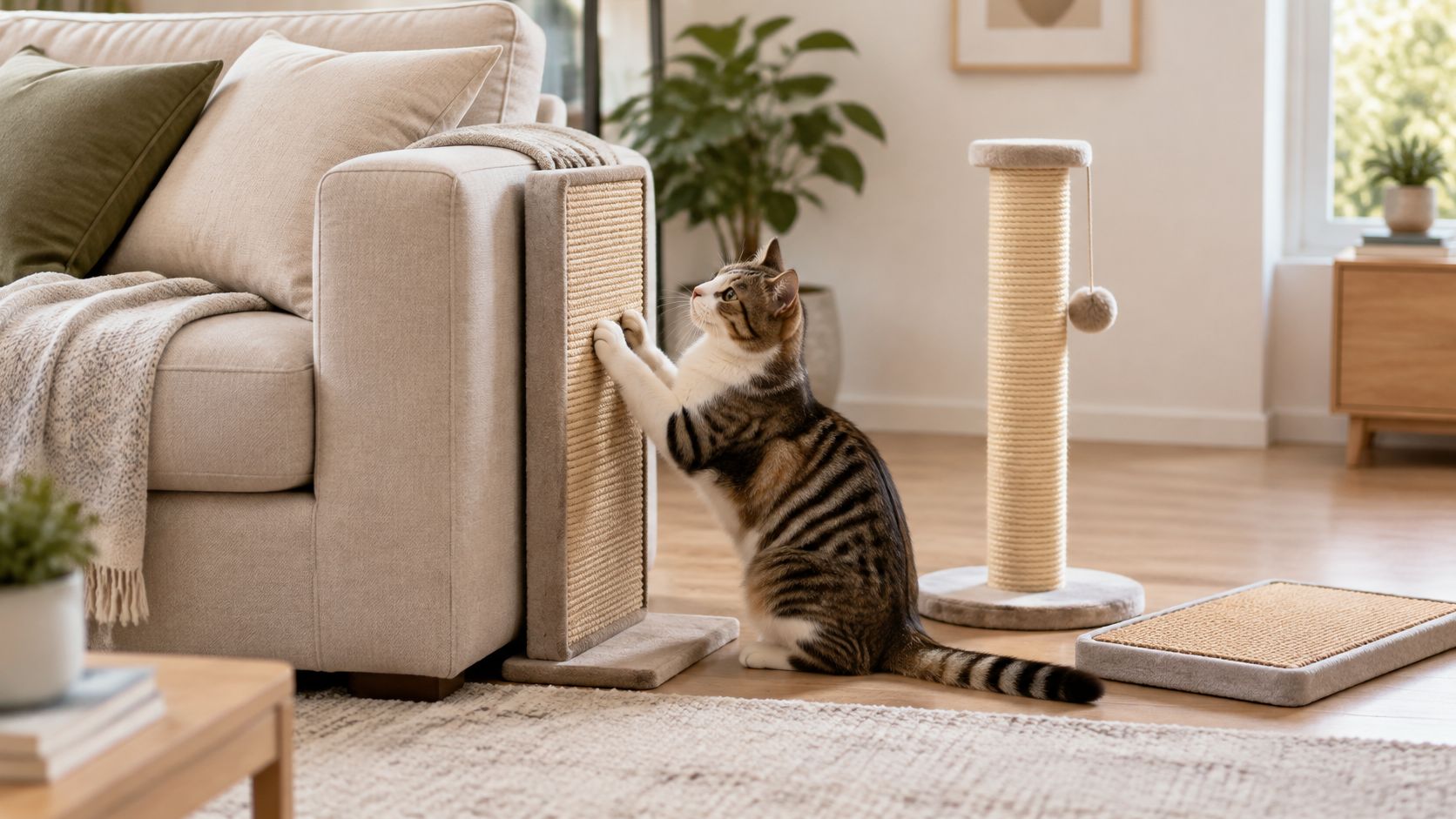
A post must be tall enough for a full-body stretch and stable during vigorous scratching. Vet Voice's scratching-post guidance supports choosing suitable scratching surfaces and positioning them where the cat needs them. A handsome post that rocks when pulled is a poor substitute for a solid couch.
Match the scratcher to the damage
Offer vertical and horizontal options rather than assuming every cat wants a pole. I recommend placing a stable scratcher right beside the targeted area and matching the cat’s preference: upright for a cat scratching sofa arms, or horizontal for one scratching flat surfaces. Use the damage pattern to choose your starting point:
- Vertical marks on couch arms: Choose a tall, firmly anchored post with enough usable surface for an extended stretch.
- Scratching along the seat front or carpet: Offer a long horizontal pad, including corrugated cardboard, and watch which orientation your cat chooses.
- Scratching concentrated near windows or doorways: Consider territorial marking or insecurity, particularly if the behaviour has changed. Seek veterinary advice when the pattern suggests distress.
Texture needs attention too. A sturdy rope-covered post and a cardboard pad feel different under the claws. If the first surface goes unused, change the texture before buying a larger version of the same unsuccessful design.
Keep additional scratching objects near sleeping areas, play spaces and well-used routes. A cat that spends time in several rooms shouldn't have to leave those rooms to find an acceptable surface.
If you would rather build a simple rope-wrapped post yourself, the following video shows one way to do it.
Leave the main post beside the couch until your cat uses it consistently. Only then move it gradually towards a more convenient position. Moving it away after an isolated successful scratch risks restoring the couch as the easiest choice.
How to Redirect and Reward Your Cat Step by Step
Calmly guide your cat towards the approved scratching post when couch scratching starts, then reward scratching on that surface. Don't grab the cat or press its paws against the post.
RSPCA Tasmania recommends giving your cat a scratching post and encouraging it onto the post with a dangled toy or catnip. The useful habit is simple: notice the behaviour, offer the alternative and make the right choice worthwhile.
Build a repeatable routine
- Watch the beginning, not just the aftermath. Note which arm your cat approaches and whether scratching follows waking, play or activity near the couch. Keep the route to the approved scratcher clear.
- Guide without forcing. Encourage your cat towards the nearby post with a toy or your movement. If your cat resists handling, don't turn the interaction into a struggle. Give the cat room to approach voluntarily.
- Reward the scratch immediately. Offer a small food treat or a short play session as soon as your cat uses the approved surface. A delayed reward makes the connection less clear.
- Add a clicker only if it helps your timing. Pair the click with an immediate reward, then use the click to mark the desired scratch. A click without the promised reward isn't the training method.
- Keep the familiar post. Shredded material isn't automatically a reason to throw a scratcher away. Scent and visible scratch marks can make an established post attractive. Replace unsafe or unstable equipment, not merely untidy equipment.
Track the change separately
- Record the trend rather than guessing. Use a practical observation window, recording couch attempts and approved-surface use daily. This is a monitoring period, not a promise that training will be finished.
- Keep the response calm. Don't yell, spray the cat or force its paws through scratching motions. Your cat needs to learn which surface earns a reward, not which room becomes unpleasant when you enter.
Progress means fewer couch attempts and more voluntary use of the approved surface, not simply a cat that stops scratching when you're watching.
Leave protection on the damaged couch zone while that trend develops. If progress stalls, reassess placement, stability and texture rather than escalating your response.
Which Deterrents Work and Which Only Look Like They Do
Couch deterrents work best when they make upholstery unpleasant to grip while a better scratching surface sits immediately nearby. Treat them as management tools that buy time while the post becomes the habit.
RSPCA Queensland identifies double-sided tape and motion-activated compressed air as options, describing the latter as harmless compressed air. Start with a passive barrier and check the upholstery before applying adhesive.
Couch deterrents compared
| Deterrent | How it helps | Main limit |
|---|---|---|
| Wide low-tack double-sided tape | Makes the couch surface unpleasant to grip | Needs regular checking and can leave residue |
| Aluminium foil | Discourages contact through its texture | Looks untidy and must stay firmly in place |
| Motion-activated compressed air | Discourages access without physically hurting the cat | Needs setup and monitoring; the cat may avoid the whole room |
| Punishment, yelling or forced handling | None | Raises stress and can push scratching elsewhere |
The important pairing is a protected couch zone and an accessible alternative.
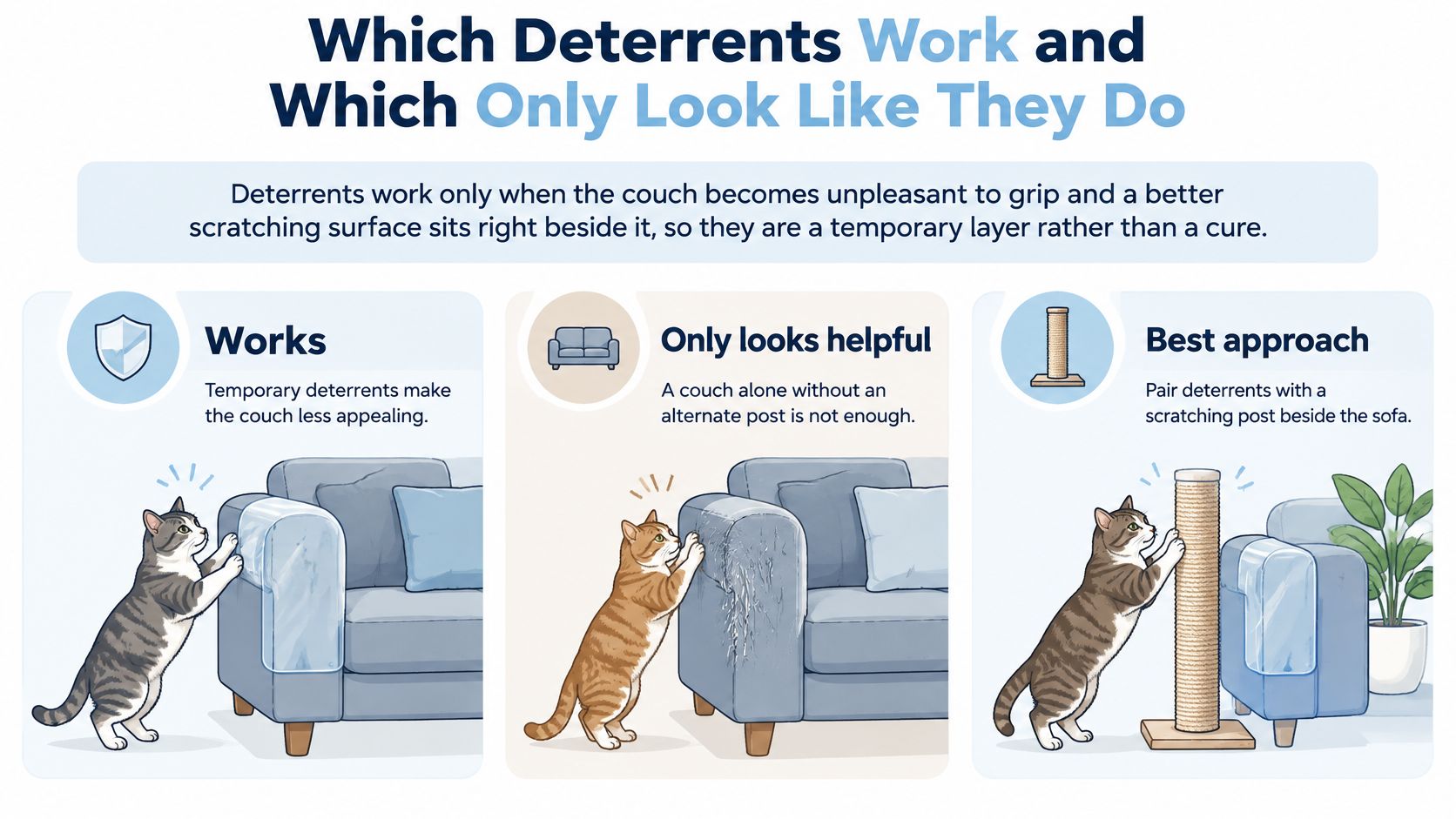
Judge a deterrent by what the cat does next. It is doing its job when the cat touches the covered surface once and moves to the post. It is failing when the cat finds an uncovered patch of the same couch or waits until the room empties. Tape demands the most upkeep: press edges back down when they lift, and replace strips that collect hair and lose their grip. With compressed air, re-aim the sensor after the cat changes position, because a unit that only fires when you walk past is decoration.
Keep the deterrent and post in place until couch attempts decline. If you want a removable cover for a pet-friendly sofa while that happens, see pet-friendly cover ideas from Casamé Home.
Can a Stretch Cover Stop a Cat Scratching the Couch?
No. A stretch cover does not stop a cat scratching, because a removable fabric layer does nothing about the reason the cat picked that spot. What it does is take the wear: the cover absorbs the snags and hides the damage while the post placement and reward work do the actual retraining. Treat it as a replaceable cosmetic layer that conceals wear. A cover provides a replaceable protective layer, but I always recommend putting a sturdy scratching post beside the cat’s favourite corner. No fabric is scratch-proof or claw-proof, and claws can snag cover material just as easily as upholstery.
Which surfaces give claws less to catch?
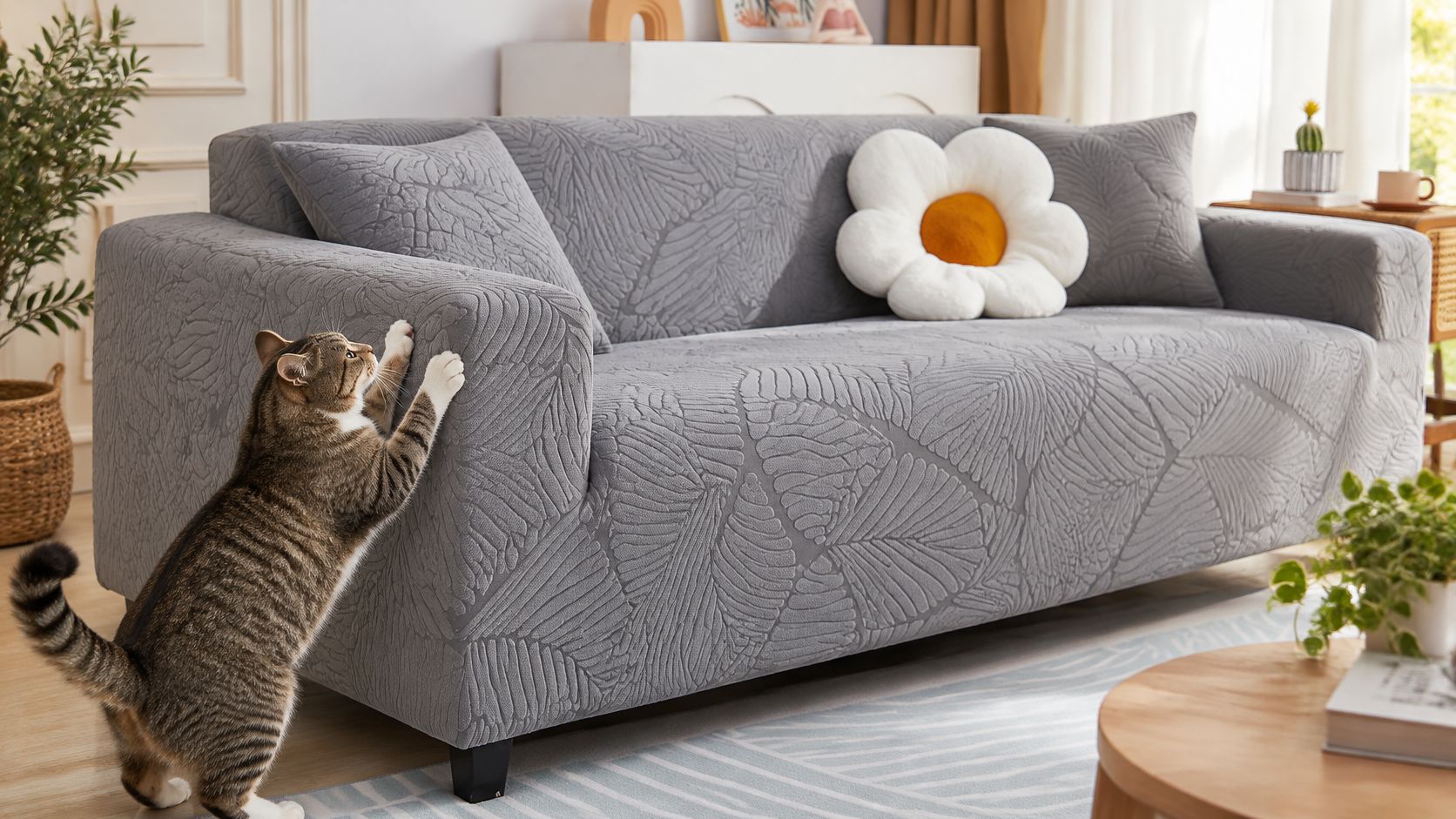
For a home with cats, I’d start with our smooth Velvet cover rather than a loose, open texture that gives claws more to catch. A claw hooks a raised loop or a long float in a weave and drags it out. Flat, tightly woven faces offer fewer catching points, which makes the Jacquard Couch Cover and the Diamond Jacquard Couch Cover further options with little for a claw to catch. Raised pattern, bobble and pebble textures work the other way: every loop is a grip point, so skip those textures on a couch that takes regular scratching. Over time, watch for flattened pile in favourite sitting spots and small pulls where the cat scratches. A raised-relief design like the one shown below is a decorative choice, so don't expect it to resist a determined scratcher.
How should a stretch couch cover fit?
Measure arm to arm in a straight line, from the outside of one arm to the outside of the other at the widest point, then match that figure to the size bands: 1 seater 90-130cm, 2 seater 135-175cm, 3 seater 180-220cm, 4 seater 225-300cm. L-shaped covers are sold as paired seater sizes, so measure each section on its own. Then choose your band in the Couch Covers collection.
Two fit rules matter for scratchers. First, don't size up: excess fabric creates loose folds that claws can grab. Second, the sofa must have a separation, even a tiny one, to insert the covers. A tuck-in cover has nothing to grip on a sofa with no gap, and a seat measurement alone doesn't confirm a recliner will work.
Fitting check: Leave the seat relaxed, tuck the fabric snugly around the seat edges and pull the elastic hem fully underneath. Push spare fabric into the back and side gaps rather than pulling the seat tight to chase every wrinkle.
Cover the arms and corners as well as the seat, and leave enough fabric for a proper tuck.
Foam Rods pressed into the gaps around the cushions help hold the tucked fabric in place and smooth out everyday creases when a cat jumps up or kneads. Anti-Slip Sofa Pads under the couch legs stop the couch sliding; they don't hold the cover.
For targeted arm coverage rather than a full-sofa change, see our guide to sofa chair arm covers. Keep a thick removable layer over the exact damaged corner during training, since no thin stretch fabric works as an impenetrable barrier.
One customer bought a large Elligate Sage Green throw for a two-seater leather sofa shared with a cat, then ordered additional sizes so both couches and a chair matched. What I like about that example is the attention to coverage and sizing. The mistake I warn against is protecting the seat while leaving the scratched arms or corners exposed. Choose protection for the area the cat actually targets, then give the cat a suitable scratching surface nearby.
Should You Repair or Replace a Scratched Couch?
Replace the cover rather than the couch when damage is confined to the removable layer, and assess repair or replacement when scratching exposes padding, springs or structural problems. Scratched original upholstery may need repair, but it doesn't automatically justify discarding a sound sofa.
Remove the cover and inspect the couch underneath. Separate pulled threads and surface scuffs from torn upholstery, missing padding or loose components. A new cover can disguise cosmetic wear; it can't stabilise a wobbling frame or make exposed springs safe.
Separate cosmetic work from structural repair
- Cover-only damage: Replace the removable layer if holes or snags make it unusable.
- Local upholstery damage: Consider a patch or professional upholstery repair when the surrounding material and frame remain sound.
- Exposed internal parts or instability: Stop relying on concealment. Have the couch assessed before deciding whether repair is worthwhile.
For leather, choose the repair position carefully rather than sticking a patch across every visible mark. Guidance on where to place leather repair patches helps with local damage.
Check the behaviour before spending
If couch scratching hasn't eased by the end of the tracking window despite consistent redirection and a properly placed post, book a veterinary visit. Don't buy a replacement sofa and expect the preferred scratching location to disappear with the old one.
Get advice sooner if scratching changes abruptly or accompanies other signs of distress. Nail care may reduce damage, but it doesn't replace a suitable scratching outlet or an assessment of possible anxiety.
For readers choosing a removable layer for a cat household, use the pet cover guide to narrow the options.
Common Questions About Stopping Cats Scratching the Couch
What if my cat only scratches after visitors or when furniture moves?
Couch scratching that appears only after visitors or furniture changes usually points to stress or territorial marking, so keep the approved post beside the couch and watch exactly when the scratching starts. If it happens only when one particular person visits, give the cat access to a quieter room during that visit rather than expecting the post to compete with a stress spike. RSPCA Australia's cat-behaviour guidance notes that scratching can be an emotional outlet for frustration, anxiety or excitement, so deterrents alone may not settle it. Changes in the household can also matter, particularly when the scratching suddenly increases. If the pattern continues through the tracking period, seek veterinary or qualified behaviour support.
Do nail trims or claw caps stop a cat scratching the couch?
Regular nail trims keep claw tips blunter and can reduce snagging, but trimming alone rarely stops couch scratching because the cat still needs a scratching outlet. The need to scratch stays the same. Ask your vet to demonstrate trimming before attempting it, because cutting too far can injure the cat. Claw caps are a separate product, not a training method, so this guide does not cover them.
Casamé Home offers stretch couch covers that can refresh scratched upholstery and provide a replaceable layer while you establish better scratching habits. Visit Casamé Home to compare cover options, measure your couch arm to arm and choose a suitable fit without expecting fabric to do the training.