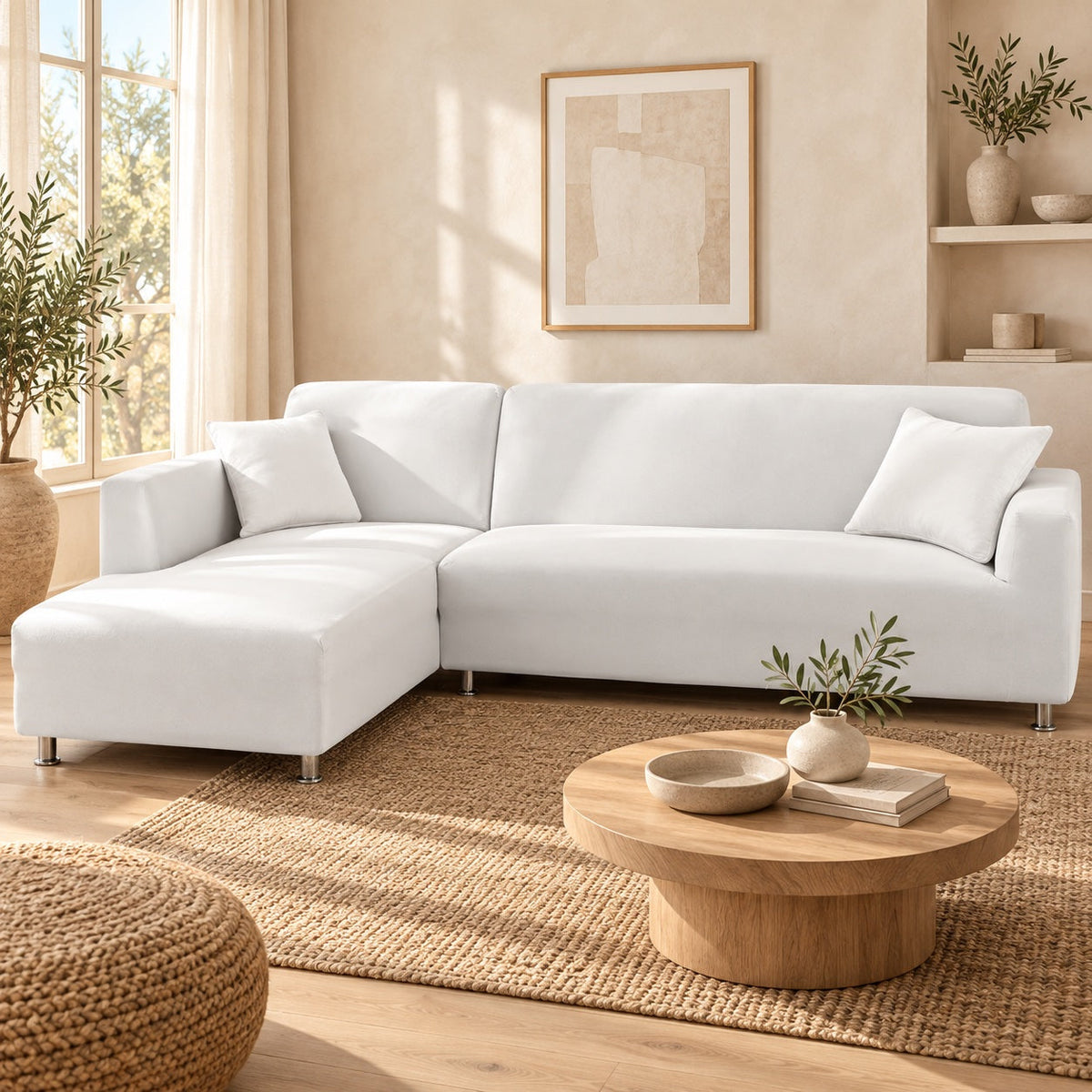
A cover can look fitted at breakfast and be wrinkled by dinner. The first job is naming what moved: fabric creeping on the couch, or the couch creeping on the floor. Sofa cover grips help only after that call, because they lock a set tuck; they cannot hold a shallow one, fabric pulled too tight, or legs that skate on smooth boards.
Table of Contents
- What Holds a Stretch Couch Cover in Place?
- Is the Cover Moving or the Couch?
- Why Does a Stretch Cover Creep Out of the Crease?
- How to Tuck a Stretch Cover Deep Enough to Hold
- Where Do Foam Rods Go to Lock the Tuck?
- What Does a Properly Tucked Cover Feel Like?
- When Should You Replace Foam Rods or Pads?
What Holds a Stretch Couch Cover in Place?
Say the cover looks neat on Saturday. By Tuesday the front hem has crept up, the arms are wrinkled, and you're straightening it every time you sit down. Treat that as a fit problem at the seams.
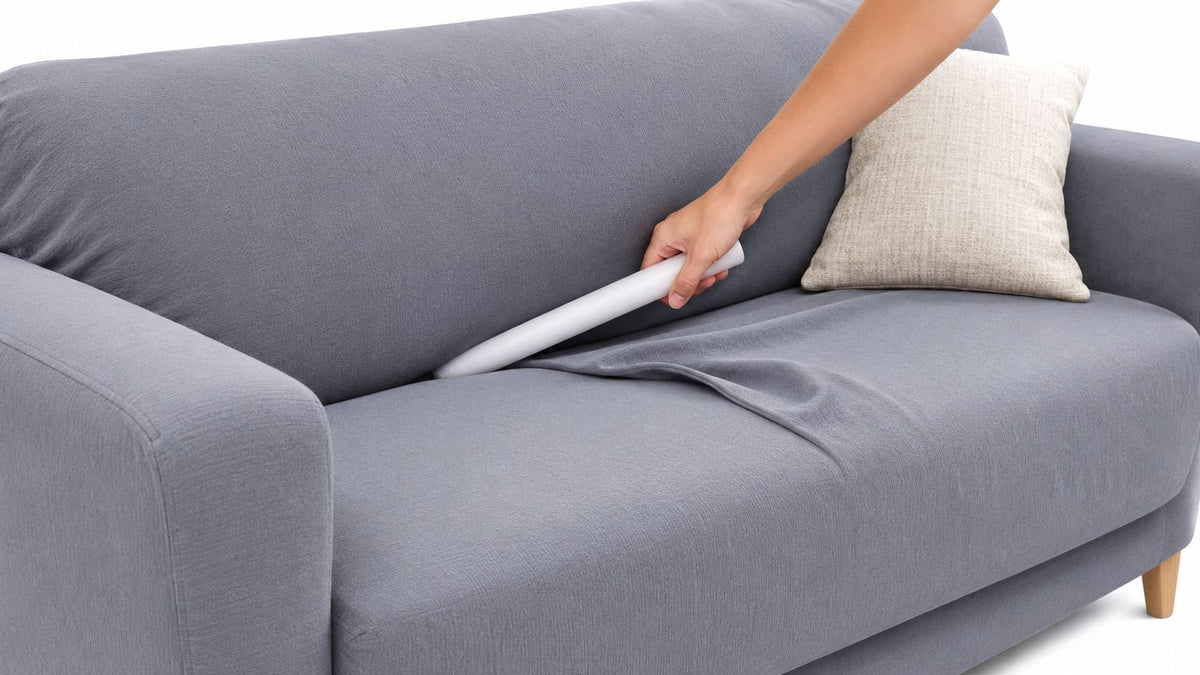
The holding force is depth plus relaxation. Work enough spare cloth down into the seat-to-back joint and arm gaps, leave the cushion settled, and friction does most of the job. Sofa cover grips then keep that set position from unravelling: Foam Rods press into the gaps over the tucked edge so the first sit does not drag it back out.
Match the accessory to the interface. Rods belong where fabric keeps escaping; pads belong under feet where the frame slides. If there is no separation at all, even a tiny one, the cover cannot be inserted far enough to hold. If the size is still in doubt, browse stretch-fit couch covers; if the cover is on, start with the deepest tuck before buying anything.
Is the Cover Moving or the Couch?
Run this test before you re-tuck anything. Sit on the sofa, shift your weight, and watch two things at once: the fabric and the frame. If the cover creeps forward while the sofa stays put, the fabric is slipping. If the whole sofa lurches across the floor, the base is unstable. Each problem has its own fix, and applying one to the other wastes effort.
Match the symptom you see to a row below.
| Symptom | What Is Moving | Fix | Product That Helps |
|---|---|---|---|
| Cover creeps out of the seat-to-back crease | Cover on the couch | Deeper relaxed tuck, then a Foam Rod pushed in on top | Foam Rods |
| Cover rides up at the arms or L-shape corner | Cover on the couch | Tuck each arm crevice fully, then lock the corner with a rod | Foam Rods |
| Cover slides on smooth leather or vinyl | Cover on a slick surface | Deepen the tuck and lock it with a Foam Rod; skip underlays unless you have checked them against your finish | Foam Rods |
| Cover wrinkles after the first day | Stretch fabric settling on the frame | Re-tuck the next day | None needed |
| Whole sofa slides when someone sits down | The couch on the floor | Anti-Slip Sofa Pads under the legs | Anti-Slip Sofa Pads (Black) |
| Sofa shifts on a rug or uneven floor | The couch on the floor | Even surface and pads under every leg | Anti-Slip Sofa Pads (Black) |
Practical rule: Foam Rods go on top of tucked fabric in the crease, never under the cover. Anti-Slip Sofa Pads go under the legs, never under the cover or seat cushions.
Check stability before you blame the tuck. The Australian Government product safety guide to toppling furniture states that furniture is more unstable on uneven or soft surfaces such as carpet or rugs, and recommends low-set furniture with a broad, stable base. Make sure every leg contacts the floor on a reasonably even surface first. A shifting base can look exactly like grip failure.
One symptom points past both accessories. If the seat itself feels sunken and keeps dragging fabric down with it, that is a cushion problem rather than a grip problem, and it needs a separate fix.
Why Does a Stretch Cover Creep Out of the Crease?
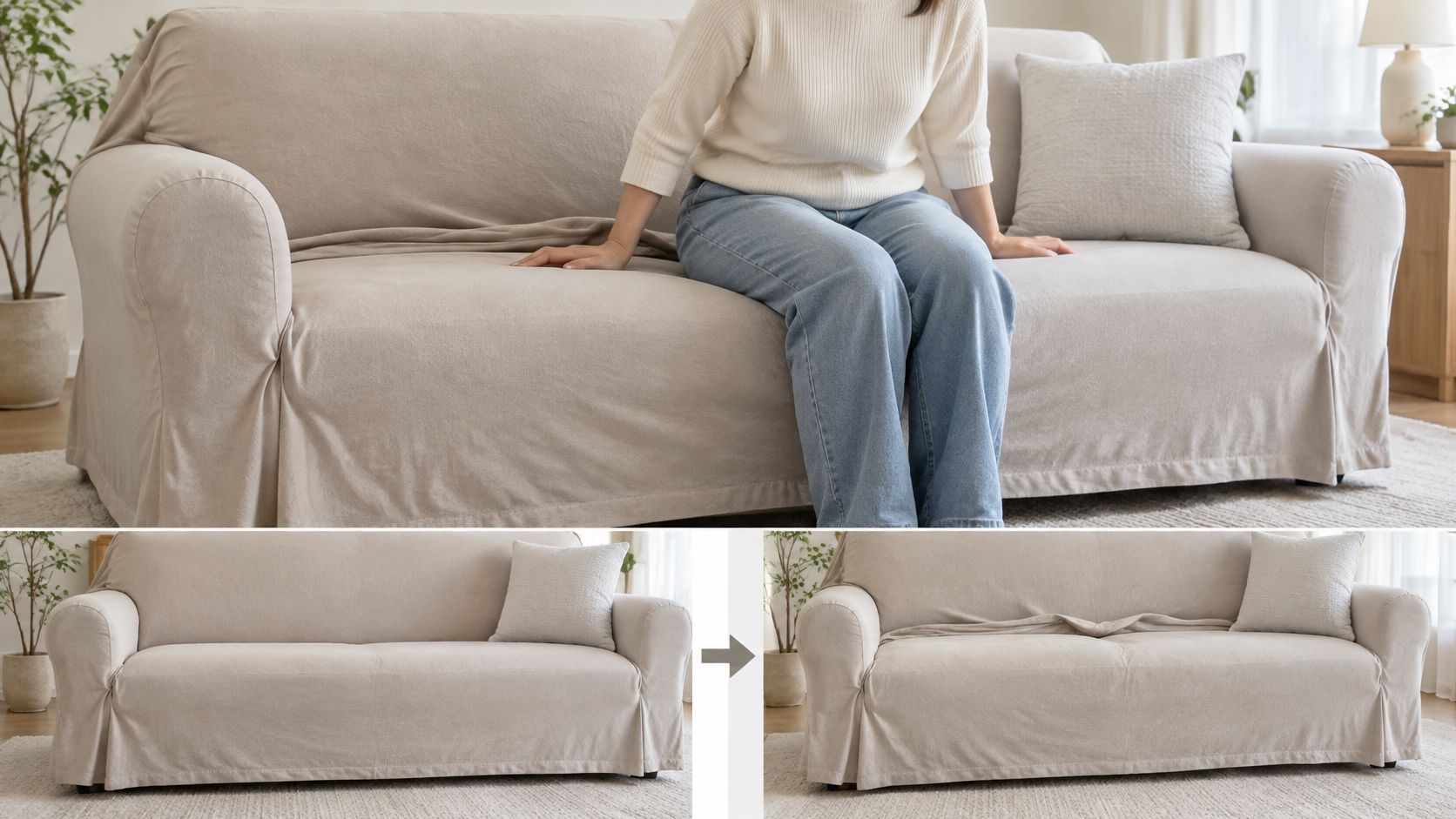
A stretch couch cover creeps out of the crease because each sit-down drags fabric forward and nothing pulls the stretch couch cover back when you stand, and the stretch couch cover is held by its tuck, not by tension.
Think of a rope wrapped around a post. A sailor can hold a boat with that rope because the wrap and the squeeze do the work, not because someone keeps pulling. A tucked cover works the same way. Fabric pushed down into the crease is squeezed between cushions and frame, and that squeeze resists the forward drag.
Why does pulling the seat tight backfire?
Pulling the seat panel tight makes a stretch couch cover pop out faster because tension leaves no spare fabric in the crease to absorb movement.
It's the most natural mistake in the world. You see a wrinkle, you pull, the seat looks smooth, and the first time someone sits down the fabric pops straight out of the crevice. A relaxed seat with a deep tuck looks slightly less drum-tight for five minutes and stays put afterwards. A tight seat looks perfect until it's used.
Does the couch surface change how a cover grips?
Yes, a stretch couch cover grips upholstered fabric far better than smooth leather or vinyl, so slick surfaces need a deeper, locked tuck.
Fabric grips fabric. On an upholstered couch, a deep tuck usually holds on its own because the two textiles resist sliding against each other. On leather or vinyl there's little of that resistance, so tuck deeper, lock the tuck with a rod, and lay a non-slip rug underlay on the seat under the cover to add friction on both surfaces.
Check that any underlay suits your leather finish before you use it. Avoid adhesive solutions that could leave residue or affect the leather. The underlay is a household tip, not a product Casamé Home sells.
Why does a new cover wrinkle after a day?
A new stretch couch cover wrinkles after a day because stretch fabric relaxes over its first day on the frame, so one re-tuck the next day is part of fitting a stretch couch cover.
Don't treat that first-day settling as failure. Re-tuck once, then judge the result over normal use.
One limit is worth stating plainly. A stretch cover in the wrong size band will never hold however well it's tucked, and sizing is handled on the Couch Covers collection rather than here. The true test of any fix is repeated sitting and standing, not how the cover looks in the first five minutes.
How to Tuck a Stretch Cover Deep Enough to Hold
Leave the seat relaxed and tuck deep, because the hold comes from the tuck, not from tension. Work slowly around the whole couch before you judge any single crease.
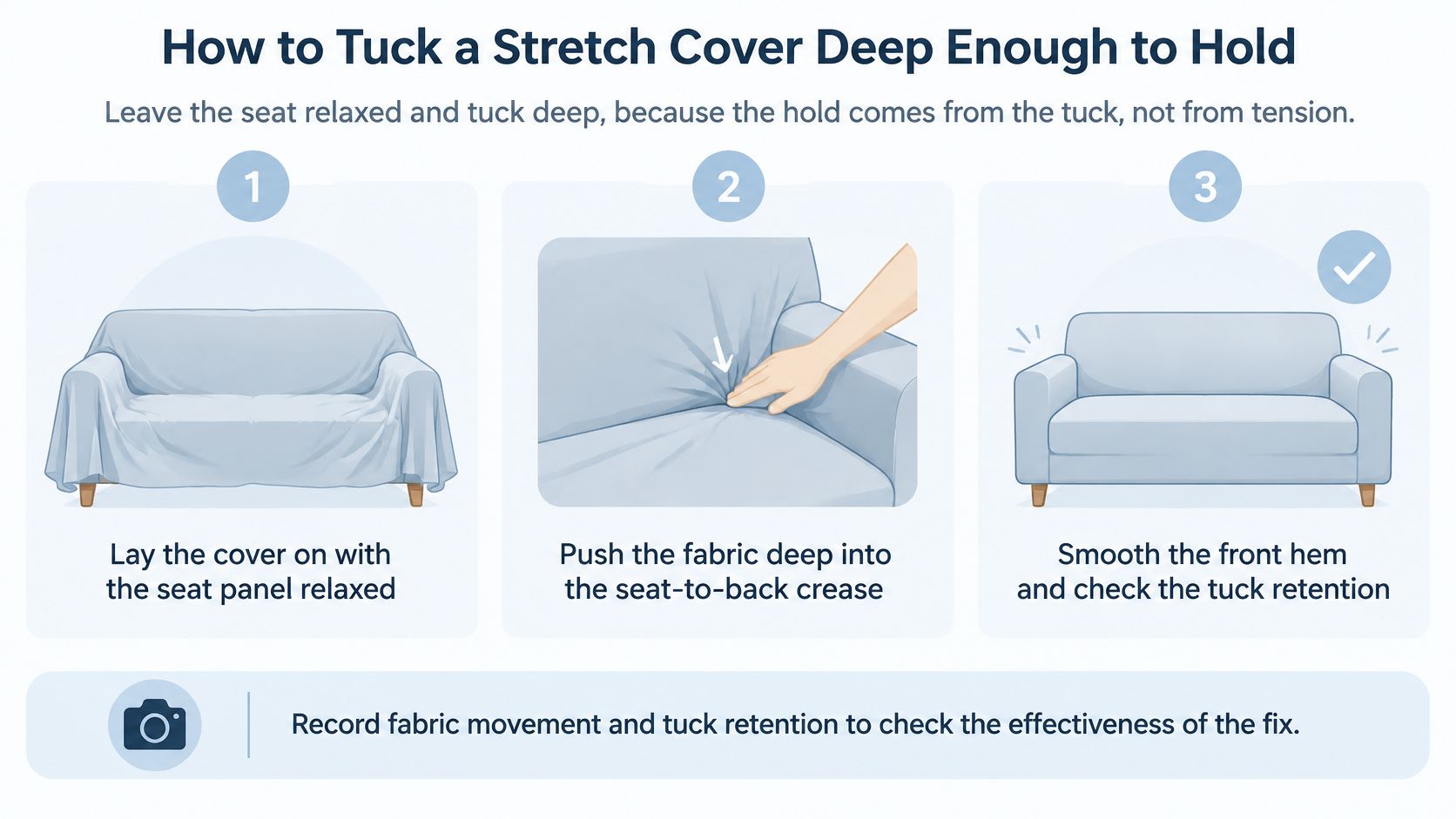
- Lay the cover on with the seat relaxed. Position the stretch couch cover evenly first and resist stretching the seat panel tight. If you pull out every wrinkle now, you'll pull the spare fabric out of the creases where it's needed.
- Push spare fabric deep into the back and sides. Feed at least 10 cm of spare fabric down into the gaps at the back and both sides of the seat. Depth is the grip. A shallow fold resting near the surface works loose with the first few sit-downs.
- Use a wooden spoon handle for depth. Press the fabric in with the handle of a wooden spoon where your fingers can't reach. It gets deeper than fingers ever will, and it pushes evenly without forcing one spot.
- Tuck each arm crevice fully. Work the fabric down along each arm until no loose bulge sits above the seat edge. Half-tucked arms are a common reason the whole cover seems to migrate sideways during the day.
- Tuck each part of an L-shape separately. Corner, L-shaped, rounded corner or chaise longue sofas need 2 covers, one for each part of the sofa, so fit and tuck each part on its own rather than dragging fabric across the corner. If you're unsure about dimensions before you start, check how to measure for sofa covers rather than guessing.
- Spread excess fabric evenly along the back crease. Distribute the spare fabric along the full length of the crease instead of forcing it into one tuck point. Concentrated pull at a single spot drags the neighbouring fabric out with it.
- Sit and stand a few times, then fix what moved. Test each seat properly. If a stretch couch cover still slips, push a Foam Rod in on top of the tucked fabric to lock it. If no rod is available, a foam stick or a rolled towel pushed in on top does the same wedging job.
- Re-tuck the next day. Once the stretch fabric has settled on the frame, push the tuck down again along the back and arms. That single re-tuck finishes the fit. Skipping it leaves first-day slack sitting in wrinkles instead of down in the crease.
Don't pull the seat tight. If the seat panel is taut, the first sit-down pops the fabric straight out of the crevice, however deep you tucked it.
Where Do Foam Rods Go to Lock the Tuck?
Foam Rods go into the seat-to-back crease, the arm crevices and the corner of an L-shaped sofa, pushed on top of fabric that's already tucked on a stretch couch cover.
Foam Rods are flexible, high-density foam cylinders designed to lock stretch couch covers in place. Pushed into the gaps around the cushions, they hold the tucked fabric down and smooth out the everyday creases that work loose as people sit.
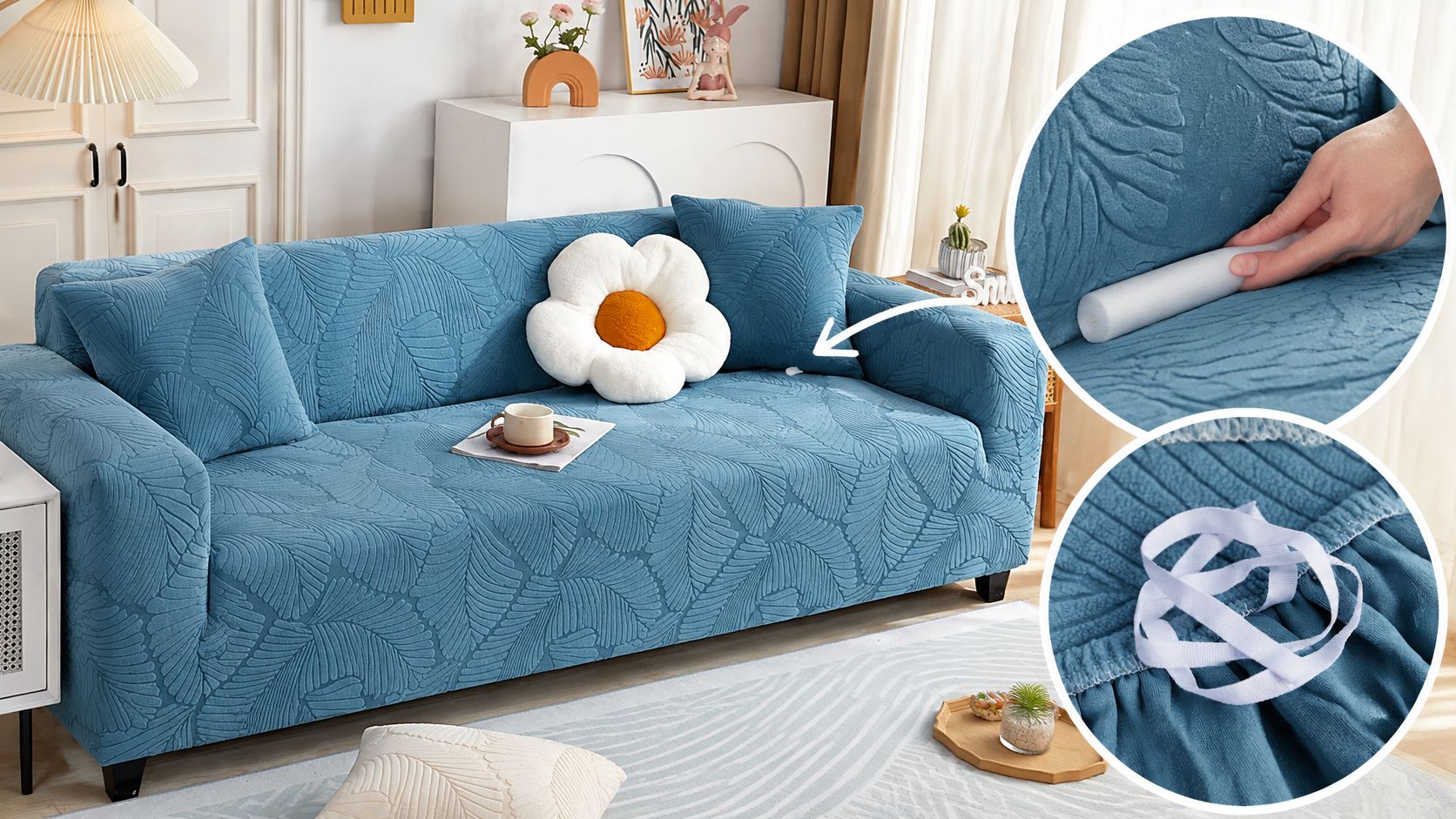
The sequence matters. Tuck first, then push the rod in on top so it wedges into the gap and holds the fabric there. I would start with the back crease, since that's where sitting drags fabric forward, then lock whichever arm crevice keeps escaping. A rod pushed underneath loose fabric, instead of on top of a finished tuck, doesn't wedge anything in place.
On an L-shaped sofa, tuck both parts first, then place one rod in the corner to lock where the two meet. That's the only corner treatment a slipping cover needs, and you can browse L-Shaped Sofa Covers for the paired seater sizes those parts use.
If the cushions are covered separately with Couch Cushion Covers, treat each cushion surround the same way: finish the tuck, then seat the rod in the gap on top of it. The rule never changes with the cover style. A jacquard like the Avelia Couch Cover · Blue · Stretch Fit is tucked and locked exactly like a plain stretch fit.
For gripping accessories, Casamé Home keeps two jobs separate: rods hold the cover, and Anti-Slip Sofa Pads hold the sofa. The pads sit beneath the legs, where they stop the furniture sliding on hardwood, tile and laminate and protect the floor from scratches. They come in black, and they never go under the cover. If your whole sofa creeps across a hard floor every time someone drops into it, no amount of tucking fixes that. That's couch movement, and it needs a pad under a leg, not a rod in a crease.
What Does a Properly Tucked Cover Feel Like?
A properly tucked stretch couch cover feels settled. The seat stays flat in the creases, the front edge stays where you left it, and people can sit down and get up without anyone reaching for the fabric afterwards.
Sophie J., who bought the Crosshatch Couch Cover in Eggshell, put it this way: it "stays in place nicely – no constantly rearranging it every time someone sits down".
How can you check whether sofa cover grips worked?
Judge grips by comparing the same stretch couch cover on the same sofa with and without them, keeping the initial tuck depth consistent. Use the tuck you set during fitting, then live on the sofa normally and watch what the cover does rather than resetting it each time.
- Photograph the starting point. Capture the back crease, both arm creases and the front hem before anyone sits down.
- Repeat the same movements. Do the same sitting, standing and reclining each time: ten sit-and-stand cycles, followed by a day of normal use.
- Record what changed. Note how far the fabric moved, whether any rods emerged, and how often the cover needed adjusting.
The benchmarks that matter are fabric movement, tuck retention, comfort and surface condition. A good grip reduces adjustments without creating a hard ridge you can feel through the seat or marking the upholstery underneath.
Those are suggested checkpoints for a home comparison, not a laboratory certification. Test furniture-foot pads separately by seeing whether the frame slides when someone sits. Keep the two judgments separate: a rod controls tucked fabric, while a leg pad controls furniture movement.
When Should You Replace Foam Rods or Pads?
You should replace a Foam Rod on a stretch couch cover when the Foam Rod stays flattened, splits, crumbles, or keeps working loose despite a proper tuck.
Check the installation before you blame the rod. Fabric pulled too tight across the seat can drag even a sound rod out of its gap, so re-tuck with the seat relaxed and test again. If the rod still won't stay, it has lost the shape that wedges it in place, and fresh rods will keep sofa covers neatly tucked again.
- Foam Rods. Replace for flattening, splitting, crumbling, or repeated loosening after a correct tuck.
- Anti-Slip Sofa Pads. Replace for movement, uneven compression, damaged surfaces, or debris stopping full contact with the floor.
Inspect both whenever you remove and refit the cover. There's no fixed number of washes or months to follow.
For care, remove loose rods before laundering the cover and follow the accessory's own cleaning instructions. The Australian care labelling guide for clothing and textiles applies to household textiles, furnishings and upholstered furniture, and required care information can include washing, drying, ironing and dry-cleaning instructions. That makes the cover's label the controlling reference for temperature, cycle and drying method, particularly for stretch, velvet or laminated fabrics. If a mark needs treating before a wash, check the label first.
Condition decides, not age. A grip that still holds securely can keep doing its job, while one that has lost its shape or grip should be replaced even if it's relatively new.
If your cover creeps out of the crease, deepen the tuck first, then lock it with Foam Rods, and if the whole sofa slides instead, fit Anti-Slip Sofa Pads under the legs. Casamé Home sells stretch couch covers, L-shaped and cushion covers, and the accessories that keep them sitting neatly. Visit Casamé Home to find the right fix for whichever part of your couch is moving.