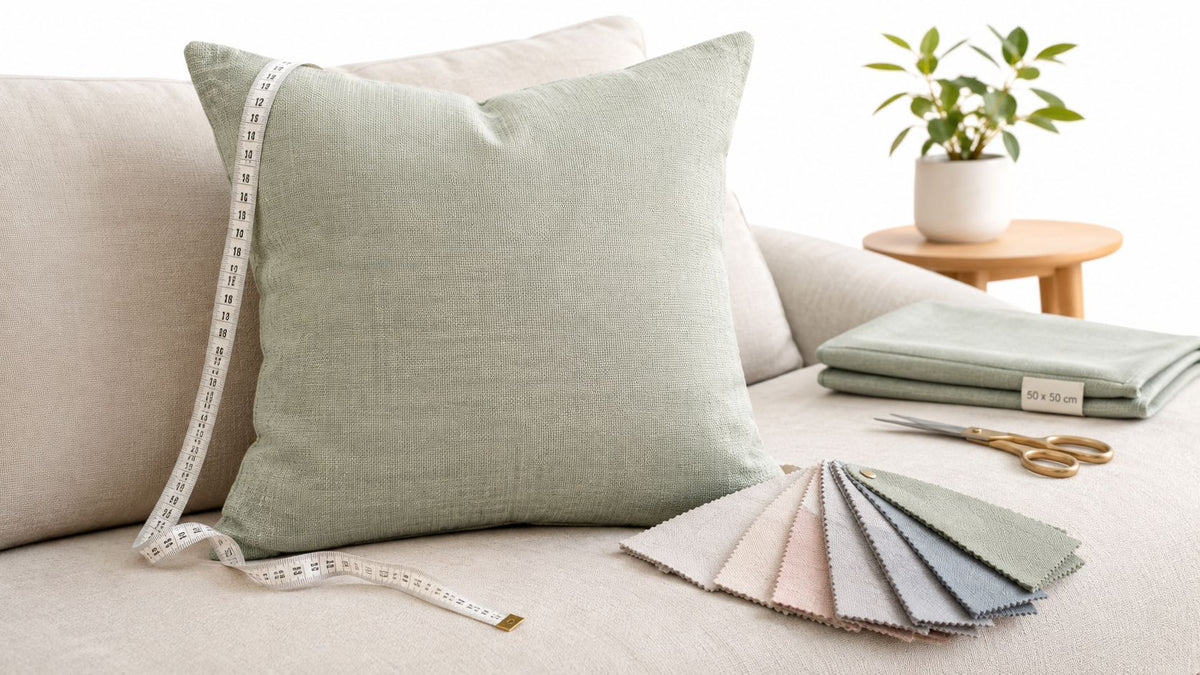
A 50 x 50 cm cushion cover isn't made by Casamé Home. Every Casamé Home cushion cover is 45cm x 45cm, so the practical answer is to measure your insert flat before ordering and decide whether a 45cm cover, particularly the stretch option, can give you the finish you want.
The popular advice is to match the number on the cushion to the number on the cover. That sounds sensible, but it ignores how inserts behave. A plump cushion can measure larger when you wrap a tape over its puff, while a soft or collapsed insert can look smaller than its original dimensions. The finished result also changes according to whether the fabric stretches or holds its shape.
Table of Contents
- I Need a Cushion Cover 50x50, But Do I Actually Need One
- How to Measure Your Cushion Insert Accurately Before Ordering
- Stretch Versus Woven Covers and Why Your Insert Changes the Look
- How to Fix Wrinkles After Washing a Cushion Cover
- Frequently Asked Questions About Cushion Cover Fit and Care
I Need a Cushion Cover 50x50, But Do I Actually Need One
No 50 x 50 cm cushion cover is stocked in this range, and every available cushion cover is 45cm x 45cm. That applies to the Classic Stretch, Velvet, Jacquard, Diamond Jacquard, Bobble-Textured, Crosshatch, Flecked, Veloura, Luma, Crossmere, Avelia, Rivelle, Gridelle, Braelyn, Cordelle, Linear Geometric, Pebble-Textured Waterproof and every printed design. They're sold as one piece or two pieces.
That doesn't mean the search for a “cushion cover 50x50” is misguided. It usually means the shopper has measured an existing cushion, read a nominal insert size, or assumed that a cover and insert should always share identical dimensions. Those assumptions can produce a disappointing fit before fabric, colour or texture even enters the decision.
What the range does and doesn't include
There are firm boundaries. The range contains covers only, not feather, poly or foam cushion inserts. It doesn't include made-to-measure or custom-size covers, and it doesn't include oblong, lumbar, bolster, round or floor cushion covers. These square covers are also a different product from Couch Cushion Covers, which fit the couch's own seat and back cushions, and from full Couch Covers.
If the insert really measures 50cm across the face, the Classic Stretch Cushion Cover is the closest option available because it's the stretch-fabric design. The woven covers are not: they have very little give.
Practical rule: If you measure a plump cushion over the puff, the tape follows the curve, so a 45 cm insert can read like a 50. Always measure flat, seam to seam.
The broader Australian context also makes accurate sizing worthwhile. Clothing textiles sit on the Australian Government's product stewardship priority list, a sign of how much textile ends up as waste. That listing is about clothing, not cushion covers. Still, a removable cover can help keep an insert in use when the outer fabric needs washing, repair or replacement.
For browsing the available square styles, start with the modern cushion cover styles, but treat every listed option as 45cm x 45cm. The right first question isn't “Where can I find a 50cm cover?” It's “What does my insert measure when it's lying flat?”
Take the Diamond Jacquard Cushion Cover in Pale Purple: it's a 45cm x 45cm product, not a 50 x 50 cover. James M. describes the fit this way: “Sizing's spot on at 45cm too, fits my existing cushion just right.”
That comment is useful because it focuses on the actual cover size rather than treating a larger search phrase as proof that every square cushion needs a 50cm product.
How to Measure Your Cushion Insert Accurately Before Ordering
Measure a cushion insert across its face while it lies flat, from seam to seam, without following the curve over the filling. That single change prevents most confusion around a cushion cover 50x50 search because it records the usable width and height rather than the inflated measurement of a rounded cushion.
Use this flat-measurement method
- Remove the existing cover. Measure the insert itself where possible. A stretched or loose old cover can disguise the actual dimensions.
- Lay the insert on a flat surface. Smooth the fabric or filling without compressing it aggressively. Measure from one edge to the opposite edge across the centre, then repeat from top to bottom.
- Keep the tape straight. Don't pull it over the puff. If the tape follows the curve of a plump cushion, it records the surface path, not the flat span. That can make an insert appear larger than it is.
- Check a soft insert twice. A collapsed or underfilled insert may read smaller because its edges have fallen inward. A woven cover with little give takes the shape of what's inside, so a soft insert can look saggy even when the nominal size sounds correct.
- Record the measurement before ordering. If the insert measures 45cm across the face, a 45cm cover fits it, though a same-size insert sits flat. If it measures 50cm, the Classic Stretch Cushion Cover is the closest thing in the range; the woven covers have very little give.
The help choosing cover size is useful when you're checking the cover dimensions, but it can't replace measuring the object in front of you. The same discipline applies to other removable household textiles. A practical dining chair covers buyer's guide is a helpful reminder that furniture measurements should be taken from the actual item, not guessed from a familiar product label.
If you're buying an insert elsewhere
Buy the insert for the 45cm cover, not the other way around. Then there's the rule every stylist knows: go one size up on the insert. A 50 cm insert in a 50 cm cover fits, but it sits flat. A 55×55 inside fills every corner, and it's what makes the famous "karate chop" dent in the top hold its shape. So if a cover looks baggy, the answer is usually a bigger insert, not a new cover.
That also explains why a correctly sized cover can still look empty if the insert lacks enough fullness. Cover construction, filling density and the shape of the corners all affect the finished appearance.
Measure flat first, then judge fullness separately. Width tells you whether the cover is plausible. Insert volume determines whether the cushion looks relaxed or properly filled.
Stretch Versus Woven Covers and Why Your Insert Changes the Look
The Classic Stretch Cushion Cover is the stretch option, while the jacquard, textured and printed covers are woven with very little give. If a reader's insert really measures 50 x 50, the Classic Stretch Cushion Cover is the closest option in the range. The woven designs are not; they have very little give.
The difference is mechanical, not just visual. A woven Jacquard or Diamond Jacquard cover takes the shape of whatever sits inside it. If the insert is soft, collapsed or lacking volume, the cover follows that weakness and the cushion reads as saggy. The Classic Stretch Cushion Cover pulls tighter over the same insert, which can make the surface look neater even when the filling underneath hasn't changed.
Compare the fit behaviour before choosing texture
| Cover type | Insert behaviour | Finished look |
|---|---|---|
| Classic Stretch Cushion Cover | The stretch fabric pulls tighter around the insert and accommodates some movement in the surface. | A closer, more held finish, especially when the insert has enough fullness. |
| Jacquard, Diamond Jacquard and other woven covers | The cover has very little give and follows the insert's actual shape. | Structured texture, but a soft or collapsed insert can appear baggy or sagged. |
| Printed designs | The woven construction provides very little give, so the insert needs to suit the cover dimensions. | The printed surface looks best when the corners are filled rather than left slack. |
| Textured woven designs such as Bobble-Textured, Crosshatch, Flecked, Veloura, Luma, Crossmere, Avelia, Rivelle, Gridelle, Braelyn, Cordelle and Linear Geometric | The raised or patterned surface doesn't compensate for an underfilled insert. | More texture, but not a substitute for correct sizing and adequate fullness. |
| Pebble-Textured Waterproof Cushion Cover | The cover is waterproof, but its fit still depends on the insert inside. | A practical protective option for a room where spills are likely. |
Choose by the look you want
For a firmer, more pulled-together appearance, the stretch mechanism is the sensible place to start. For a defined woven pattern, choose a woven cover only when the insert's flat measurement and fullness are appropriate. Don't select a jacquard or printed design hoping the fabric will stretch around a size mismatch.
The cover is only one half of the finished cushion. A flat insert can make an accurately sized woven cover look loose, while an adequately full insert helps the corners read clearly. That's why the measurement and insert decisions need to happen before the style decision.
How to Fix Wrinkles After Washing a Cushion Cover
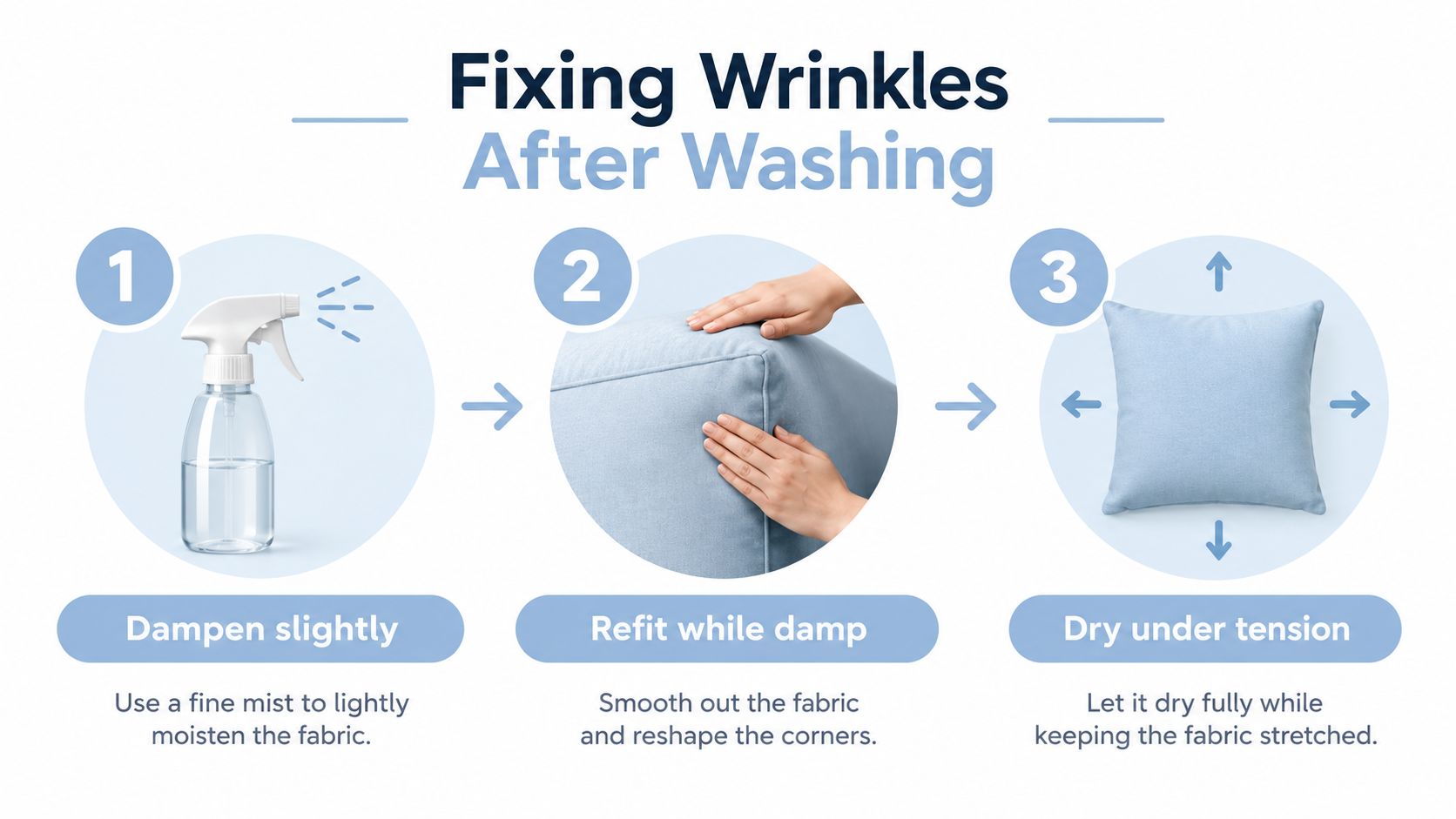
Refit a cushion cover while it's slightly damp, push the insert fully into every corner, and let the cover dry under even tension. Wrinkles usually become stubborn because the cover dries flat and empty. Folds press into the fabric and hold their shape once the fabric is dry.
Use the insert as a stretcher
Take the cover from the wash while it's still slightly damp, then put it back over the cushion. Work slowly around the edges and push each corner of the insert all the way into the corresponding corner of the cover. Leave the cover on the cushion while it finishes drying, so the insert holds the panels under even tension.
The process works because the cushion supports the fabric in its intended shape. The creases have less opportunity to set into empty folds, and the corners stay extended instead of drying collapsed. Don't yank the fabric aggressively, especially around closures or textured sections.
If the cover is already bone dry, lightly dampen it and refit it rather than pressing it. A dry cover won't reshape just because you smooth the surface with your hands, but it can relax again when moisture and even tension work together.
A separate machine washable pillow guide can help with the wider issue of washing filled bedding and soft furnishings. For a removable cover, the critical point is what happens during drying, not just the wash itself.
Why ironing is the wrong repair
Pressing a woven or textured cover can flatten the raised yarn that creates its surface. You may remove the crease while also removing the texture that makes the cover look and feel distinctive. That trade-off isn't worth it for jacquard, bobble-textured or other raised designs.
Never iron velvet. If you need to freshen nearby soft furnishings, use a suitable method such as the guidance on how to freshen sofa throws with a steamer, while keeping direct heat away from the velvet cover itself.
Repair sequence: Slightly damp, refit, corner by corner, then dry on the insert. Pressing is not the shortcut it appears to be.
The insert also reveals whether the problem is mainly creasing or poor fullness. If the cover remains visibly loose after it dries in place, check the insert's flat measurement and volume before trying another care method.
Frequently Asked Questions About Cushion Cover Fit and Care
Why can a 45cm cover look baggy with a 45cm insert?
Size matching on paper is only half the job. A 45cm cushion cover can look baggy when the insert is soft, collapsed or too flat, because the cover is responding to volume, not just edge-to-edge measurement. The cover is not necessarily wrong. The insert is often the weak point: a same-size insert fits but sits flat, a slightly larger one fills every corner.
Woven covers show this faster than stretch ones because they have little give and mirror whatever is inside them.
Can a stretch cover accommodate a slightly larger insert?
A Classic Stretch Cushion Cover is the closest option for a slightly larger insert because it's the stretch-fabric design, but it isn't a 50 x 50 cm cover. That distinction matters. A shopper searching for “cushion cover 50x50” is often trying to solve a fit problem with the wrong size label.
Stretch fabric can forgive a small mismatch, but it does not turn a 45cm cover into a proper 50cm one.
What should I do instead of ironing after washing?
Refit the cover while it's slightly damp and let it dry on the insert. Work the insert into the corners first, then smooth the face so the fabric dries under even tension. If the cover is already dry, mist it lightly and refit it again. Never iron velvet, and be cautious with textured weaves that can flatten under direct heat.
If you are also cleaning the surrounding upholstery, this cloth sofa maintenance advice is a useful companion to the damp-refit method.
What does Australian Consumer Law cover if the size is wrong?
Accurate product descriptions matter in Australia. If a cover is listed with the wrong dimensions or misleading care information, that can become a description issue under consumer guarantees, as outlined in the ACCC's small-business consumer guarantee guidance.
If the seller stated the size wrongly, that is different from a buyer choosing the wrong size after measuring badly. In practice, that is the line that matters. Consumer guarantees can help when the listing is wrong. They generally do not fix a simple measuring mistake or a change of mind.