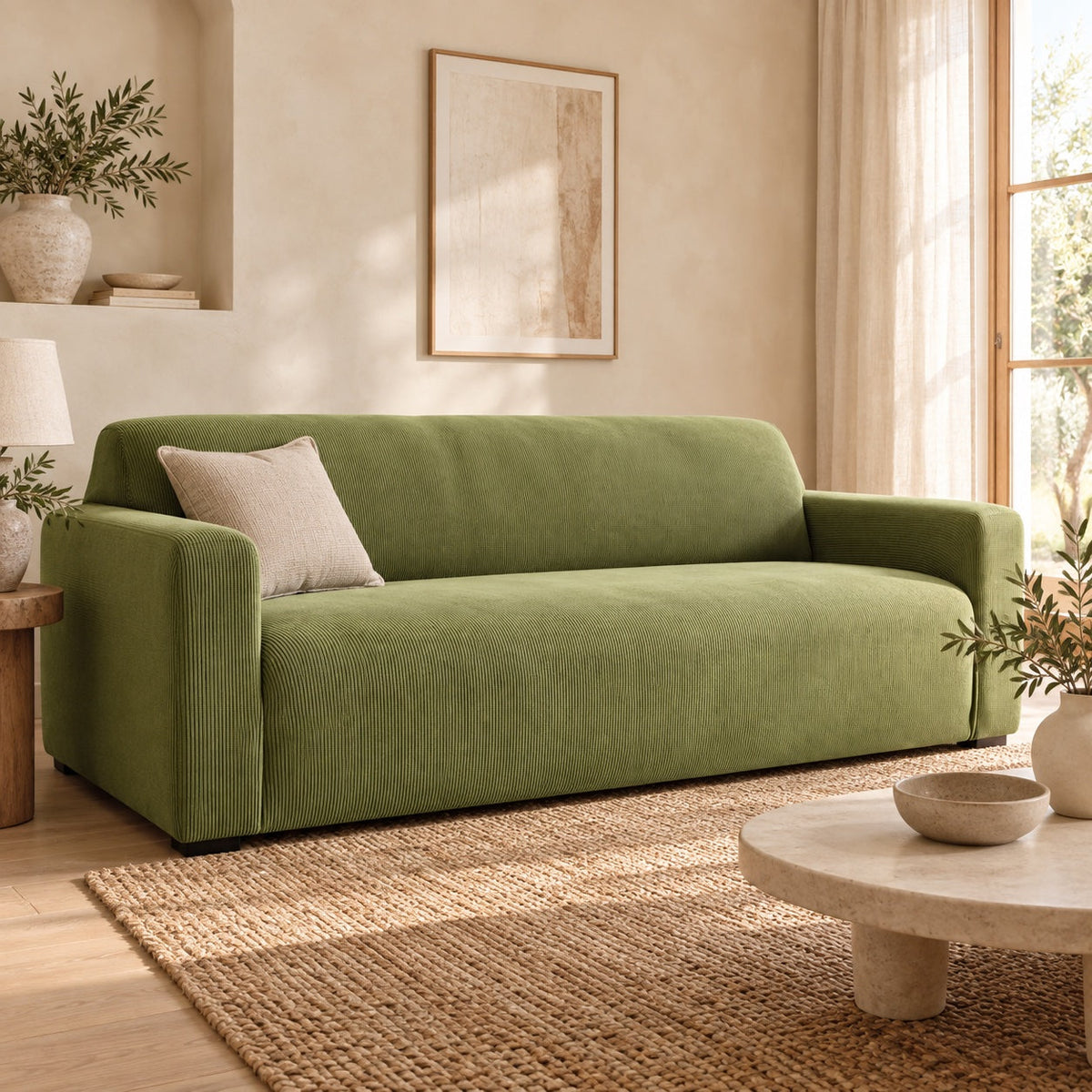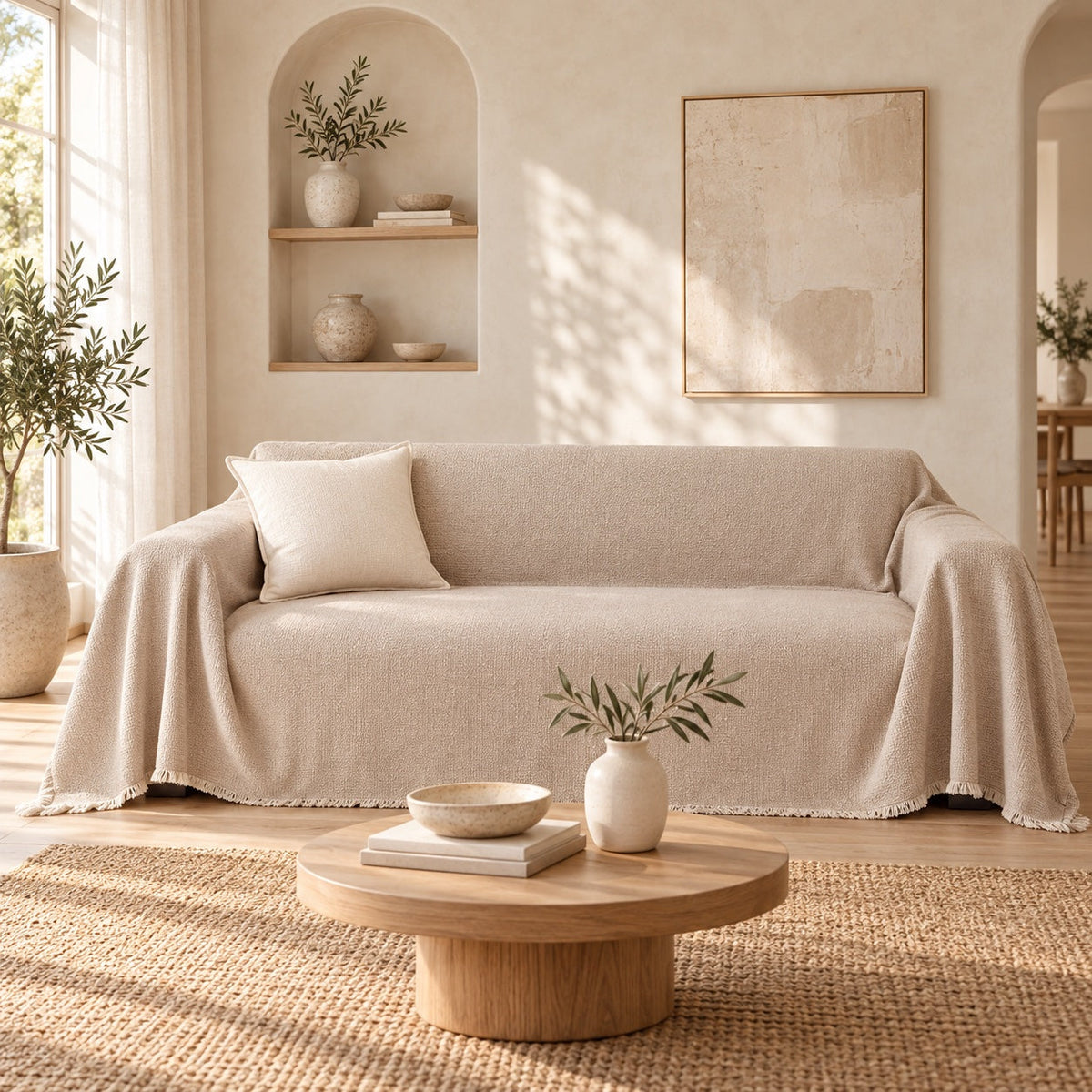
Sizing up a stretch couch cover is the mistake that makes the cover fail. A cover that feels “safe” one band larger usually ends up bagging at the arms, riding up on the seat and sliding every time someone sits down, because the cover is meant to follow the sofa's shape, not hang off it.
Table of Contents
- Why Sizing Up on a Stretch Couch Cover Always Backfires
- How Do You Measure a Sofa for a Stretch Couch Cover
- Does a Stretch Cover Fit an L-Shaped Sofa
- How Do You Make a Stretch Couch Cover Stay Put
- Which Stretch Couch Cover Family Should You Pick
- What About Care, Returns and What Casamé Home Does Not Stock
- Your Stretch Couch Cover Fitting Checklist
Why Sizing Up on a Stretch Couch Cover Always Backfires
A stretch couch cover is cut smaller than the sofa frame and stretches to fit it, so it follows the shape. That is why the instinct to “go one size up just in case” usually creates the very problem buyers are trying to avoid, spare fabric no tuck can take up.
The safe-feeling choice is the wrong one
When a sofa already sits neatly inside one size band, choosing the next band up removes the cleanest part of the fit. The cover has room to float, so the fabric bags where the frame needs a close line, especially at the arms and seat edge. Once that happens, every sit-down becomes a reset, and the cover starts looking tired before it is worn out.
Practical rule: a stretch cover should follow the sofa, not float over it.
That's the point most shoppers miss. The right fit is not about leaving “extra room for comfort”, it's about giving the cover enough shape to tuck cleanly and stay there.
Why the tuck matters more than the pull
The most common fitting mistake is treating it like a T-shirt instead of a fitted sheet. People pull the cover tight across the seat to smooth out every wrinkle, and the first time someone sits down, it pops straight out of the crevices. A stretch cover isn't held on by tension. It's held by the tuck, the same way a fitted sheet is held by its corners.
For people who want a cleaner room look, that same logic applies to the whole styling brief. A cover that fits the frame properly reads as intentional, while a cover that's been over-sized reads as temporary, no matter how good the colour is.
How Do You Measure a Sofa for a Stretch Couch Cover
Measure the full width from the outside of one arm to the outside of the other at the widest point, then match that single figure to the correct band. For Casamé Home stretch couch covers, the bands are 1 seater 90 - 130 cm, 2 seater 135 - 175 cm, 3 seater 180 - 220 cm, 4 seater 225 - 300 cm, and 5 seater 306 - 360 cm for the Luma Couch Cover.
One width, not the seat cushions
Do not measure the seat cushions. Do not add anything extra for the arms. The sofa's outside width is the number that matters, because the cover has to land on the frame the way it will sit in the room, not on the removable parts that move around inside it.
If a width falls in the gap between two bands, take the larger size for an easier tuck. That rule only applies when the sofa sits between bands or right at the top edge of one, not when the sofa already fits neatly inside a band.
The simplest way to avoid a sizing-up error is to keep the measuring path boring and exact. One width, one band, one decision. That's the whole job.
A quick reference sits in the stretch couch cover sizing guide, which is the right place to confirm the width bands before ordering.
Does a Stretch Cover Fit an L-Shaped Sofa
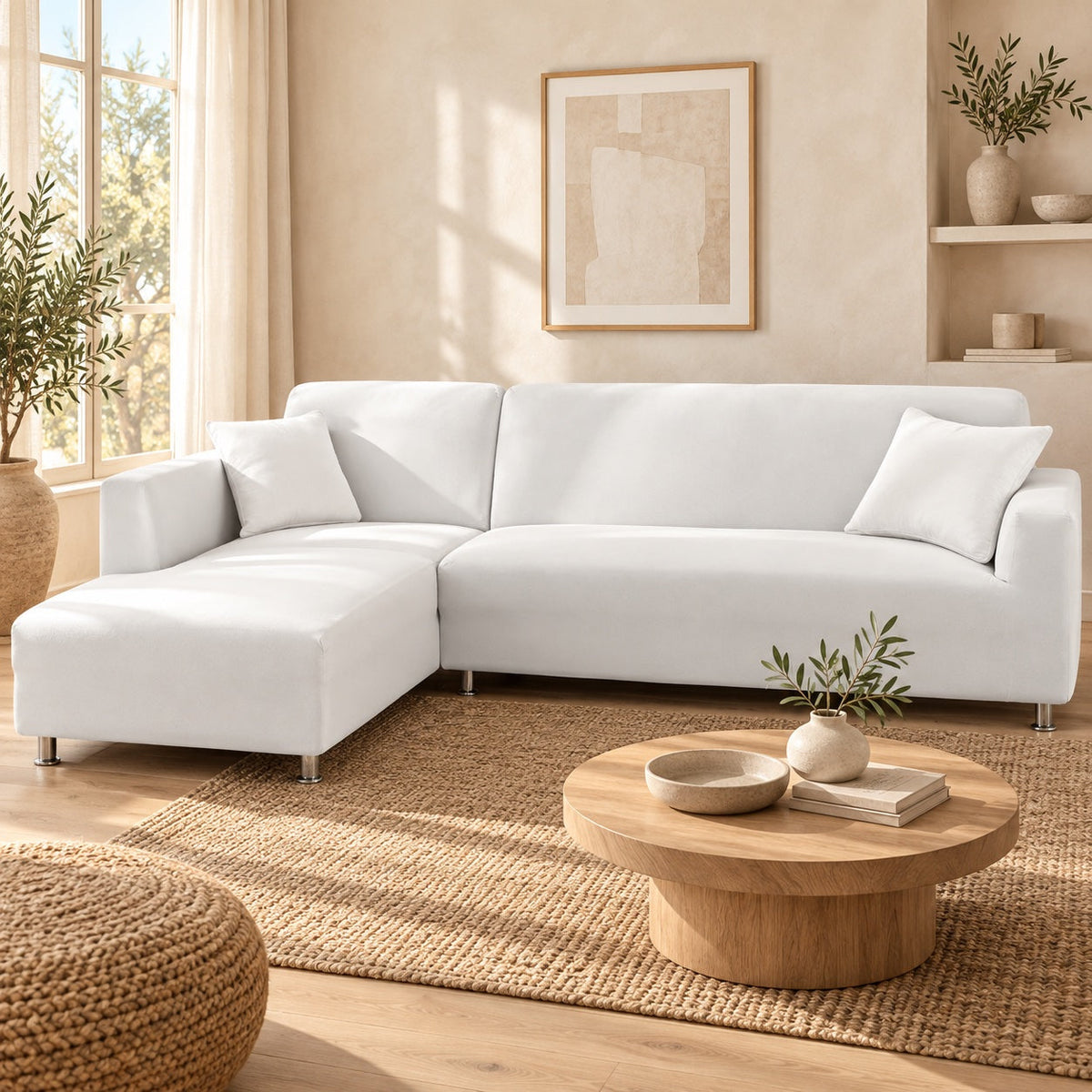
A stretch cover fits an L-shaped sofa when each arm is measured on its own and matched to its own band, because Casamé Home L-shaped covers are sold as paired seater sizes rather than as one wraparound piece.
Two arms, two readings
Use the same width bands for each section of the lounge. Our L-shaped covers are sold as paired seater sizes, from 1 seater and 2 seater up to 4 seater and 4 seater, so each arm is measured on its own, from the outside of the arm to the inside corner, and matched to its own band. A single-piece stretch cover will not turn a regular sofa into an L-shape, and there is no made-to-measure option to force a one-piece fit.
If one arm lands in the gap between two sizes, choose the larger size for the easier tuck. That rule still applies here, but it applies to each arm individually, not to the whole lounge as one broad shape.
The stretch-fit L shaped covers collection follows that two-arm method, so buyers can match each side without guessing which arm should drive the order.
How Do You Make a Stretch Couch Cover Stay Put
A stretch couch cover stays put when the tuck is deep and continuous, not when the fabric is pulled tighter across the face of the sofa.
Tuck the whole length of the crease
Push the fabric deep into the crevice where the seat meets the back along the full length of the sofa. That join is doing the heavy lifting, because it anchors the cover where the body weight and movement try to drag it loose. If the tuck is shallow, the cover creeps back out and the cycle starts again the first time people sit down.
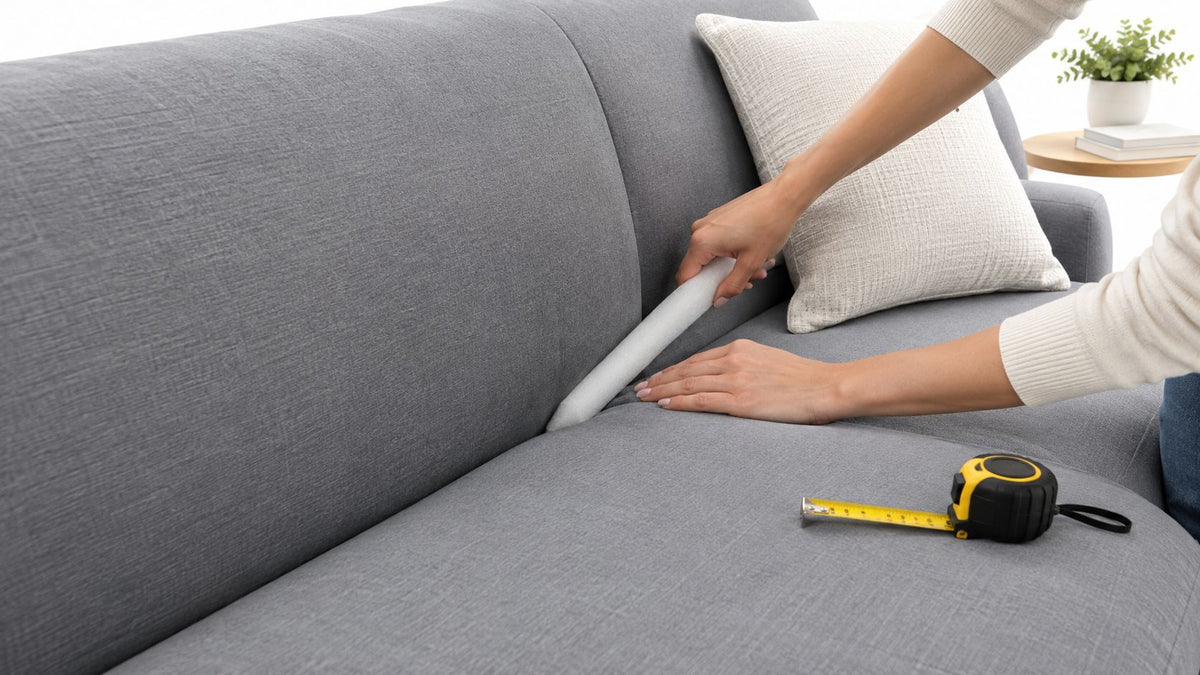
A foam rod is sold for exactly that job, pushed into the tucked crevice so the fabric can't creep back out. Use it after the fabric is already sitting where it should, not as a replacement for the tuck itself.
The cover doesn't fail because the fabric is weak, it fails because the tuck is shallow.
Mathis S., on the Classic Stretch Couch Cover in Buttermilk Yellow: "It fits my two-seater snugly – no bunching or slipping around, which is a miracle since my dog likes to leap on it."
That's the pattern worth copying. The fix: leave the seat relaxed and push the spare fabric at least 10 cm down into the gaps at the back and sides, using the handle of a wooden spoon to get it deep. If it still slips, push a foam stick or a rolled towel in on top of the tuck. The guide to tidy slipcover fit is the natural troubleshooting reference when a cover keeps walking up the frame after the first install.
Don't fight wrinkles with brute force
Pulling harder across the seat usually creates more movement, not less. The cover starts to look tight on the visible face, but the looseness just migrates to the arms and edges where it can escape. A better result comes from controlling the tucked areas first, then smoothing the front only after the fabric has somewhere to settle.
That fitting method is the difference between a cover that looks installed and a cover that behaves installed.
Which Stretch Couch Cover Family Should You Pick
Pick the family that suits the sofa shape first, then match the seat cushions with the right Couch Cushion Covers size.
The stretch families stocked by Casamé Home
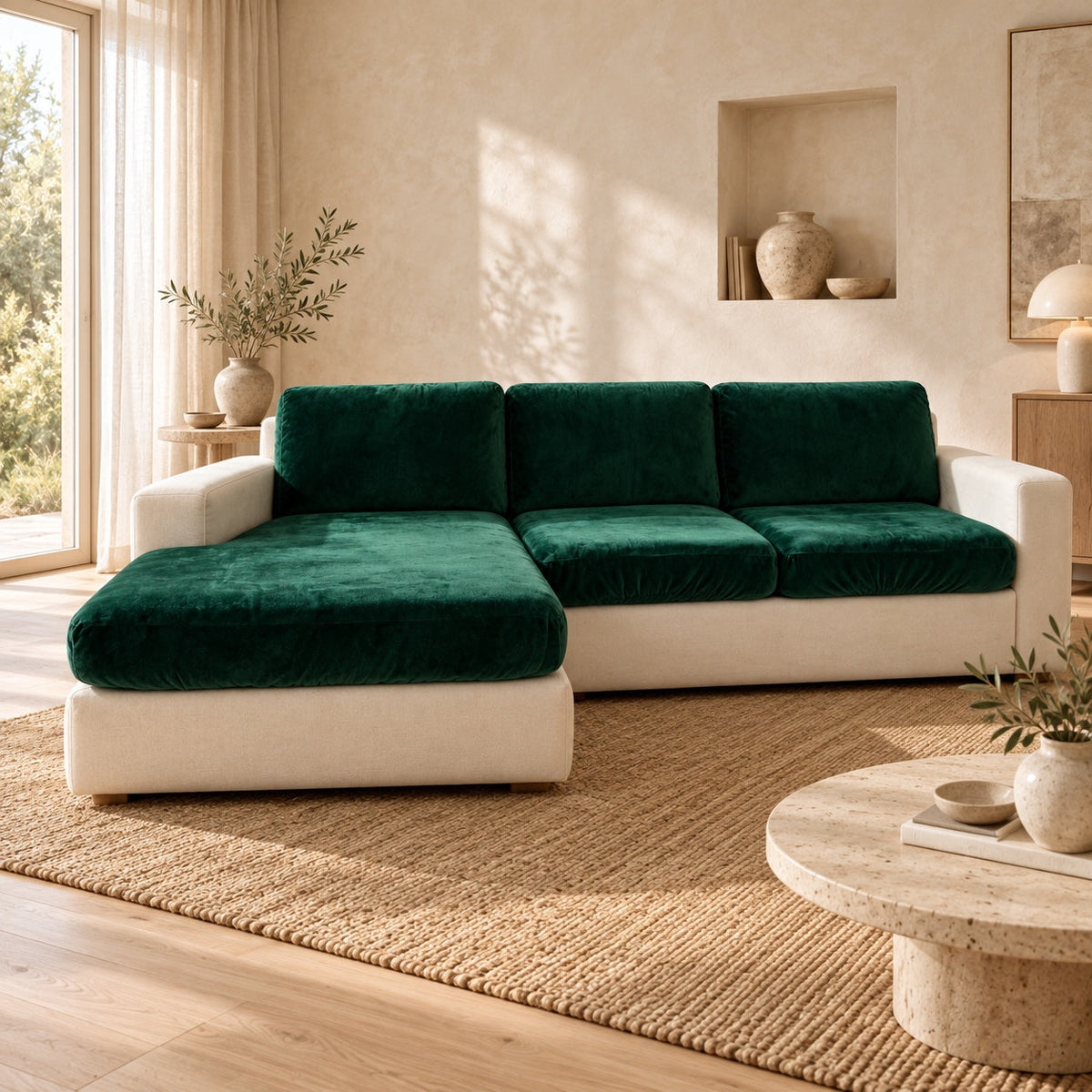
The stretch range includes the Classic Stretch Couch Cover with twenty colourways, Crosshatch Couch Cover, Flecked Couch Cover, Jacquard and Diamond Jacquard Couch Covers, Velvet Couch Cover, Bobble-Textured Couch Cover, and Luma Couch Cover, plus the Veloura, Arquette, Avelia, Braelyn, Cordelle, Gridelle and Crossmere lines and the printed designs. The matching Couch Cushion Covers come in Standard, Deep, Chaise Narrow and Chaise Wide, which keeps the seat cushions aligned once the base cover is on.
Among Couch Cover units ordered over the past year, the Velvet Couch Cover is 18% (422 units), the Crosshatch Couch Cover 17% (403 units) and the Classic Stretch Couch Cover 16% (384 units); the Jacquard Couch Cover is 9% (199 units) and the Luma Couch Cover 5% (113 units). By colour within couch covers, grey is 20% of Couch Cover units (475 units) and green 19% (449 units).
Across every product type, products tagged velvet are 10% of all units ordered (555 units) and products tagged jacquard 8% (440 units). That is an order snapshot, not a design rule, so I treat it as a record of what was ordered rather than a verdict on what will suit a particular lounge.
Start with the frame cover, then finish the sitting surface with the right cushion cover size. A cover family handles the body of the sofa, and the cushion covers tidy the parts people sit on, so the lounge looks planned rather than pieced together.
What About Care, Returns and What Casamé Home Does Not Stock
Casamé Home does not stock made-to-measure or custom-cut covers, separate arm caps, separately sold modules, or cushion inserts.
Care needs to be clear before purchase
That matters because stretch fabrics need proper care instructions, not vague promises. Australian care-labelling rules for textiles, including furnishings and upholstered furniture, exist to prevent damage such as shrinkage and colour running, and the label or product page should spell out washing, drying, ironing, bleaching and dry-cleaning limits in plain English or recognised symbols.
If a cover is sold as machine-washable, the buyer still needs the exact maintenance path before ordering. The important question is not whether the fabric can be washed at all, but whether the washing and drying method suits the fabric's recovery and the sofa's dimensions after laundering.
Consumer law and a sizing mistake
Australian consumer law draws a clean line between a faulty product and a wrong-size choice. If a product matches its description and is fit for purpose, measuring errors are usually sizing mistakes, not a consumer-guarantee failure. That's why the width bands matter so much upfront, because the cover can only behave properly if the sofa was matched to the right range from the start.
The same logic explains why care matters after purchase. A stretch cover that's washed incorrectly can lose recovery, distort, or shrink, which is exactly the kind of problem that turns a good fit into a bad one.
Your Stretch Couch Cover Fitting Checklist
Measure the full width from outside arm to outside arm, match it to the right band, and only choose the larger size when the sofa sits between two bands or right at the top of one. For an L-shape, measure each arm separately and match each one to its own band. Fit the base first, leave the seat relaxed, push the spare fabric at least 10 cm into the seat-back crevice, then set a foam rod into the tucked line after the fabric is seated, not as a substitute for the tuck. Finish with the right Couch Cushion Covers and shop the Couch Covers range when you're ready.