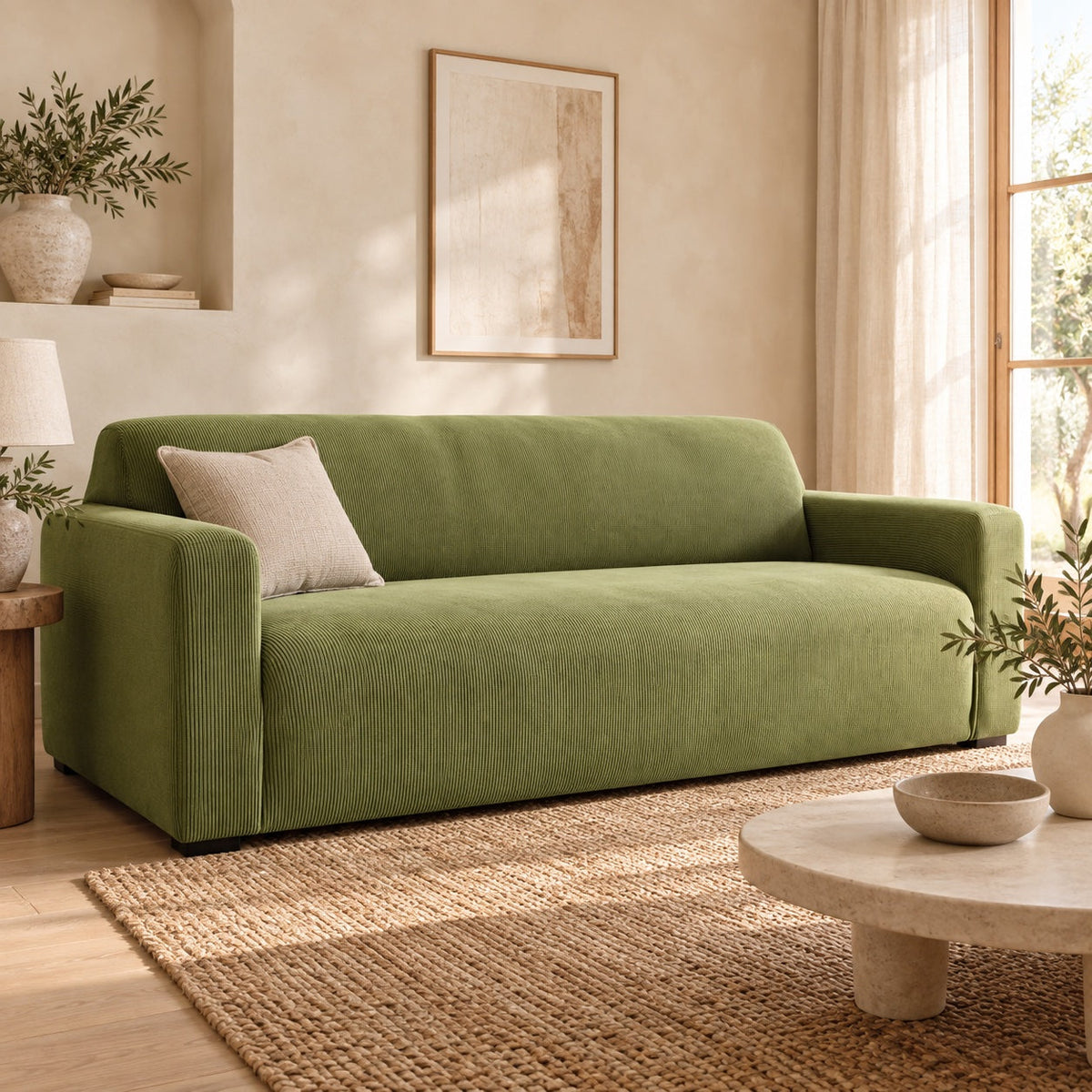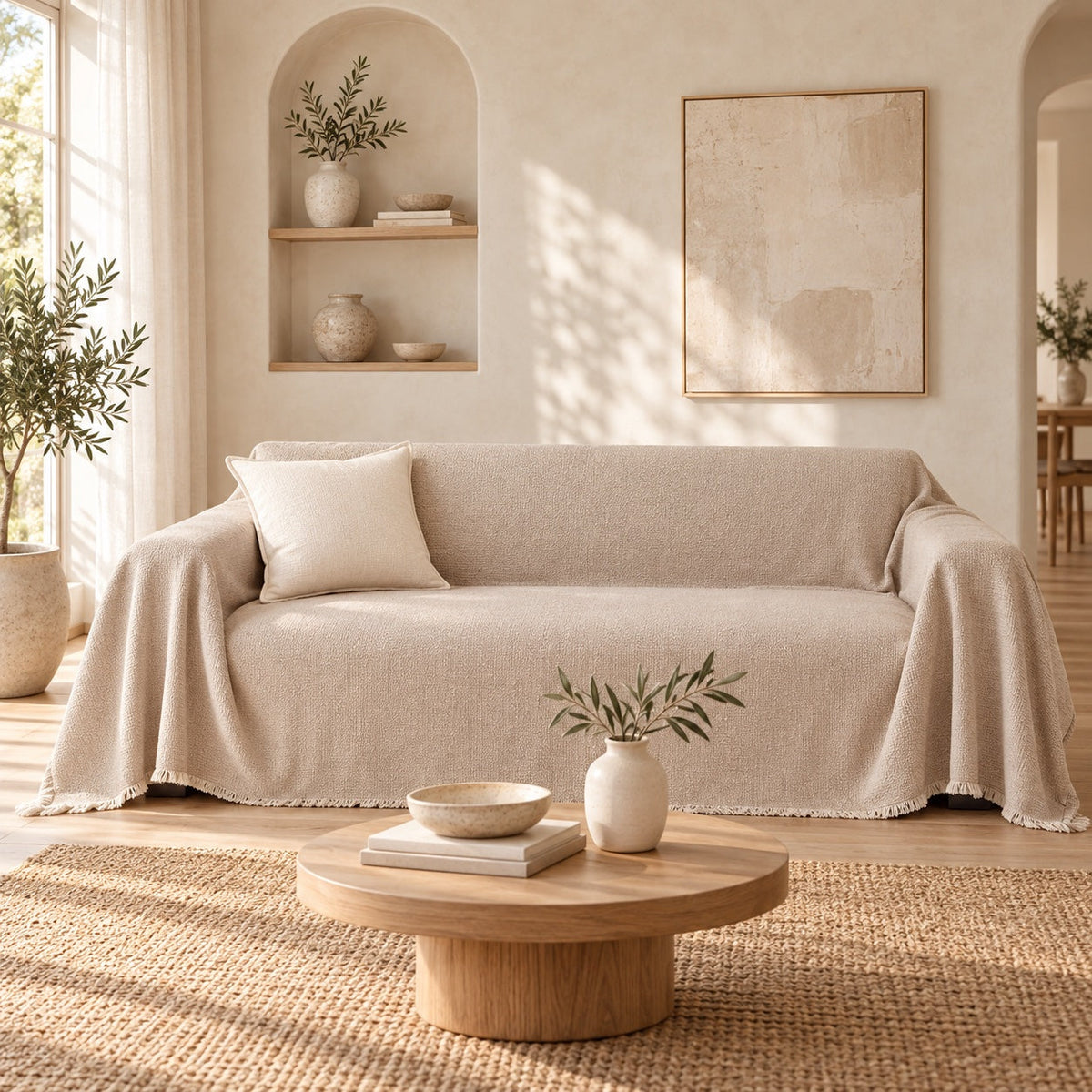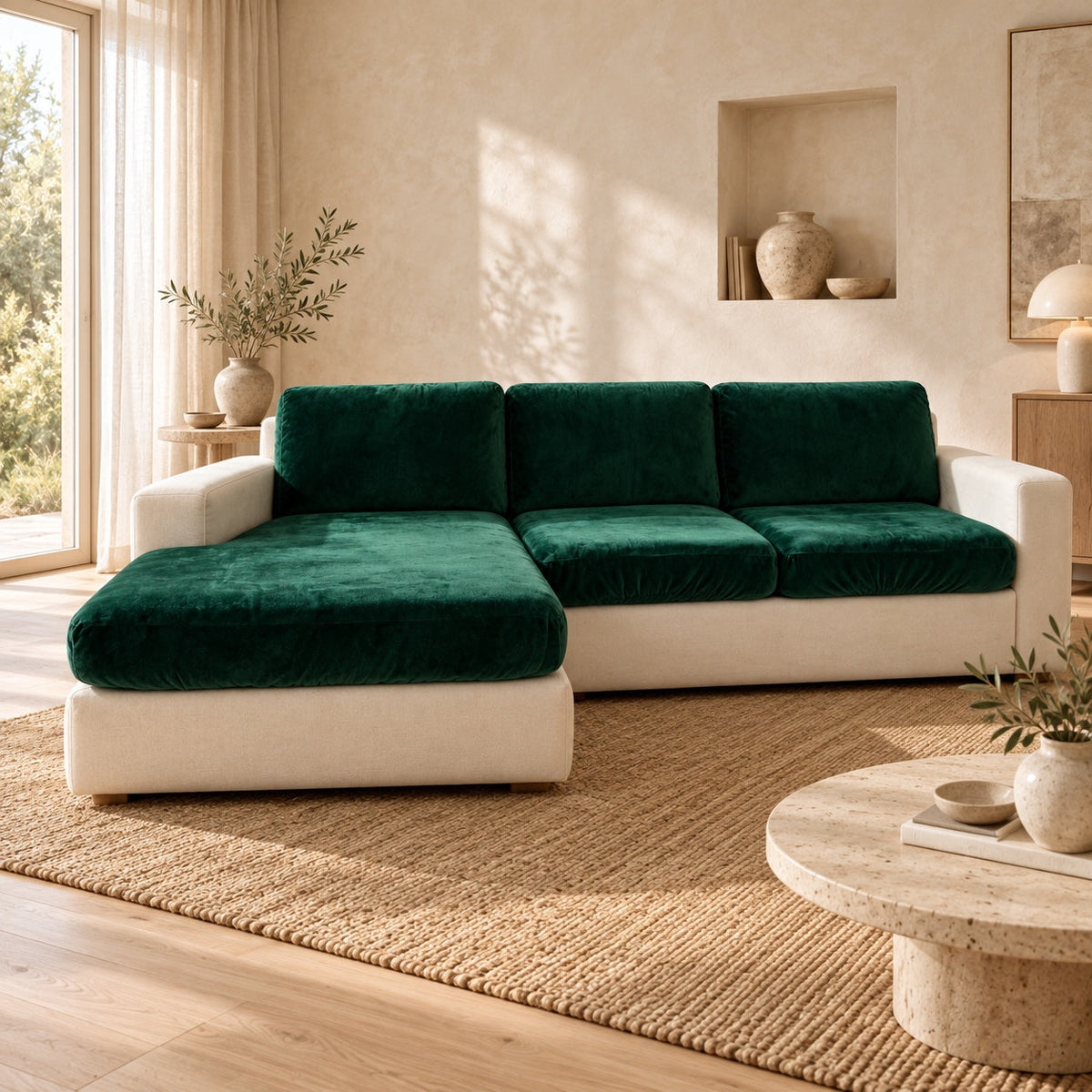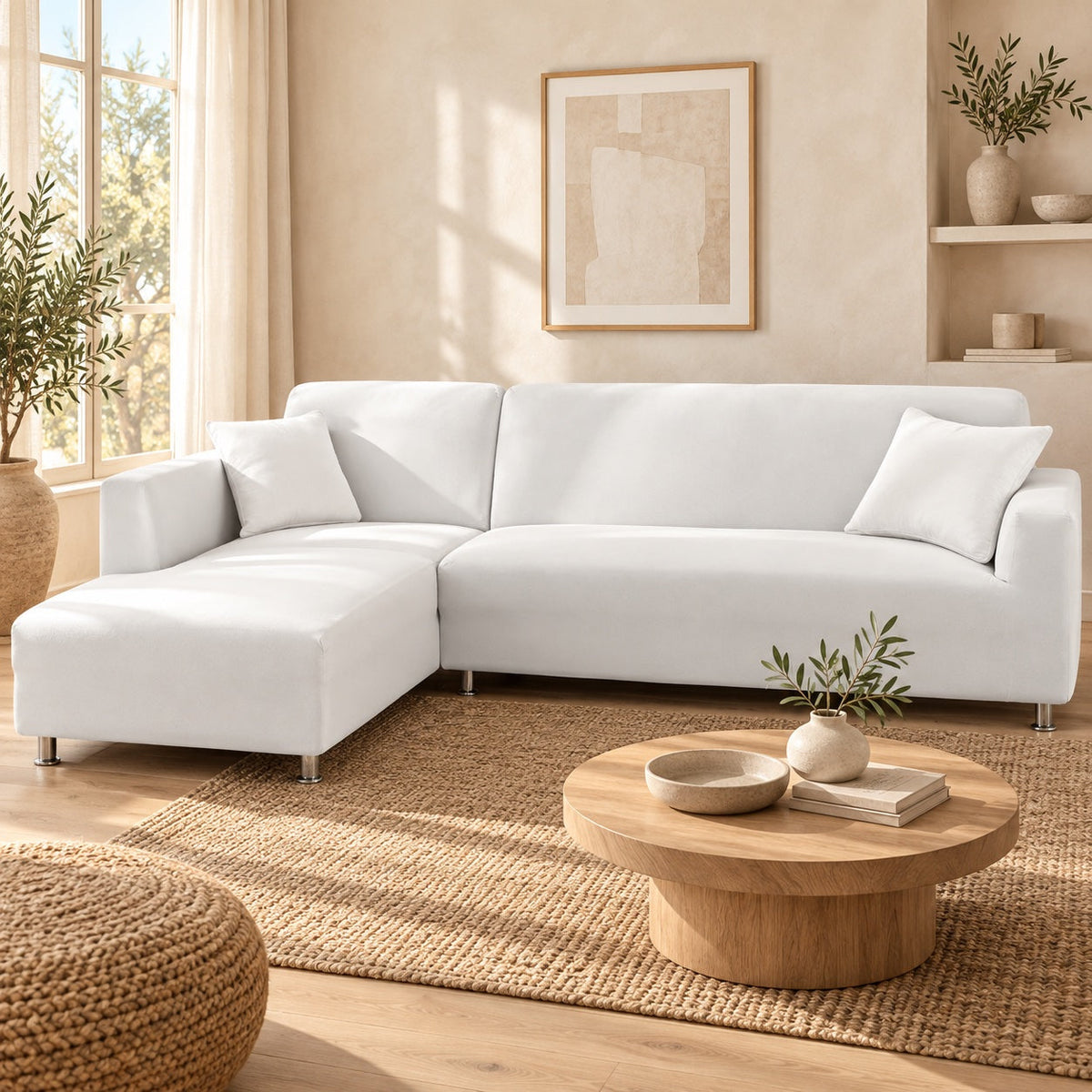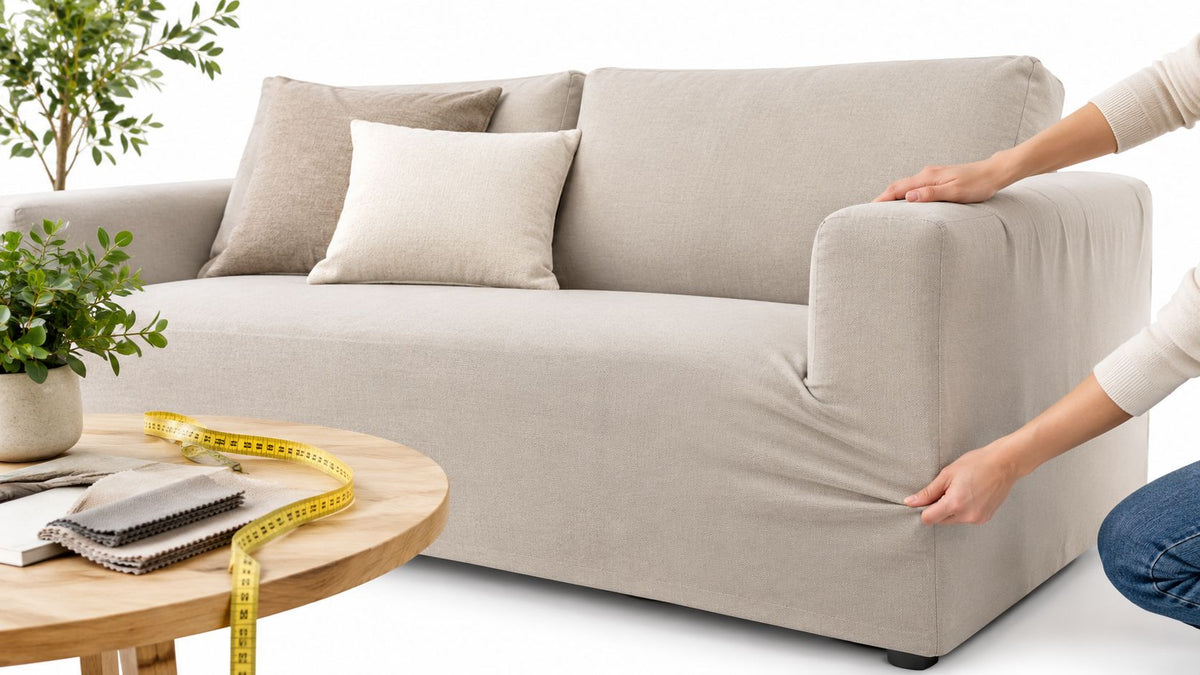
Most advice about custom couch slipcovers starts in the wrong place, with sewing. For a stretch cover, the fitted look doesn't come from a tailor, it comes from picking the right size band and tucking it properly. Casamé Home doesn't offer made-to-measure slipcovers, so the main job is to make a published size band look like it was built for the couch.
Table of Contents
- What Does Custom Mean for a Couch Slipcover Today
- How Does a Size Band Replace a Sewing Pattern
- How Do You Measure So the Size Band Is Right
- How Do You Fit a Stretch Cover So It Looks Tailored
- Will a Stretch Cover Fit My Awkward Sofa Shape
- When Should You Cover Care for or Return It
What Does Custom Mean for a Couch Slipcover Today
Custom couch slipcovers usually mean a cover that looks fitted, not a cover that was cut and sewn to a house-call pattern. In practice, that look comes from two things you control, the size band and the install. Casamé Home's Casamé Home slipcover selection is built around that reality, so there's no consultation, no sewing lead time, and no promise of a one-off pattern.
The word custom has shifted
A stretch-fit cover can read as custom when the proportions suit the sofa and the fabric is tucked cleanly into the frame gaps. That's why the result feels custom-made even though the product isn't bespoke. The fit lives in the tuck points, especially the arms, the back corners, and the crevices where slack fabric either disappears or shows.
Practical rule: A cover looks made for the couch when the size band is right and the tucks are deep enough. If either part is off, the cover will look loose no matter how good the fabric is.
That matters because shoppers often expect a bespoke process when they search for a custom-looking solution. What works is a published band, careful measuring, and a methodical install. Once those three pieces line up, a stretch cover can sit far more neatly than a rushed fitted product ever will.
What to expect instead of made-to-measure
The buyer's path is simpler than a sewing commission. Measure the sofa correctly, choose the matching band, then fit the cover in the right order so the fabric settles into the frame rather than fighting it. If the couch shape is outside the product's limits, the honest answer is to say so plainly rather than pretend a stock cover can solve everything.
That's the useful definition of custom here, not a tailor's service, but a controlled fit outcome. It's the difference between buying fabric and buying a system that behaves like a custom-fit finish when handled well.
How Does a Size Band Replace a Sewing Pattern
A size band replaces a sewing pattern by giving you a stretch range instead of a cut line. Casamé Home sells couch covers as Stretch Fit in 1 seater 90 - 130 CM, 2 seater 135 - 175 CM, 3 seater 180 - 220 CM, and 4 seater 225 - 300 CM, measured as the outside width arm to arm. L-shaped covers are sold as a pair of those bands, one for each run of the L, with no left-hand or right-hand version and no module-by-module cover.
The bands are the sizing system
That system works because the cover stretches over the frame, not over the cushions alone. A sofa in the middle of a band usually behaves well if the install is clean, while a sofa near the top of a band needs more care around the arms and base. The practical idea is straightforward, the published range does the work that a paper pattern would normally do.
| Stretch Fit size bands by outside width | Outside width arm to arm | How to use it |
|---|---|---|
| 1 seater | 90 - 130 CM | Use for compact single-seat sofas within the range |
| 2 seater | 135 - 175 CM | Use for smaller two-seater sofas within the range |
| 3 seater | 180 - 220 CM | Use for standard three-seater sofas within the range |
| 4 seater | 225 - 300 CM | Use for larger four-seater sofas within the range |
The range approach is also why the catalogue can offer several looks without turning into a tailoring service. The Classic Stretch Couch Cover comes in 20 colours, and the range also includes Crosshatch, Flecked, Jacquard, Diamond Jacquard, Veloura and Velvet Couch Covers. Cushion options sit in their own system too, with Standard S, M, L, XL, Deep S, M, L, Chaise Narrow, Chaise Wide, and, on some families, Backrest and Headrest sizes.
Patrick T., on the Crosshatch Couch Cover in Blue: "It fits my two-seater perfectly, stretched just right without being a hassle." That's the outcome a well-chosen band should create, a cover that reads as fitted without requiring a custom sew-up.
If you want a parallel from another craft, adjustable mannequins for dressmakers work for the same reason, the form changes within a published range instead of being remade from scratch. The idea is different from upholstery, but the logic is similar. You're not inventing a new shape, you're matching a real one to the right band.
What Casamé Home does and doesn't sell
Casamé Home does not offer made-to-measure slipcovers, and it does not sell covers for wingback chairs or for chairs with exposed wooden arms. That boundary is useful, not limiting, because it keeps the buying decision honest. A stretch cover can look fitted on the right sofa, but no stock cover can fix a furniture shape it was never designed to grip.
The L-shaped range follows the same principle. If a sectional has two runs, each run gets its own band, and the pair is chosen from the published combinations rather than from a custom cut list. For sectional browsing, the L-shaped sofa cover collection is the relevant starting point.
How Do You Measure So the Size Band Is Right
You measure the outside width arm to arm, over the outside of the arms, because that's the part the cover must travel over and stretch across. Don't measure the seat cushions and don't use the sofa footprint on a floor plan, because neither one tells you how far the fabric has to climb. If the sofa falls between two bands, take the larger band, since a stretch cover can pull in to a smaller frame but won't stretch past the top of its range.
What changes on an L-shape
An L-shape is measured as two separate runs, each against its own band. Don't turn the whole corner sofa into one long number, because that ignores how the cover fits across the break in the shape. The right approach is run one, then run two, then choose the matching pair.
For a quick refresher on the measuring method, accurate arm to arm sizing keeps the focus on the frame, not the cushions. That's the useful habit here. You're matching a stretch range to the outside contour of the sofa, not guessing from the living room layout.
Fit note: If a sofa is borderline, choose the larger size band and rely on tucking for refinement. Forcing a smaller band to behave usually creates diagonal tension and a cover that keeps crawling back up the frame.
Why cushion depth matters too
The same sizing trap shows up on cushion covers, where depth changes the fit just as much as face size. That's why Standard and Deep exist in the same S, M and L families. A cushion cover that fits the face but ignores depth often rides up, twists at the corners, or leaves too much bulk at the seams.
The principle is simple, the numbers have to match the object that the material crosses. For cushions, that means depth. For sofas, it means the outside width arm to arm.
How Do You Fit a Stretch Cover So It Looks Tailored
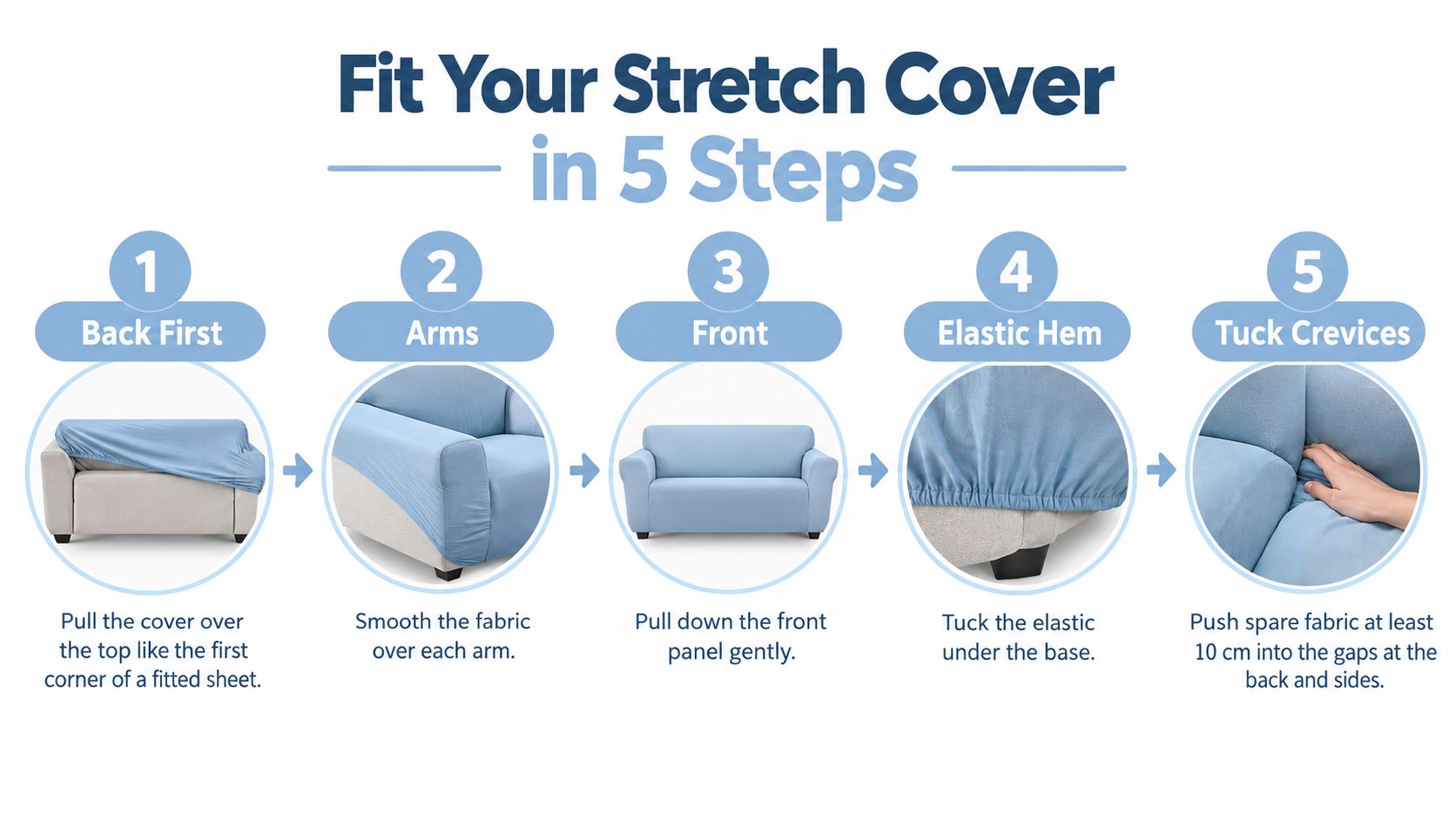
I start at the back, then do the arms, then the front, then the elastic hem under the base, and I tuck the crevices last. Starting with the seat is the mistake that makes the whole job feel like a fight, because the fabric keeps getting pulled out of shape before the frame is settled. When I fit a Classic Stretch Couch Cover from Casamé Home, I want the back anchored before I think about the seat line.
The order matters more than force
I pull the cover over the top like the first corner of a fitted sheet, then smooth the arms, then bring the front down cleanly. After that, I work the elastic hem under the base and only then do I deal with the crevices. That order keeps the fabric from loading up diagonally, which is where wrinkling and seam stress usually start.
Don't pull the seat tight. It's the most natural mistake in the world: you see a wrinkle, you pull, and the first time someone sits down, the fabric pops straight out of the crevice. The grip doesn't come from tension; it comes from the tuck. It's the same reason a sailor can hold a boat with a rope wrapped around a post: the hold comes from the wrap and the squeeze, not from pulling. So leave the seat relaxed and push the spare fabric at least 10 cm down into the gaps at the back and sides.
My secret weapon is the handle of a wooden spoon; it gets deeper than fingers ever will. If it still slips, push a foam stick or a rolled towel in on top and it's locked. That's usually the difference between a couch that looks dressed and one that looks temporary.
Practical rule: Don't judge the fit before the crevices are tucked. A cover that looks loose for five minutes can settle neatly once the spare fabric is locked below the visible line.
For a deeper troubleshoot flow, Casamé Home's couch cover troubleshooting guide is the right companion piece. The main thing to remember is that the fit is built in layers. Back first. Arms second. Tucks last.
Why the installation feels different on the day
A fresh installation often looks best once the fabric has had a day of normal use. The cover settles, the seams relax into the frame, and the tuck lines become more natural. If the fabric has to be corrected every time someone sits down, the problem is usually sizing or a weak tuck, not the idea of a stretch cover itself.
That's why a fitted-looking finish comes from restraint as much as effort. Pull too hard and the fabric fights back. Tuck well and the frame starts doing the visual work for you.
Will a Stretch Cover Fit My Awkward Sofa Shape
A stretch cover fits some awkward sofa shapes well and fails on others, and the difference comes down to whether the furniture surface moves. Loose plump back cushions are the hardest case, because a stretch cover can't grip something that shifts every time someone sits back. Fixed backs split into sections are manageable, high curved camel backs are usually easy, and deep-buttoned club-chair arms are often easier than people expect.
Shapes that need a different approach
If the sofa has loose back cushions, I remove them, fit the cover over the frame, then put the cushions back in their own cushion covers. That gives the stretch fabric a fixed structure to hold. If the back is divided into sections, I push the fabric down into each groove so the lines stay visible instead of floating loose across the backrest.
A high curved camel back is usually straightforward because the stretch fabric follows a smooth curve without fighting a sharp corner. Deep-buttoned club-chair arms are the ones that surprise people. Everyone assumes the buttons will fight the cover. They don't: a stretch cover pulls straight across the button dips and follows the roll of the arm. Those shapes are less about volume and more about whether the fabric can contour without sliding.
The problem cases are more important to say plainly than the easy ones. The two things a standard armchair cover can't handle are wings and exposed wooden arms, and furniture that relies on a module-by-module fit is outside the range too. A stock stretch cover can't properly dress surfaces that it can't grip all the way around.
A cover can hide a lot, but it can't invent attachment points that the furniture doesn't have.
For cushion-led solutions, the sofa cushion covers collection is the better path when the frame is fine but the seating surfaces need attention. That split matters. Sometimes the right answer is a whole-couch cover. Sometimes it's separate cushion covers plus a throw or two. And sometimes the sofa shape is the wrong candidate for a stock cover.
The simplest go, no-go test
Shape matters far less than people think. Two things decide the fit: every surface the cover touches has to be upholstered, and the chair has to be within the size range. On a couch, that range is the published band. If the piece has wings, exposed wood, or moving cushions that carry the load instead of the frame, stop there. That isn't a failed purchase decision, it's just the wrong product for the object.
When Should You Cover Care for or Return It
A couch cover makes sense when the sofa frame and cushions are still sound, but not when the foam has collapsed, the frame is broken, or the upholstery damage points to mould or moisture. For renters and budget-conscious households, the value is often in extending a usable sofa rather than replacing one that still has a healthy structure. Photograph the original sofa before fitting, avoid permanent alterations, and remove the cover before an inspection if you need the furniture to read as unchanged.
Care starts with the label
Washability has to be validated on the product label, because not every upholstery fabric is meant for machine washing. Some care systems allow gentle machine washing with synthetic detergent, no wringing, shade drying, and full drying before reuse, while others are meant for spot or professional cleaning. For a removable couch slipcover, follow the care label on the cover itself, and reinstall it only once it is completely dry.
The main risk is dimensional change. Heat, heavy spinning, and incomplete drying can shorten a panel, weaken elastic recovery, and leave a cover that no longer reaches the frame underside cleanly. That's why drying discipline matters as much as washing.
Rights matter when a product doesn't match the listing
For Australian online purchases, the Australian Consumer Law applies to businesses selling directly to consumers in Australia, including overseas-based online businesses, and sellers must handle consumer guarantees properly. Goods have to be of acceptable quality, match their description, and be fit for any purpose the seller has stated. A shopper doesn't get an automatic return just because the size was guessed wrong or the colour changed in daylight, but a retailer also can't hide behind a blanket no-refunds policy for faulty or misdescribed goods.
If a problem is major, the consumer can generally choose a refund or replacement. If the issue is minor, the business may be able to repair or replace the product instead. When a return is valid under consumer guarantees, the seller may ask for proof of purchase, but the product doesn't have to go back in its original packaging, and reasonable return costs already paid should be reimbursed when the seller confirms the problem.
For upholstery decisions, that combination of care discipline and consumer rights is the practical end of the story. Cover the sofa when the frame still deserves another season. Return the product when the product itself is wrong. Don't try to make a stock cover solve a furniture problem it was never built to fix.
If you want a stretch-fit cover that looks custom without the custom-premise confusion, browse the Casamé Home range at Casamé Home, then match the outside width arm to arm, choose the right band, and fit it with the back-first tuck sequence. Casamé Home sells published-size couch covers, sectional pairs, and coordinated cushion covers for Australian homes, so the right result comes from the right band and a clean install.