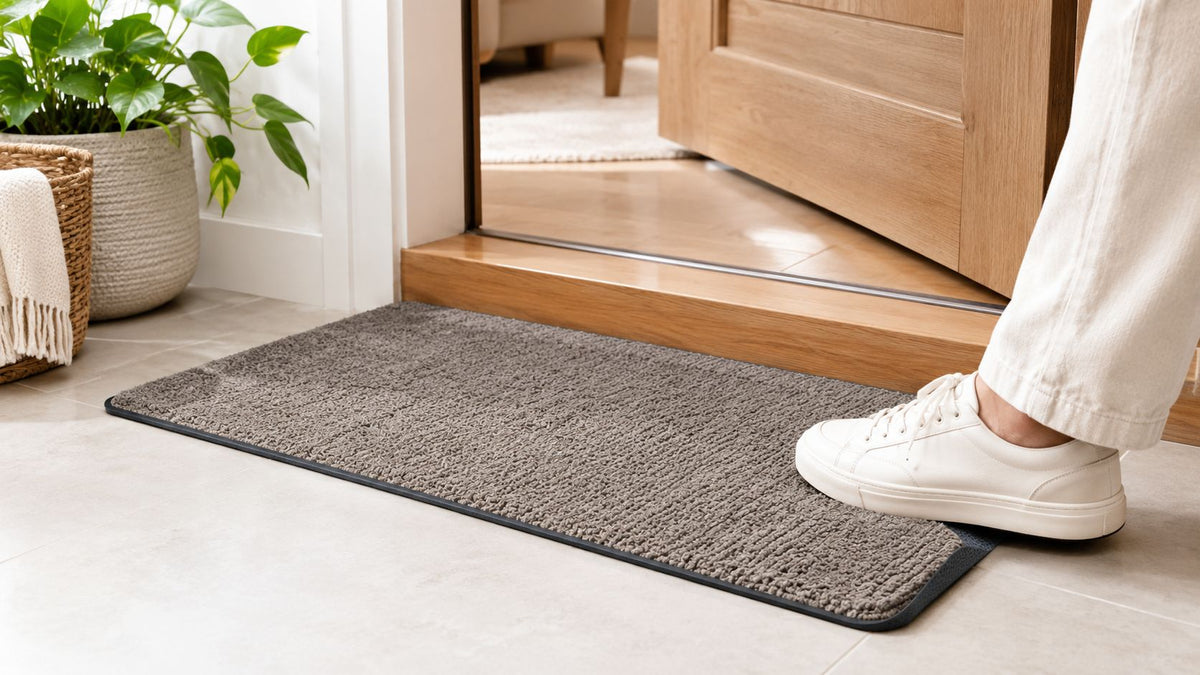
If your indoor door mat keeps skating across polished tiles, the answer isn't another glossy “non-slip” label. The mat has to match the floor, stay flat at the edges, and carry enough weight to resist the first shove from a shoe. Casamé Home doesn't sell door mats, rugs, runners, or underlay, so the blunt truth here is a practical buying guide, not a product pitch.
Table of Contents
- What Actually Stops an Indoor Door Mat From Sliding
- Why an Indoor Door Mat Moves in the First Place
- Which Mat Backing Works on Which Floor
- Why Mat Edges Lift Before the Middle Does
- Doorway Clearance, Wet Shoes, and Tracked-In Grit
- One Mat or a Two-Mat Setup at the Entry
- Buying and Care Checklist for a Non-Slip Indoor Mat
- Where Casamé Home Fits In And Where It Does Not
What Actually Stops an Indoor Door Mat From Sliding
A non-slip indoor door mat stops sliding when three things line up: the backing grips the floor finish, the mat has enough mass to resist movement, and the perimeter lies flat without curling. A tag that says “non-slip” is only useful if the underside performs reliably on your floor, not the showroom sample. On hard, smooth entry flooring, that difference is everything.
The backing has to suit the floor, not the label
A mat backing that works on textured tile can misbehave on polished timber, vinyl, or low-pile carpet. A rubber, latex, PVC dot, or felt-style reverse all behave differently, and the right match is the one that keeps contact without creeping.
Practical rule: buy for the floor finish first, then for the mat pattern, because the floor decides whether the backing holds or slides.
Australian guidance is blunt on the risk side too. Falls are a major issue, with the Australian Institute of Health and Welfare reporting 248,211 fall-related hospitalisations in 2023–24, 43% of all injury admissions, 6,698 deaths in 2022–23, and estimated annual health-system costs above A$5 billion. NSW Health also says loose mats should be removed or firmly secured with slip-resistant backing, which is exactly why the underside matters more than the packaging language. Australian Institute of Health and Welfare falls report and NSW Health home safety checklist
Casamé Home doesn't sell the thing you need here
Casamé Home sells couch covers, cushion covers, chair covers, and throw blankets, plus one anti-slip accessory for sofa legs. That means the right answer for a sliding entrance mat still has to come from the mat itself, the floor it sits on, and how the edge lies at the doorway.
Why an Indoor Door Mat Moves in the First Place
A mat moves because foot traffic pushes it sideways, moisture reduces grip, grit works like tiny rollers, and the leading edge gets peeled up first. The cleanest showroom demo won't show that, because the issue begins after a week of shoes, dust, and wet soles through the front door.
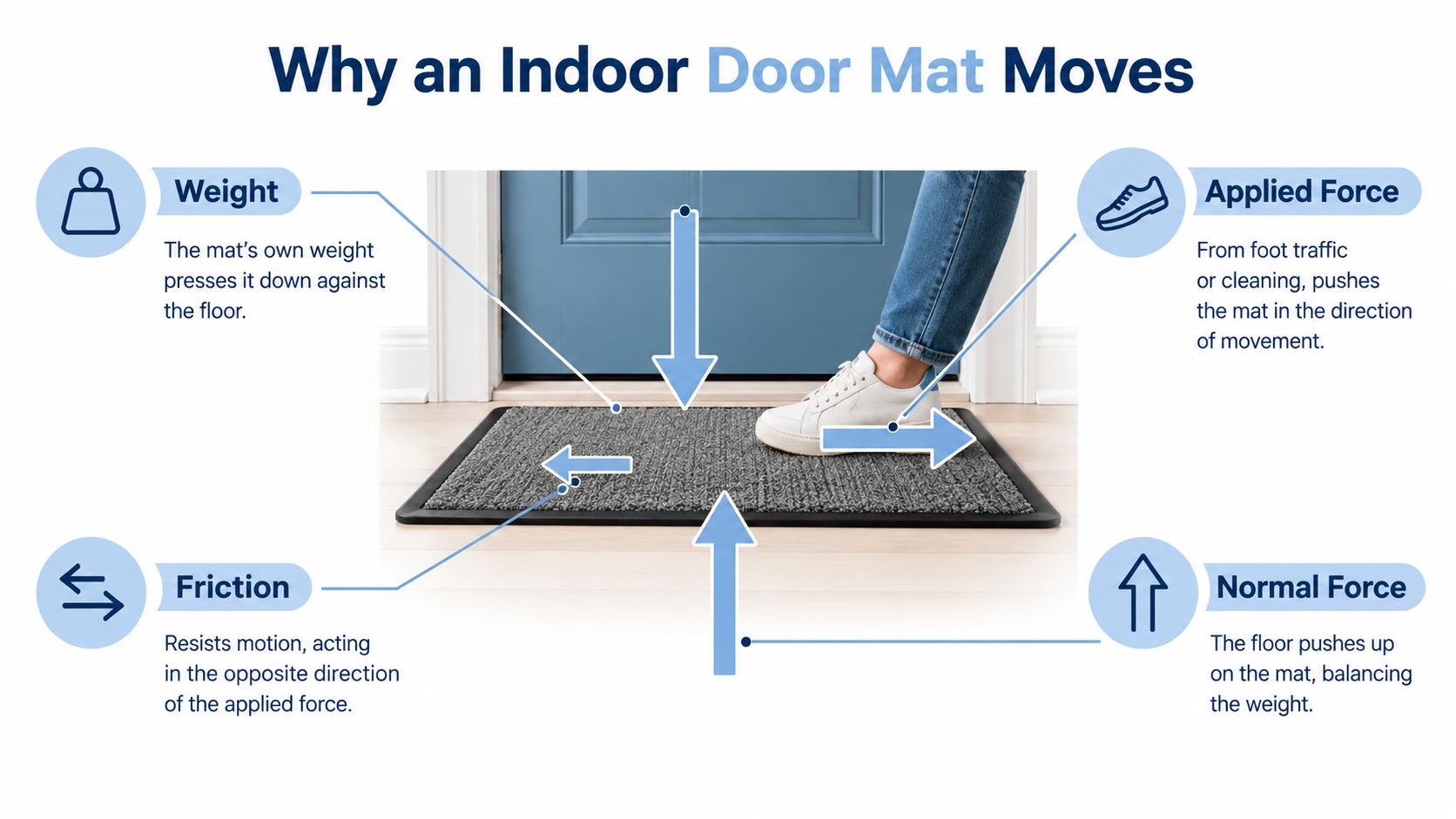
The doorway adds four forces at once
The mat takes downward weight from its own body and from the foot stepping onto it. At the same time, the floor pushes back, friction resists motion, and the shoe toe adds a sideways shove when someone turns, drags, or pivots at the threshold.
A mat that felt fine in the store can start creeping at home once the floor changes. Sunscreen residue, cooking film, polish, or a damp foot can alter the surface enough that the underside no longer bites the same way.
Moisture and grit are the real troublemakers
Wet shoes matter because they don't just make the top slippery. They also leave moisture and fine debris under the mat, and that layer can behave like ball bearings between the backing and the floor.
The Australian Government's falls-prevention guide advises removing mats and rugs or making sure they have non-slip backing or are secured with double-sided tape, and it warns against polishing floors. The safe reading is simple, if the entry is dirty or damp, the mat needs more than a claimed grip surface. Falls can be prevented PDF
Which Mat Backing Works on Which Floor
The right backing is the one that behaves on your actual floor finish, not the one that sounds strongest on the label. Rubber, latex, PVC dot, felt, and plain textile all have different failure points, and polished timber is not the same problem as ceramic tile or low-pile carpet.
Mat backing vs floor finish
| Backing type | Polished timber / bamboo | Ceramic or porcelain tile | Vinyl (sheet or LVP) | Low-pile carpet |
|---|---|---|---|---|
| Natural rubber | Often grips well, but can mark some finishes if the floor coating is delicate | Usually strong contact on smooth hard floors | Can be a good hold, but some vinyl floors don't like certain rubber compounds | Usually not the right match |
| Latex | Can hold on hard floors, but soften or creep in warmer conditions | Often serviceable if the mat lies flat | Can creep if the floor warms up or the backing softens | Usually poor |
| PVC dot | Can work on some hard floors if the dots bite evenly | Mixed performance, depending on texture and dust underneath | Often better than plain textile, but still floor-dependent | Can catch, but not ideal as a true anchor |
| Felt | Usually needs an underlay gripper on hard floors | Too slippery on its own for most entries | Not enough on its own for an entry mat | More usable on carpet, but still not a true anti-slip solution |
| Plain textile | Poor on smooth floors | Poor on smooth floors | Poor on smooth floors | Can sit better on carpet, but still needs a proper anchor |
If a mat seems fine on the shop floor, test that exact backing on your own floor before you trust it near the front door.
For a broader safety angle, the guide to bathroom slip safety sits in the same general family of wet-surface caution, but the entryway problem is different. Here you're matching floor finish, mat weight, and edge lie, not just looking for a damp-zone label.
Why Mat Edges Lift Before the Middle Does
A mat usually fails at the edge or corner first, not in the middle. That's where a shoe pivots, a curl starts, or grit builds up and creates a tiny ramp under the perimeter.
The perimeter is where the trip starts
The centre of the mat can feel planted while one corner creeps out a few millimetres at a time. Once a corner lifts, the mat stops lying flush and the leading edge becomes a toe catcher.
Key takeaway: a mat that stays flat is safer than a mat that only feels grippy in the middle.
Weight distribution matters here too. A denser mat resists the sideways tug of a turning foot better than a light mat, and a bevelled or weighted border often behaves better than a thin, feathered edge that curls back on itself.
What to look for at the edge
A flat-cut edge is usually safer than a folded or overlocked one because it's less likely to roll. A backing that runs fully to the perimeter is also better than one with a skimpy gap at the border, because the outer edge is where the movement starts.
Australian fall-prevention material also makes the same point in different words, loose mats are a hazard. WorkSafe Victoria tells workplaces to remove loose mats from walk areas and keep entrances clean, well lit and clear of obstacles, and home safety advice says mats should have non-slip backing or be secured with double-sided tape. WorkSafe Victoria slips, trips and falls
Doorway Clearance, Wet Shoes, and Tracked-In Grit
A mat that looks stable in a showroom can fail at home because the doorway is harsher than it looks. The door swings, shoes drip, and the floor picks up grit faster than you might notice.
Clearance under the door comes first
An inward-swinging door needs room to move over the mat without scuffing or binding. If the mat is too thick, the door can catch it, drag it, or leave it bunched at the edge, which is another way to create a trip point.
Wet shoes and fine grit do different damage
Wet shoes reduce grip on polished floors and can make a mat feel like it's skating. Fine grit does something quieter, it sits underneath and acts like a tiny rolling layer, so the mat shifts even when the top still looks clean.
The fix is simple, but people skip it. Lift the mat and clean underneath, don't just mop around the edges and hope the problem disappears.
Moisture control works better in layers
A practical layout for real homes is the two-mat setup, a hard scraper outside and an absorbent mat inside. That split makes sense when the entry opens straight onto a driveway, footpath, or lawn, because the outdoor layer strips off grit before the indoor layer has to deal with it.
One Mat or a Two-Mat Setup at the Entry
A single mat is enough for a sheltered, relatively dry entry. A two-mat setup earns its keep when the front door faces open weather, a driveway, or a patch of lawn that brings in mud and gravel with every step.
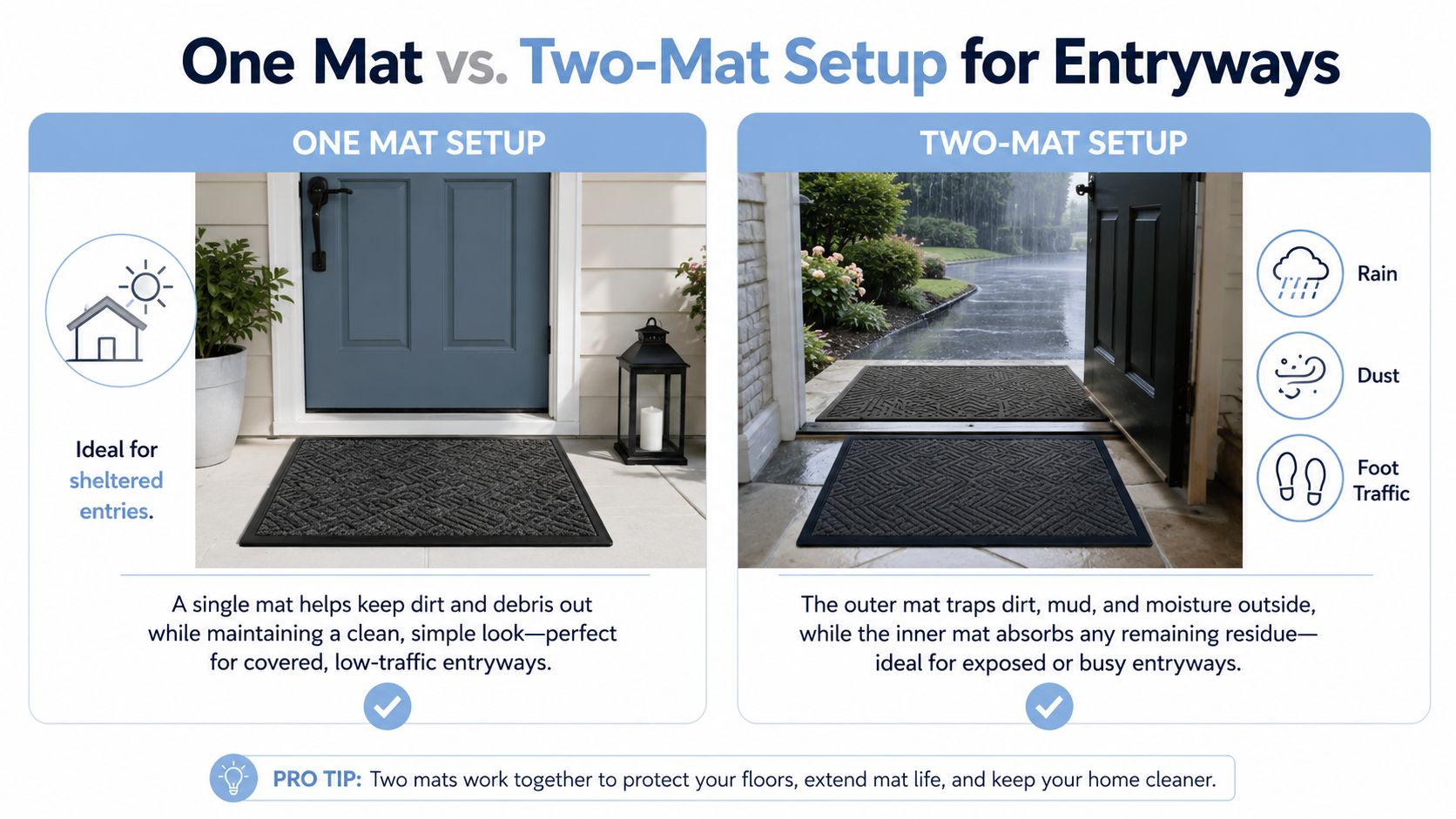
One mat does less, two mats split the work
A single indoor mat has to catch moisture and trap dirt at the same time, which is asking a lot of one surface. A two-mat entry divides the job, the outside scraper handles the rough stuff, and the indoor mat focuses on moisture and fine dust.
That split matters because a loaded indoor mat loses grip faster. Once grit builds up, the backing loses contact with the floor and the whole mat starts to wander.
The outside layer protects the inside layer
Skipping the outer mat doesn't just leave more mess indoors. It also wears the indoor mat out faster, because the backing is constantly fighting grit instead of sitting against a reasonably clean floor.
For practical design thinking around a tight entrance, the same logic that helps with an entrance bench seat guide applies here, keep the entry functional, uncluttered, and easy to clean. A mat system should support that, not fight it.
Buying and Care Checklist for a Non-Slip Indoor Mat
Buy the mat for the floor you have, not the one you wish you had. If the backing and the surface don't suit each other, the mat will move, curl, or lift no matter how “non-slip” the tag sounds.
Before you buy
- Match the backing to the floor: Use rubber or latex on hard floors only if the specific backing behaves well on your surface, and treat felt or plain textile as weak choices for smooth entryways.
- Check the edge profile: Pick a mat that lies flat at the corners and doesn't have curled, fluffy, or bulky edges that can catch a toe.
- Measure the doorway: Make sure the mat won't foul an inward-swinging door or create a raised edge where people step through.
- Judge the weight properly: A heavier, denser mat usually resists movement better than a light one that only looks substantial.
- Think about floor type: Low-pile carpet needs a different approach from tile or timber, because a hard-floor solution doesn't automatically hold on carpet.
On installation day
Put the mat down on a clean, dry floor. Press the corners flat, then open and close the door a few times to check clearance and any edge drag.
A mat should lie flat from the first day. If a corner won't settle, it won't improve on its own.
Every week after that
Lift the mat and clean underneath. That one habit removes grit before it turns into a sliding layer and stops the backing from losing contact with the floor.
If the corners start curling or the backing has hardened, replace the mat. A mat that no longer lies flat is no longer doing the safety job you bought it for. For broader care thinking around household textiles, the washable kitchen mats guide covers a different room, but the logic is similar, keep surfaces clean and functional before they become a nuisance.
Where Casamé Home Fits In And Where It Does Not
Casamé Home fits the furniture side of the house, not the doorway mat side. The range includes couch covers, cushion covers, chair covers, throw blankets, and the Anti-Slip Sofa Pads product, which is sold as one pack of 24 felt pads for under sofa legs to stop sofa movement on hardwood, tile, and laminate floors while protecting floors from scratches.
Those sofa-leg pads are not made for under a mat, not for rug gripping, and not for doorway underlay. Casamé Home does not sell door mats, rugs, runners, or underlay, so the right move for a sliding entry mat is still the same, choose the right backing for the floor, make sure the edge lies flat, and keep grit out from underneath.
If you want furniture textiles that fit the rest of the room, Casamé Home has couch covers, cushion covers, chair covers, throw blankets, and sofa-leg anti-slip pads for hard floors. For the doorway problem, use the checklist above and buy the mat that suits your floor, not the label. Visit Casamé Home if you're sorting the lounge as well as the entry.