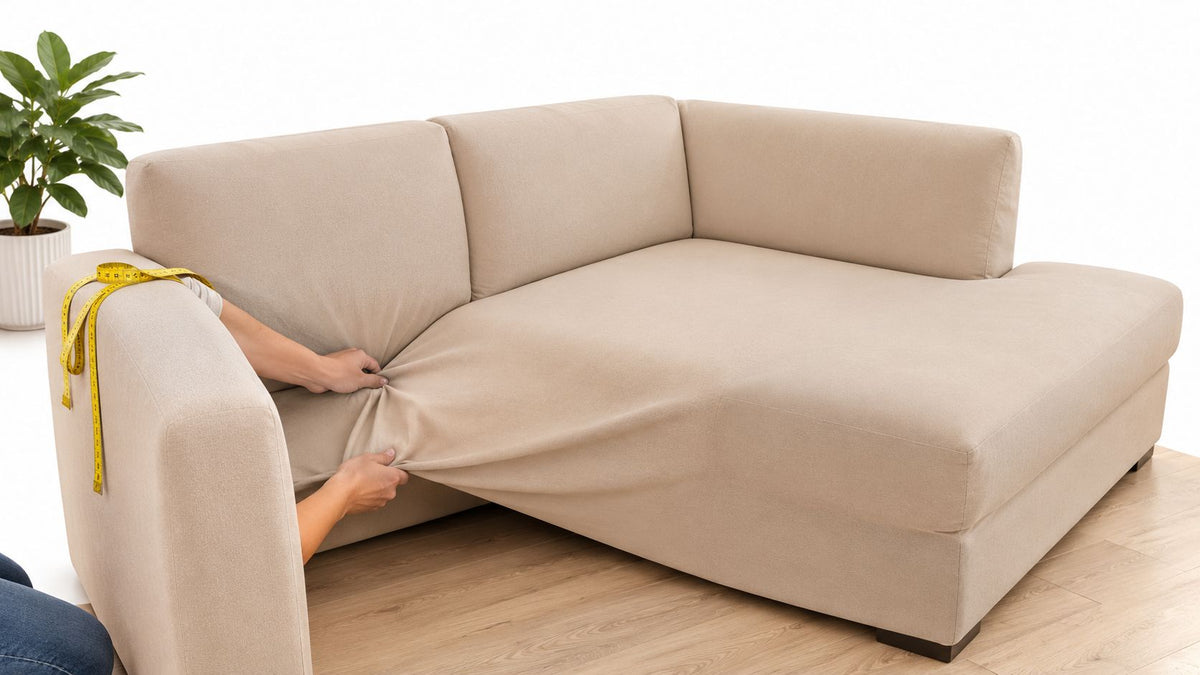
You've measured the outside width of your L-shaped lounge, but that number alone won't tell you which cover to order. L-shaped lounge covers are selected as two paired seater sizes, one for each arm of the lounge, then fitted together at the corner. Measure the longer arm first, match both measurements to the correct bands, fit each arm, and finish at the corner.
Table of Contents
- How L Shaped Lounge Covers Are Sold as Pairs
- Measuring Each Arm of the L Shaped Lounge
- Turning the Two Measurements Into the Right Paired Size
- Fitting Each Arm and Finishing at the Corner
- Using Foam Rods to Stop the Cover Creeping Loose
- Which L Shaped Cover Families and Cushion Covers Are Available
- Keeping Your L Shaped Cover Fitted Long Term
How L Shaped Lounge Covers Are Sold as Pairs
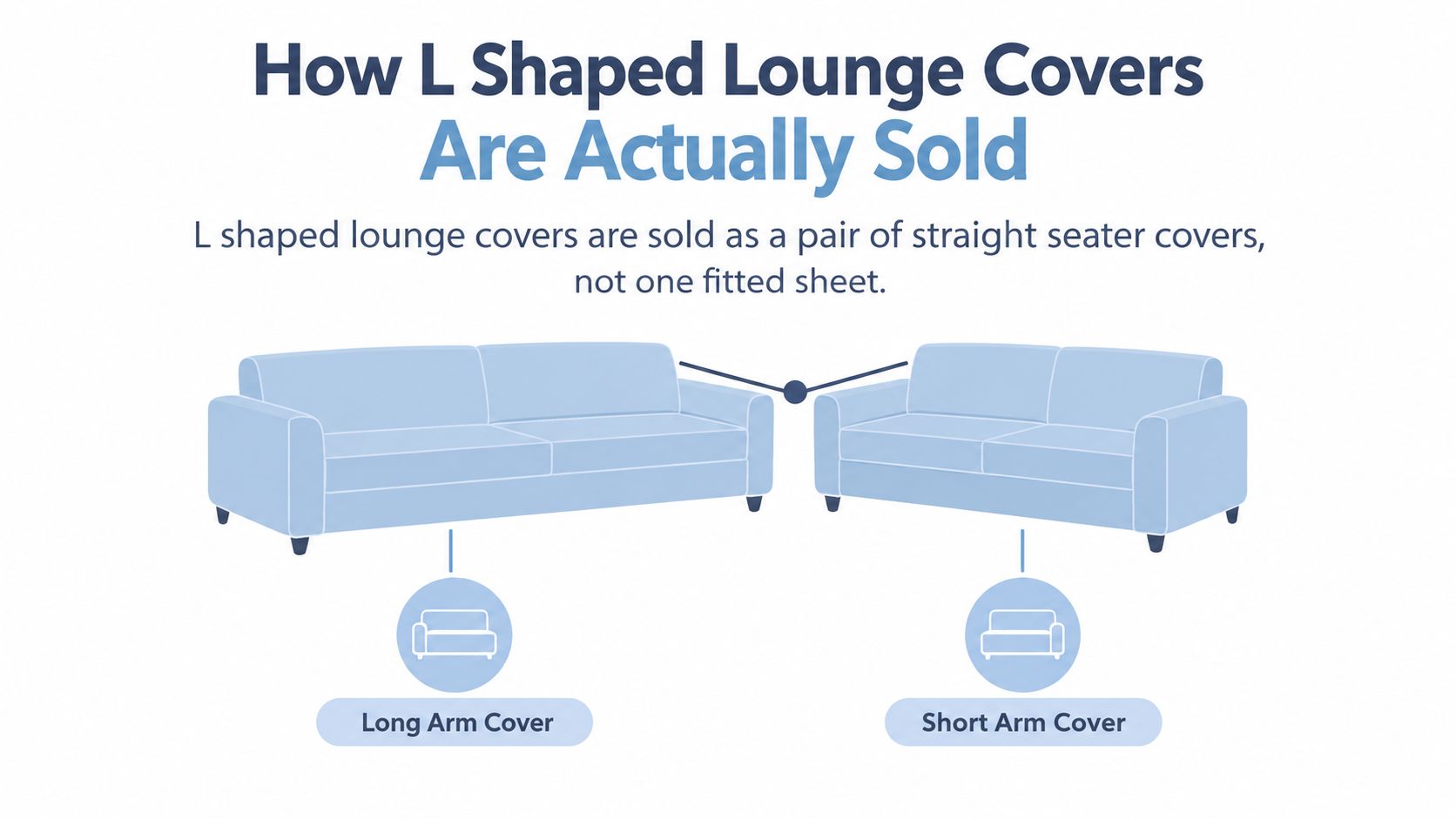
If your lounge has one longer run and a shorter return, order two covers that match those sections. Casamé Home supplies L-shaped lounge covers as a pair of straight seater covers, with one cover for each arm. Together, they meet at the corner during fitting. This paired arrangement replaces the need for one fitted sheet to wrap around the entire L shape.
The available paired sizes are:
- 1 seater and 2 seater
- 1 seater and 3 seater
- 1 seater and 4 seater
- 2 seater and 2 seater
- 2 seater and 3 seater
- 2 seater and 4 seater
- 3 seater and 3 seater
- 3 seater and 4 seater
- 4 seater and 4 seater
The two arms can fall into different size bands. For example, a main run in the 3-seater band can be matched with a return in the 2-seater band. Choose each cover from its own measurement rather than treating the lounge as one oversized sofa.
The four size bands
Each arm is matched to one of these couch-cover bands:
- 1 seater: 90 to 130 cm
- 2 seater: 135 to 175 cm
- 3 seater: 180 to 220 cm
- 4 seater: 225 to 300 cm
These ranges apply to each arm separately, measured from the outside of the arm to the inside corner. After both arms are measured, their matching seater categories form the paired size you order.
Important fit check: L-shaped covers are supplied in paired sizes rather than made to measure for each individual lounge. Measure both arms before choosing a product.
Casamé Home does not stock made-to-measure or custom-cut L-shape covers, and separate covers for individual modules are not sold on their own. The supplied cover is the selected pair.
This range is designed for two straight sections meeting at one corner. U-shaped or three-arm modular lounges require three sections and a different covering arrangement, so they are outside this paired L-shaped system.
Measuring Each Arm of the L Shaped Lounge
Measure an L-shaped lounge as two straight sofas meeting at the corner, not as one continuous piece. Measure each arm from the outside of the arm to the inside corner, then match each result to the relevant seater band.
Start by moving the lounge far enough away from the wall to see both ends and the corner clearly. Sketch the footprint on paper and label the longer arm and shorter arm.
Measure the longer arm first
Place the tape at the outside edge of the arm on the longer run. Measure across the sofa section to the inside corner where the two sides meet. Keep the tape following the measurement line, and include the arm rather than measuring only the seat cushion or the front edge.
Repeat the process for the return or chaise. You should finish with two separate numbers:
- Longer arm, measured from the outside arm edge to the inside corner.
- Shorter arm or return, measured from its outside arm edge to the inside corner.
Read each number against the cover bands:
| Seater size | Arm measurement |
|---|---|
| 1 seater | 90 to 130 cm |
| 2 seater | 135 to 175 cm |
| 3 seater | 180 to 220 cm |
| 4 seater | 225 to 300 cm |
If a measurement falls between two bands, choose the larger size for an easier tuck. That extra room gives the stretch fabric somewhere to go inside the seat-to-back and seat-to-arm gaps. A smaller size has less fabric to tuck and can pull away from the corner.
Avoid the measurements that mislead
Don't measure the whole L as one width. Don't measure only the straight front edge, because that ignores the corner relationship and arm thickness. There is no left-hand or right-hand version to choose, so the two arm measurements are all you need.
For broader furniture-measuring background, keep these accurate sofa measurement tips separate from the L-shaped method above. The important point here is specific to the pair system: one arm produces one size, and the other arm produces the second size.
Turning the Two Measurements Into the Right Paired Size
Write the longer arm first, then the return arm. Once both measurements sit inside their bands, convert them directly into one of the nine available pairs.
For example, a longer arm measuring 195 cm falls within the 3-seater band, while a return measuring 160 cm falls within the 2-seater band. The correct order is therefore 2 seater and 3 seater, meaning one 3-seater cover and one 2-seater cover. It isn't one cover spanning the full L, and it isn't automatically two covers of the same size.
Use the pair, not the overall width
| Main run arm | Return arm | Paired size to order |
|---|---|---|
| 1 seater | 2 seater | 1 seater and 2 seater |
| 1 seater | 3 seater | 1 seater and 3 seater |
| 1 seater | 4 seater | 1 seater and 4 seater |
| 2 seater | 2 seater | 2 seater and 2 seater |
| 2 seater | 3 seater | 2 seater and 3 seater |
| 2 seater | 4 seater | 2 seater and 4 seater |
| 3 seater | 3 seater | 3 seater and 3 seater |
| 3 seater | 4 seater | 3 seater and 4 seater |
| 4 seater | 4 seater | 4 seater and 4 seater |
Between sizes, choose the larger size for an easier tuck. A cover that is slightly generous can be pulled into the crevices and secured. A cover that is too small creates tension in the wrong places, especially where the two pieces meet at the inside corner.
A measurement of 176 cm, for example, sits just above the 2-seater band and below the 3-seater band. Use the larger 3-seater size for that arm rather than trying to stretch a 2-seater cover beyond its range.
Before ordering, write the pair in the same order every time:
- Longer arm: record the seater size.
- Return arm: record the seater size.
- Final check: confirm that the pair appears in the table.
That last check prevents a common ordering mistake: choosing two matching sizes because the lounge looks broadly symmetrical when the two arms measure differently.
Fitting Each Arm and Finishing at the Corner
A stretch cover isn't held on by tension. It's held by the tuck, the same way a fitted sheet is held by its corners. With paired l shaped lounge covers, the inside corner is where both pieces meet, so it is the part you fit last. Lay both pieces out before anything touches the sofa, and work out which goes where.
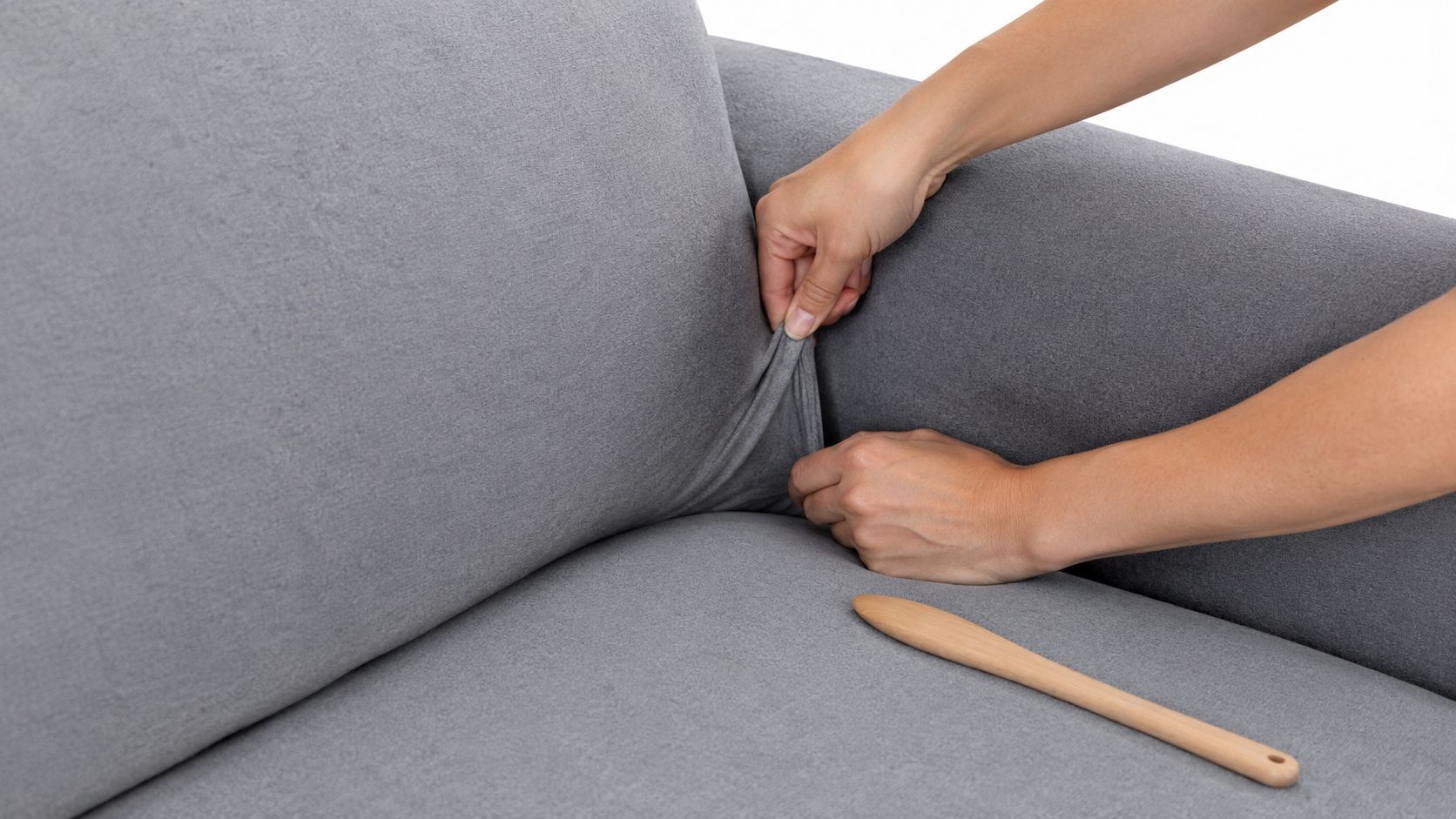
Fit each section fully except the corner, then do the corner once, at the end. Fit the longest section first and get it perfect, pulling the fabric down into the crease where the seat meets the back and tucking as you go. Then fit the second piece the same way along the return. Keep both covers centred over their backs and arms while you adjust them.
Finish with the corner. Push both pieces deep into the corner gap, one over the other, the way you'd tuck in a bed, and the join disappears. Keep a wooden spoon handy. The handle pushes fabric deeper into the corner than fingers ever will.
The tuck is the mechanism
Don't pull the seat tight. Each time someone sits down, the cushion presses against the fabric and draws a little of it back out of the seat-to-back gap. Fabric left above that gap will gradually work loose, even when the cover initially looks smooth. Leave the seat relaxed and push the spare fabric at least 10 cm down into the gaps at the back and sides.
Dylan S., reviewing the Classic Stretch L-Shaped Sofa Cover in Black, said: "Took me a minute to sort out how to fit it properly since it's adaptable but once it's on, it looks like it was made for my sofa!"
Use this fitting order:
- Lay both pieces out: work out which goes where before anything touches the sofa.
- Fit the longest section first: pull it over its back and arm, tucking as you go.
- Fit the second piece: work it along the return the same way, leaving the corner for last.
- Finish with the corner: push both pieces deep into the corner gap, one over the other.
- Check the join: confirm that neither piece has pulled away from the corner.
Make it a two-person job. One holds the cover on the back while the other pulls it over the arm.
Press the corner tuck firmly with your palm and check that it stays below the cushion edge. The fabric is then positioned correctly for the anchors that keep the fit secure during use.
Using Foam Rods to Stop the Cover Creeping Loose
Foam Rods hold the tucked fabric inside the lounge's crevices, so the stretch cover is less likely to creep back out during everyday sitting. Insert them after the corner and both arms have been pulled into position.
Start at the inside corner. Push a rod down into the seat-to-back gap over the tucked fabric, making sure the fabric is deep enough that the rod sits below the visible edge of the cushions. Then continue along each arm where the seat meets the back.
Place the rods where the fabric wants to escape
The corner deserves the first rod because it receives movement from both directions. Add rods along the main run and return wherever the cover begins to lift or where a back cushion rests over the tucked section.
A back-cushion gap can act like the same holding pocket. If fabric sits between the back and seat cushions, push a rod into that gap rather than leaving the tuck exposed.
Three common signs point to a missing anchor:
- The cover looks neat on day one but shifts by day three: the tucked fabric is being pushed out during use.
- The inside corner pops up when someone sits there: the corner tuck needs support from below the cushions.
- The chaise end rides upwards: the return section needs a rod in the seat-to-back or under-cushion gap.
These problems don't automatically mean the paired size is wrong. Check that the two arm measurements were matched correctly, then inspect the tucks before ordering a different size. A correctly selected cover can still loosen if the fabric has nowhere to stay inside the crevice.
You can use Foam Rods at the corner and along the arms. Push them in firmly, but don't force them against a hard frame or mechanism. After the cushions are replaced, run your hand along the join and check that the cover remains tucked rather than bulging visibly above the seat line.
Which L Shaped Cover Families and Cushion Covers Are Available
Once the paired size is settled, choose the cover family by appearance and finish rather than trying to compensate for a measurement problem with fabric choice. Every family still depends on the same two-arm sizing and the same fitting method.
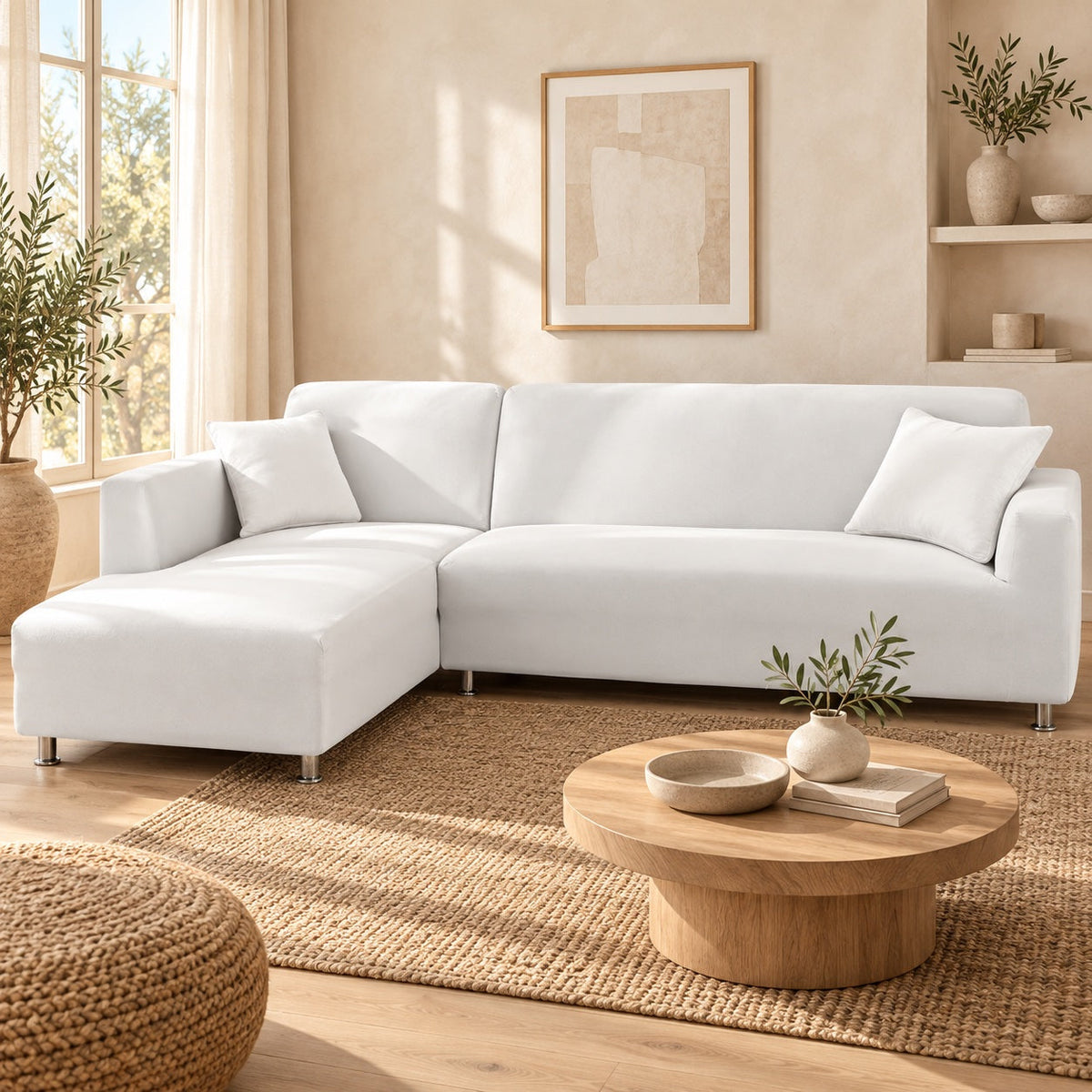
The L-shaped sofa cover collection includes the Classic Stretch L-Shaped Sofa Cover in Alabaster White, Ocher, Cherry Red, Malachite Green, Night Blue, Linen Beige, Clay Grey, Plum, Mouse Grey, Garnet Red and Black. The Classic Stretch L-Shaped Sofa Cover in Black is one representative option.
Choose the family after measuring
The Velvet L-Shaped Sofa Cover (Stretch Fit) offers a softer-finish look. The Crosshatch, Flecked and Luma L-Shaped Sofa Covers (Stretch Fit) provide textured alternatives without changing the paired-size process.
The printed designs are Esagonali, Asio, Automne, Printemps, Vintage, Azrose and Folige. Treat these as style choices after confirming both arms, because a print won't correct a return that has been placed in the wrong size band.
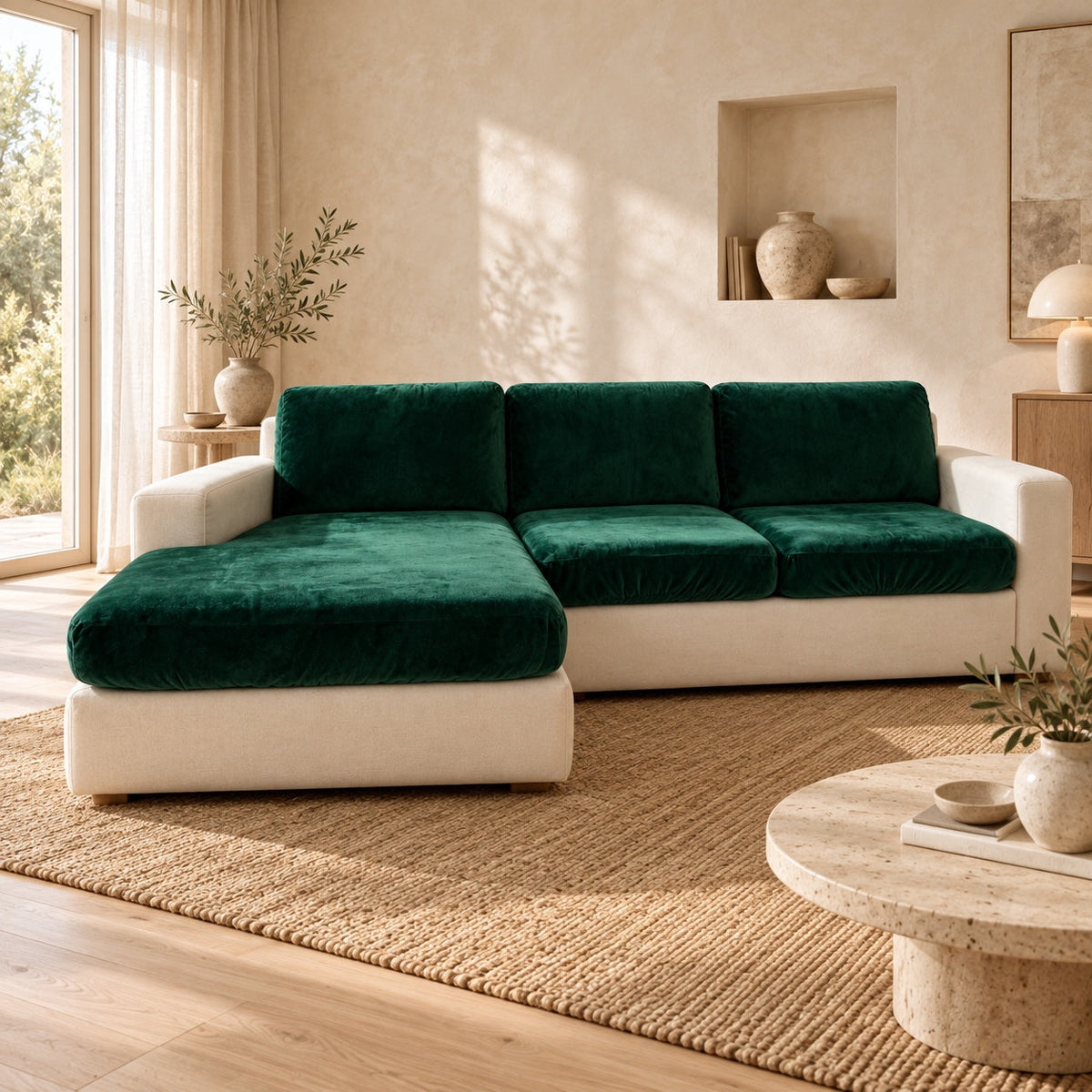
Matching Couch Cushion Covers are available for seat and back cushions in Standard, Deep, Chaise Narrow and Chaise Wide sizes. Use the cushion measurements separately from the L-shaped lounge measurements. A well-fitted body cover can still look unfinished if the original cushion fabric remains exposed or the cushion cover doesn't match the depth of the cushion.
Casamé Home doesn't stock made-to-measure or custom-cut L-shape covers, and it doesn't sell per-module L-shape covers individually. The available L-shaped product is the paired size.
There is no cover for a U-shaped or three-arm modular lounge. The L-shaped range is for two arms meeting at one corner.
There are no cushion inserts. Cushion covers only are supplied, so retain your existing seat and back cushion inserts when using the matching cushion covers.
Keeping Your L Shaped Cover Fitted Long Term
A fitted L-shaped cover stays orderly when the corner tuck is deep and the foam rods stay in the crevices. The tuck holds the fabric on the lounge, while the rods stop everyday movement from drawing it back out.
If the cover begins to loosen, inspect the inside corner first. A cover ordered too small will fight the tuck, while a cover between sizes should follow the rule that says between sizes, choose the larger size for an easier tuck.
Measure the longer arm first, measure the return separately, read both numbers against the centimetre bands, and order the paired size that matches both. Use the L-shaped collection for the body cover and the cushion-cover collection for Standard, Deep, Chaise Narrow or Chaise Wide cushions.
Measure both arms of your lounge, longer arm first, then choose the paired seater size, fit each arm and finish with the corner tuck. Visit Casamé Home to select an L-shaped cover, matching cushion covers and Foam Rods for a fit that stays organised through everyday use.