


You've topped up your above-ground pool, skimmed out the leaves, and found the water level low again the next morning. A properly selected pool cover for an above-ground pool can reduce evaporation, keep debris out and help retain heat, but it cannot replace compliant fencing or a permanent safety barrier in Australia. That distinction is where many owners make an expensive and potentially dangerous mistake.
Table of Contents
- What Pool Covers Actually Do for Above Ground Pools
- Which Cover Type Solves Your Specific Problem
- How to Measure Your Above Ground Pool Correctly
- Installing Your Cover So It Stays Put in Wind
- How Much Water and Energy Will You Actually Save
- Maintaining Your Cover to Maximise Its Lifespan
What Pool Covers Actually Do for Above Ground Pools
A cover manages water and maintenance. It does not control legal access to the pool. Under Western Australian guidance, a swimming or spa pool deeper than 30 cm requires a compliant safety barrier. Above-ground walls count only when they meet the required height and technical conditions. A lockable cover cannot replace that barrier, as the Western Australian pool and spa rules make clear. Treating a cover as a safety solution can leave an owner with non-compliant equipment and an unsafe pool.
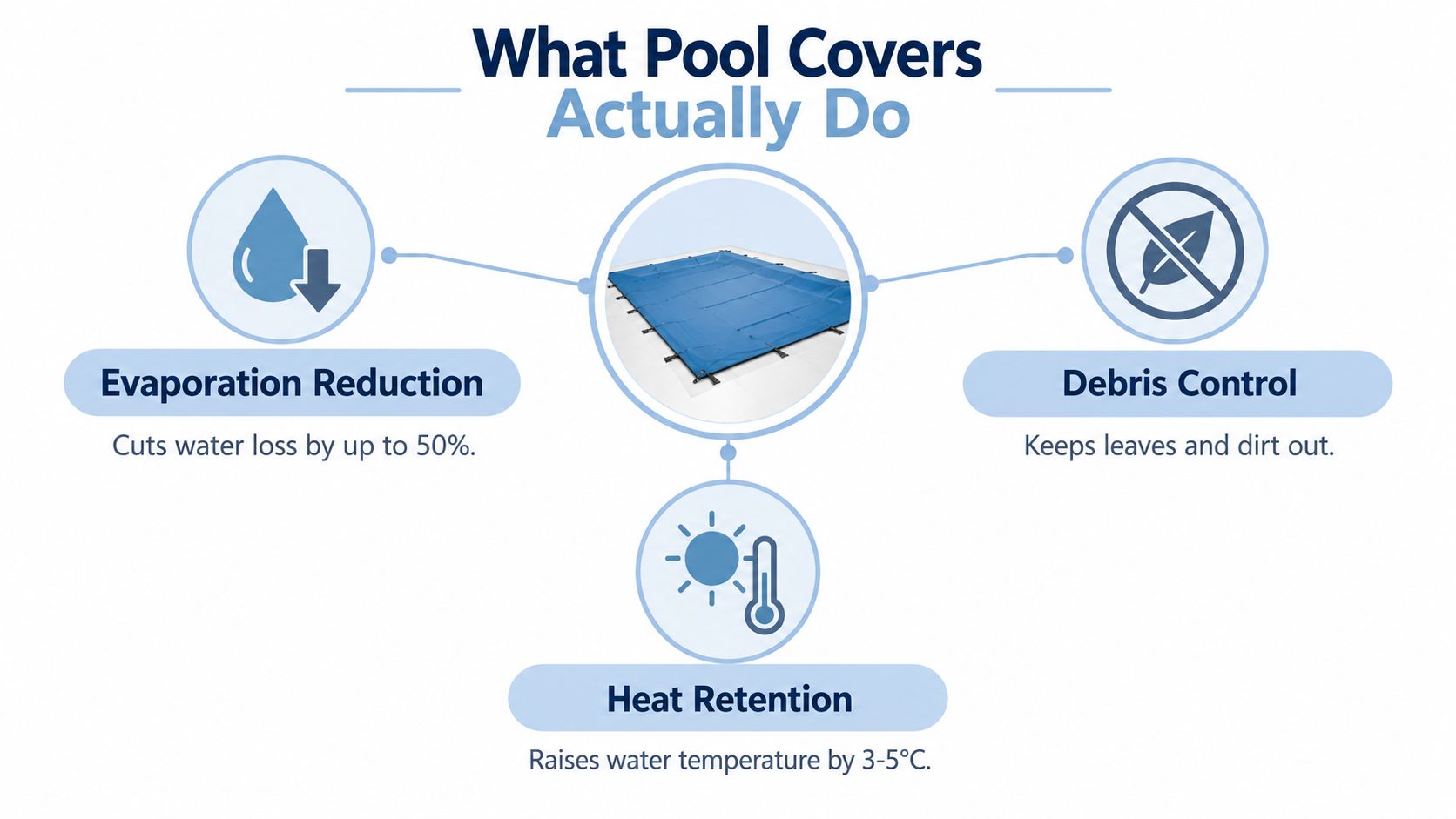
What does an above-ground pool cover protect against?
A cover forms a physical layer over the water. Water Corporation describes the arrangement as wrapping over the pool and fastening like a shower cap. That fitted layer interrupts wind across the surface, reduces direct sunlight and keeps leaves, insects and airborne dirt from falling straight into the pool. Its evaporation prevention guidance for pool owners explains how this setup limits water loss.
Australian guidance commonly cites evaporation reductions of up to 97% when a pool is covered. One Australian guide reports that a typical 32-square-metre pool in Brisbane can lose about 62,400 litres of water per year, while a 40-square-metre pool can save more than 53,200 litres annually when covered. Those figures appear in Australian pool-cover guidance, and the same evaporation factors affect exposed above-ground pools.
Practical rule: Buy a cover to manage evaporation, debris and heat loss. Keep the compliant barrier system responsible for preventing unsupervised access.
Above-ground pools are often installed in open yards with little shelter. Wind carries dust and leaves across the water while increasing evaporation. A cover performs best when fitted before extended periods of non-use, then removed completely before anyone swims. Leaving it loose or partly over the pool creates a different maintenance problem and can allow water to collect on top.
Covers also reduce cleaning work, but they do not remove the need for filtration, water testing or skimming. Their job is to stop much of the contamination entering in the first place. The same principle applies to garden furniture waterproof cover ideas, although pool covers need purpose-built materials, sizing and fastening systems.
Which Cover Type Solves Your Specific Problem
A solar blanket is usually the right choice for evaporation and basic heat retention, while a debris cover suits leaf control and a compliant barrier remains essential for safety. No single cover type performs every job equally well, so choose according to the problem you're trying to solve.
| Cover Type | Primary Function | Material | Best For |
|---|---|---|---|
| Solar blanket | Reduce evaporation and retain heat | Bubble-style floating material | Open, exposed pools where water loss is the main concern |
| Thermal cover | Insulate heated water | Dense insulating material | Heated above-ground pools where heat retention matters |
| Debris cover | Keep leaves and dirt out | Mesh or solid cover material | Pools beneath trees or in dusty yards |
| Safety cover | Add a controlled covering layer | Reinforced, purpose-designed material | Owners needing secure operational control, never as a fencing replacement |
Is a solar blanket enough for an above-ground pool?
A solar blanket is suitable when water loss and heat retention are your priorities, but it offers limited protection from heavy debris and isn't a child-safety barrier. Its bubble-style construction floats directly on the water and reduces the exposed surface, making it a practical daily-use option.
Solar blankets are easy to remove, but that convenience creates a common failure point. Owners often leave the blanket partly folded across the pool while someone is using the water. That creates an obstruction and doesn't satisfy the requirement for controlled access. Remove it fully, keep swimmers out during removal, and store it where it won't block supervision.
When is a thermal cover worth choosing?
A thermal cover makes more sense for a heated pool where retaining warmth is more important than keeping the purchase price low. Its denser construction generally provides stronger insulation than a basic solar blanket, but the added material can make handling more demanding.
A debris cover works differently. It keeps leaves, insects and larger particles off the water, but a mesh design may allow fine dust and water through, while a solid design may require active management of rainwater collecting on top. Don't buy a debris cover expecting it to deliver the same evaporation performance as a fitted floating cover.
Safety covers need especially careful interpretation in Australia. A hard or lockable cover isn't a permanent barrier, and South Australian guidance states that a cover over a pool or spa doesn't satisfy the Regulations because there is no barrier when the cover is removed. For broader ideas about combining pool access control with outdoor design, these Ottawa pool enclosure tips provide useful enclosure context, although Australian state requirements remain the authority for an Australian property.
How to Measure Your Above Ground Pool Correctly
Measure the outside dimensions of the above-ground pool structure, then confirm the cover's required overlap and fastening allowance with the manufacturer. Measuring only the visible water surface is the mistake that leaves many covers too small to secure properly.
Which dimensions should you record?
For a round pool, measure across the widest point from outer wall to outer wall. Take the measurement in more than one direction because a frame can be slightly irregular, especially after installation or movement.
For an oval pool, record the full outside length and full outside width. For a rectangular pool, measure both outside length and outside width, including the wall or frame rather than stopping at the waterline. A cover needs to sit over the pool edge and connect to its fastening points, so the structure matters more than the water surface alone.
Measure the wall and top-rail arrangement as well. Record the distance from the top rail to the bottom of the pool wall, then note ladders, built-in steps, skimmer boxes, rails, posts and any fittings that sit outside the main shape. These features can determine whether you need a custom cut, a larger cover or a separate access arrangement.
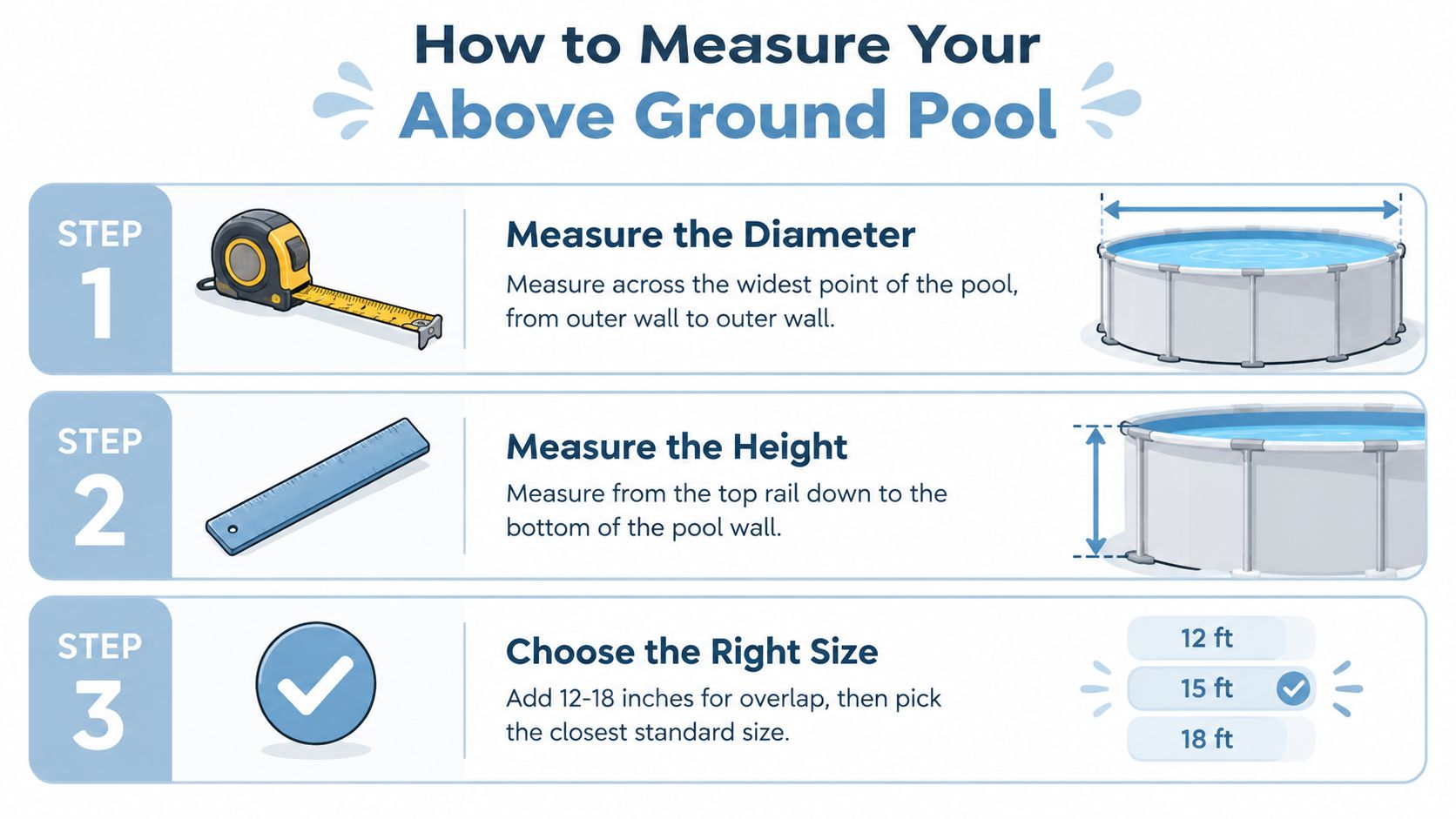
What should you check before ordering?
Use this checklist before you place the order:
- Pool shape: Confirm whether the pool is round, oval or rectangular.
- Outside dimensions: Measure the frame or wall, not just the water.
- Top rail: Record its width and whether it has unusual curves or supports.
- Wall height: Measure from the top rail down to the bottom of the wall.
- External fittings: Mark ladders, steps, skimmer boxes, posts and pipes.
- Overlap allowance: Follow the manufacturer's recommended allowance for securing the cover.
- Fastening points: Identify where straps, cable systems, clips or anchors can safely attach.
Don't assume a standard catalogue size will suit a pool with a projecting ladder or external skimmer. Send a sketch and photographs to the supplier when the configuration is unusual. A simple drawing can prevent a cover arriving with the correct length but the wrong attachment position.
The same disciplined approach applies to other fitted protective products. These fitted sofa slipcover measuring tips illustrate why measuring the underlying structure, rather than guessing from appearance, produces a better fit. For pools, the consequence of poor measurement is more serious because a loose or undersized cover can shift in wind and become difficult to manage.
Installing Your Cover So It Stays Put in Wind
Wind is the main reason above-ground pool covers shift, crease, tear or pull away from the edge. Fit the cover with the manufacturer's fastening system, secure it longitudinally where the design allows, and never depend on loose weights alone in an exposed backyard.
Australian pool-safety guidance recommends fastening devices that provide longitudinal fixing, which helps reduce the chance of the cover being dislodged in strong winds. Follow the product instructions for fitting and removal. A pool cover is a water-saving and debris-control product, not a substitute for compliant isolation fencing or supervision. Check the Royal Life Saving and Australian pool safety guidance against your cover manufacturer's instructions before installation.
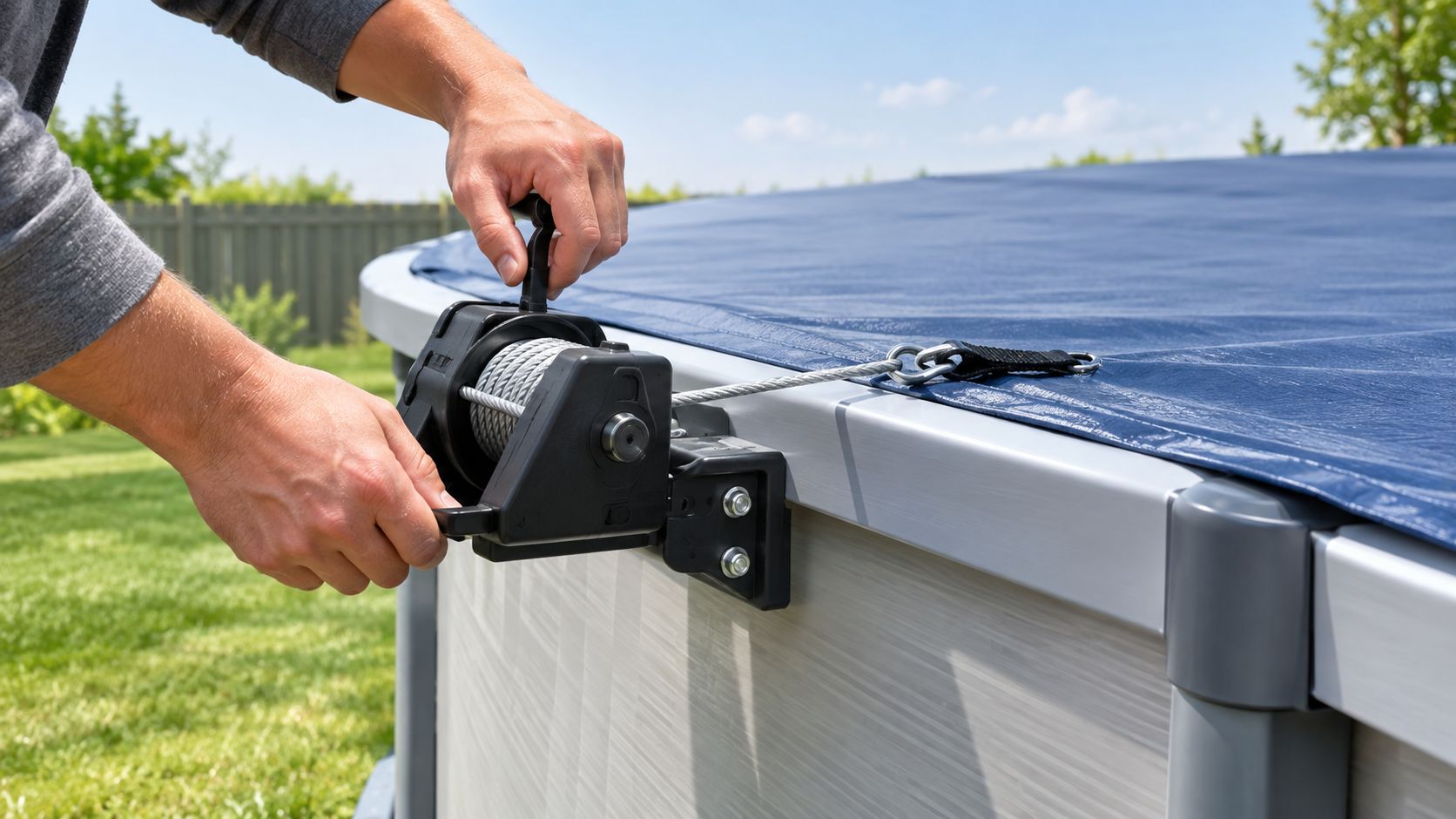
How do you fit a cover without creating wind pockets?
Install in calm conditions. Clear branches and sharp debris from the top rail, check the cover for existing damage, then centre it so the overlap is even around the pool. Uneven overlap puts more tension on one side and gives wind an easier edge to lift.
On a round pool, a cable and winch system can draw the cover evenly around the perimeter. Feed the cable through the correct loops, keep it at the height specified for the product, and tighten it in small stages. Tightening one section fully while another remains loose distorts the edge and creates a wind pocket.
Rectangular pools commonly use straps, buckles or fixed attachment points. Work across opposite sides and tension progressively, keeping the cover centred as you go. If the pool lacks dependable attachment points, water-bag anchors may work, provided they cannot damage the wall or create a trip hazard.
A cover that flaps loudly in a breeze is not settling in. Reposition it, correct the tension or improve the fastening.
The surface should remain reasonably taut, without constant excessive strain on the fabric or seams. Do not allow deep water to collect on top. The added weight can deform the cover and transfer stress to the pool structure. Inspect it after the first windy period, then adjust the fastening before minor movement becomes a tear.
What should you do when the cover is partly removed?
Treat partial removal as a loss of access control. Do not allow swimming while any part of the cover remains over the water, and do not leave a folded section blocking your view of the pool.
Storage also affects safety. Keep the removed cover and its storage frame clear of the waterline, supervision paths and walking areas. Australian safety guidance specifies storing them at least 2 m from the water edge. This keeps the pool visible and reduces the chance of someone tripping over the folded cover beside the pool.
How Much Water and Energy Will You Actually Save
Your savings will depend on evaporation conditions, sun, wind, shading, heating and how consistently you use the cover. A cover used only occasionally can't deliver the same result as one fitted whenever the pool is not in use.
The strongest water-saving results occur where hot, dry or windy conditions drive evaporation. Australian guidance cites up to 97% evaporation reduction when a pool is covered, while Australian pool-cover research has also estimated that up to 95% of evaporation loss can be prevented and that about 93,100 litres can be saved annually for a Sydney pool. These figures come from different sources and conditions, so treat them as benchmarks rather than a promise for every backyard.
The Australian aquatic-centre energy and water study notes that pool-cover heating-cost savings can range from roughly 52% to 86% across Australian capitals, with savings falling substantially under heavy shade. The same source discusses more modest outcomes in aquatic-centre contexts, including around 3% energy reduction and 1.2% water reduction, which reinforces the need to compare like with like. A domestic above-ground pool in full sun and wind isn't the same operating environment as a large aquatic centre.
Which conditions increase the return?
Perth provides a clear example of why climate matters. Australian pool guidance estimates that a 9.2 by 4.5 metre pool in Perth can lose roughly 344 litres per day during the summer swimming season when exposed. That rate makes consistent covering particularly valuable, especially where the pool is heated or water replacement is inconvenient.
Use this practical assessment:
- High evaporation: Covering should be a high priority if the pool sits in full sun and wind.
- Heated water: A thermal or solar cover can reduce heat escaping from the surface.
- Heavy shade: Savings may be less pronounced because the pool receives less direct solar load.
- Seasonal use: A cover still protects the pool between swims, but the value depends on how often the pool would otherwise be exposed.
- Frequent swimming: Choose a system that's easy to remove and replace, or you'll stop using it.
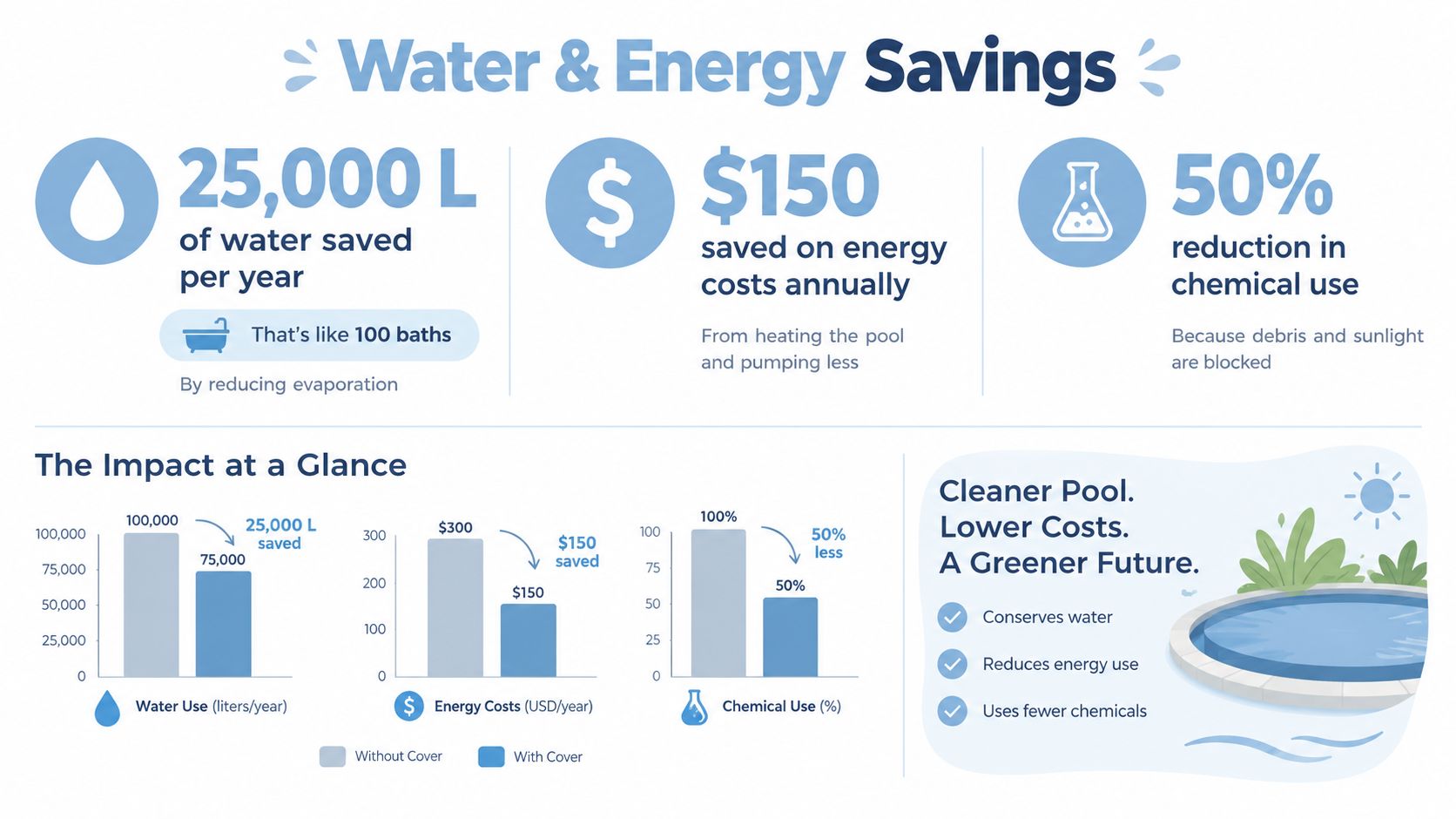
The sensible calculation is simple. Start with your pool's current top-up pattern, note how much water you add over a representative period, then compare covered and uncovered periods under similar weather and usage. Don't count every reduction as evaporation, because leaks, splash-out and backwashing have different causes. A cover pays back fastest where evaporation is high, heating is regular and the fastening system is convenient enough to use every day.
Maintaining Your Cover to Maximise Its Lifespan
Clean, dry, inspect and store the cover correctly, because UV exposure, wind movement and trapped moisture cause more failures than normal use. Maintenance starts with removing leaves and branches before they grind into the material or pull at the seams.
Rinse the cover with fresh water and use a soft brush or sponge when needed. Avoid abrasive tools, harsh solvents and chemicals that the manufacturer doesn't approve. A leaf rake designed for pool covers is safer than dragging sharp garden tools across the surface. Check seams, eyelets, straps, clips and cable channels each time you clean it.
How should you store a removed cover?
Remove the cover completely, allow it to dry on both sides, then fold it according to the manufacturer's method. Damp folds encourage mould and unpleasant odours, while careless stuffing can crease or stress the same areas repeatedly. Keep the stored cover away from sharp edges, pests, direct sunlight and chemicals.
The same principle applies to fabric protection generally. This guide to couch cover cleaning shows why following material-specific cleaning instructions matters. Pool-cover fabrics need the same respect, but their chemical and water exposure makes the product instructions especially important.
Repair small punctures or tears with a repair kit approved for the material, and inspect the surrounding area for stretching. A patch won't solve a cover that has widespread UV brittleness, split seams or repeated wind damage. Replace it when the fastening points no longer hold securely or the material can't remain intact during normal handling.
Keep a simple seasonal routine:
- Before regular use: Clean, inspect and test every fastening point.
- During windy periods: Check for shifting, flapping edges and strain around eyelets.
- After storms: Remove debris, drain collected water safely and inspect seams.
- Before storage: Wash, dry completely, fold carefully and store off the ground.
These habits won't turn a lightweight cover into a permanent barrier. They will, however, help the cover perform its proper job reliably while your compliant fencing and supervision procedures manage pool safety.
If you're protecting other parts of your Australian home from everyday wear, Casamé Home offers washable, pet-friendly sofa covers, waterproof options and cosy throw blankets for practical living-room updates. Visit Casamé Home to find protective covers designed for busy households, renters and homeowners who want a cleaner, more comfortable space without replacing their furniture.


