


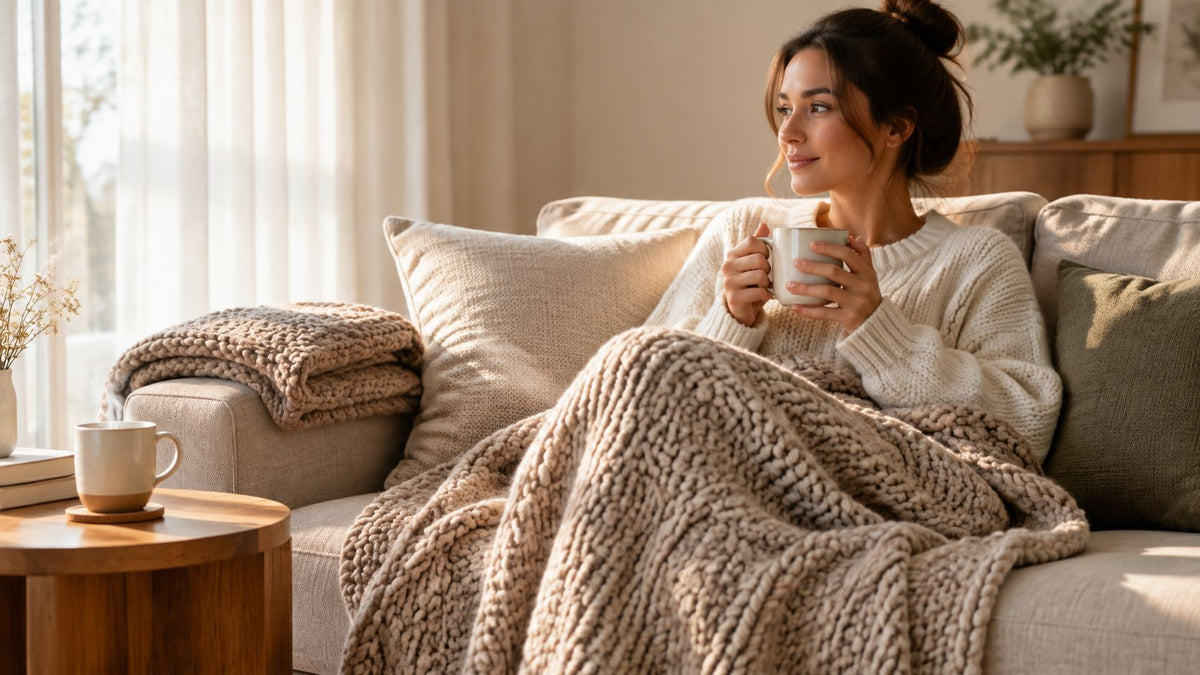
Yes, you can absolutely use a throw as a blanket. Around 742,000 blanket and travelling-rug units were consumed in Australia in 2024, which reflects the continuing practical role of blanket-like coverings in Australian homes. The honest qualifier is that a throw only works well when its size, fabric weight and day-to-day purpose match the person, room and season.
That matters on a chilly sofa, in a rental with limited linen storage, or during a humid evening when a thick doona feels excessive. A compact decorative throw can warm your lap while you watch television, but it won't replace full bed coverage. A large wool or fleece throw can act as a genuine single-person blanket, particularly when layered over existing bedding.
Table of Contents
- Can You Use a Throw as a Blanket
- What's Different Between a Throw and a Blanket
- Where a Throw Works in Place of a Blanket
- How to Pick a Throw That Actually Feels Like a Blanket
- Washing, Care and Storage the Australian Way
- The Australian Tradition Behind Throws as Warmth Layers
- Your Quick Buying Checklist Before You Choose
Can You Use a Throw as a Blanket
Yes, a throw can serve as a blanket for sofa lounging, naps, guest layering and light bed warmth, but a small throw isn't a substitute for full-size sleeping coverage.
Start with the job. For one person reading on the couch, a throw that covers the torso and legs may be completely adequate. For overnight sleeping, check whether it reaches from the shoulders to the feet and whether its width allows movement without leaving the body exposed. A throw placed across the lower half of a bed is useful as an extra layer, but it should be treated as supplementary unless its dimensions provide comfortable full-body coverage.
Fabric changes the result. Cotton and linen feel breathable in humid conditions, while wool, fleece and dense knits generally provide more winter warmth. A lightweight cotton throw may be ideal beside an open window in summer, yet disappointing as the only covering during a cold inland night. Families should also inspect the stitching, edge finish and care label before choosing a throw for daily use.
Practical rule: Buy for the person and the task first, then choose a colour that suits the room.
Throws work especially well in Australian rentals because they're portable, easy to fold and useful across several rooms. You can move one from the lounge to a spare bed, caravan or covered outdoor area without storing a bulky bed blanket. If you're organising temporary family or travel equipment as well, baby and beach gear rental tips can help with the broader question of what to rent rather than permanently store.
Measure the sofa, bed or intended user before ordering. A throw that's primarily decorative can still provide warmth, but only when its construction and coverage are honest matches for the job.
What's Different Between a Throw and a Blanket
A throw is usually smaller and more flexible, while a blanket is generally sized to cover a bed or wrap around a sleeping person. The labels overlap, so choose by the job, not the name. In an Australian rental, a throw may suit the lounge, spare room or caravan because it folds away easily. In a humid summer, breathable cotton or linen feels more comfortable than a dense winter layer. For a cold room where you are trying to limit heating costs, warmth and coverage matter more than decorative appeal.
Throws are commonly draped over sofas, folded across an armchair or carried between rooms. Blankets usually provide broader coverage for bedrooms and longer periods of use. A thick wool throw can feel warmer than a thin blanket made from a light synthetic weave. Dimensions, insulation and construction matter more than the product name.
| Feature | Throw | Blanket |
|---|---|---|
| Main purpose | Sofa comfort, light warmth and styling | Bed coverage or full-body warmth |
| Typical handling | Folded, moved and displayed regularly | Usually kept on a bed or stored nearby |
| Coverage | Often suited to one person or part of a bed | More likely to cover the whole body or bed |
| Fabric options | Cotton, linen, wool, fleece and decorative knits | Similar fibres, often with larger formats |
| Design details | Fringe, tassels, textured yarn and visible pattern | Usually simpler edges and practical construction |
| Best buying test | Does it cover the intended user comfortably? | Does it provide enough width, length and warmth? |
Decorative details affect everyday comfort. Tassels, fringe and eyelash yarn may look appealing over a leather sofa, yet they can irritate bare feet or catch on children's and pets' claws. For a pet-fur sofa, a tightly woven, machine-washable throw is easier to brush and clean than loose boucle or shaggy yarn.
Use a throw as a blanket only when its length covers the body, its width stays in place and its weight suits the room temperature. Check the finished dimensions and care method before buying. If the product description focuses on appearance and leaves those details unclear, choose another option.
Where a Throw Works in Place of a Blanket
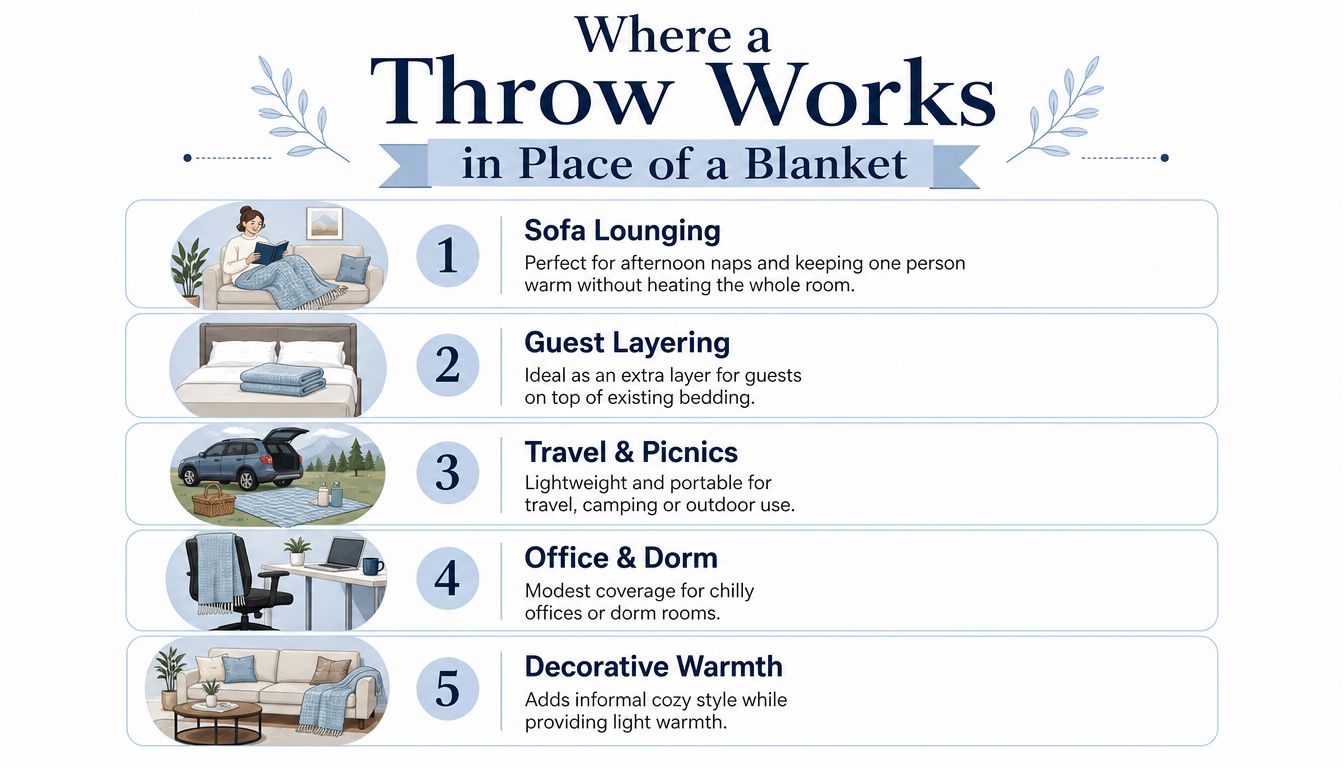
A throw works best instead of a blanket when one person needs modest warmth in an informal setting. It isn't the right replacement when several sleepers need full bed coverage or when the household depends on one layer for serious overnight insulation.
Is a throw enough for the sofa
For a sofa, yes. A throw is often the most convenient personal layer because it warms the person using it rather than the entire room. It suits reading, afternoon naps, television and working from a lounge chair, especially when heating the whole living area feels wasteful.
Choose a fabric that matches the upholstery. Smooth, tightly woven materials release pet hair more easily than loose boucle or shaggy yarns. If a dog or cat regularly climbs onto the sofa, avoid delicate fringe and prioritise secure seams.
Can a throw cover a bed
A throw can cover part of a bed or provide an extra top layer, but a compact design shouldn't be treated as the sole covering for full-body sleep. Fold it across the lower third for warmth at the feet, or choose a larger format when one sleeper needs more complete coverage.
On a guest bed, a throw is useful when the existing bedding already supplies the main warmth. It also gives visitors an easy layer to remove without disturbing the rest of the bed.
Is a throw useful for travel and rentals
Yes. A throw is lightweight, easy to move and practical for renters, caravans, spare rooms and picnics. It can also soften a plain sofa without permanent decorating changes. For more ideas on choosing between styles and materials, browse these types of throw blankets.
Layering gives a throw its widest range. Place a breathable cotton throw beneath a warmer layer in winter, or keep a light linen-style option beside the sofa for humid evenings. The failure point remains coverage, so measure before you buy rather than assuming every throw is bed-sized.
How to Pick a Throw That Actually Feels Like a Blanket
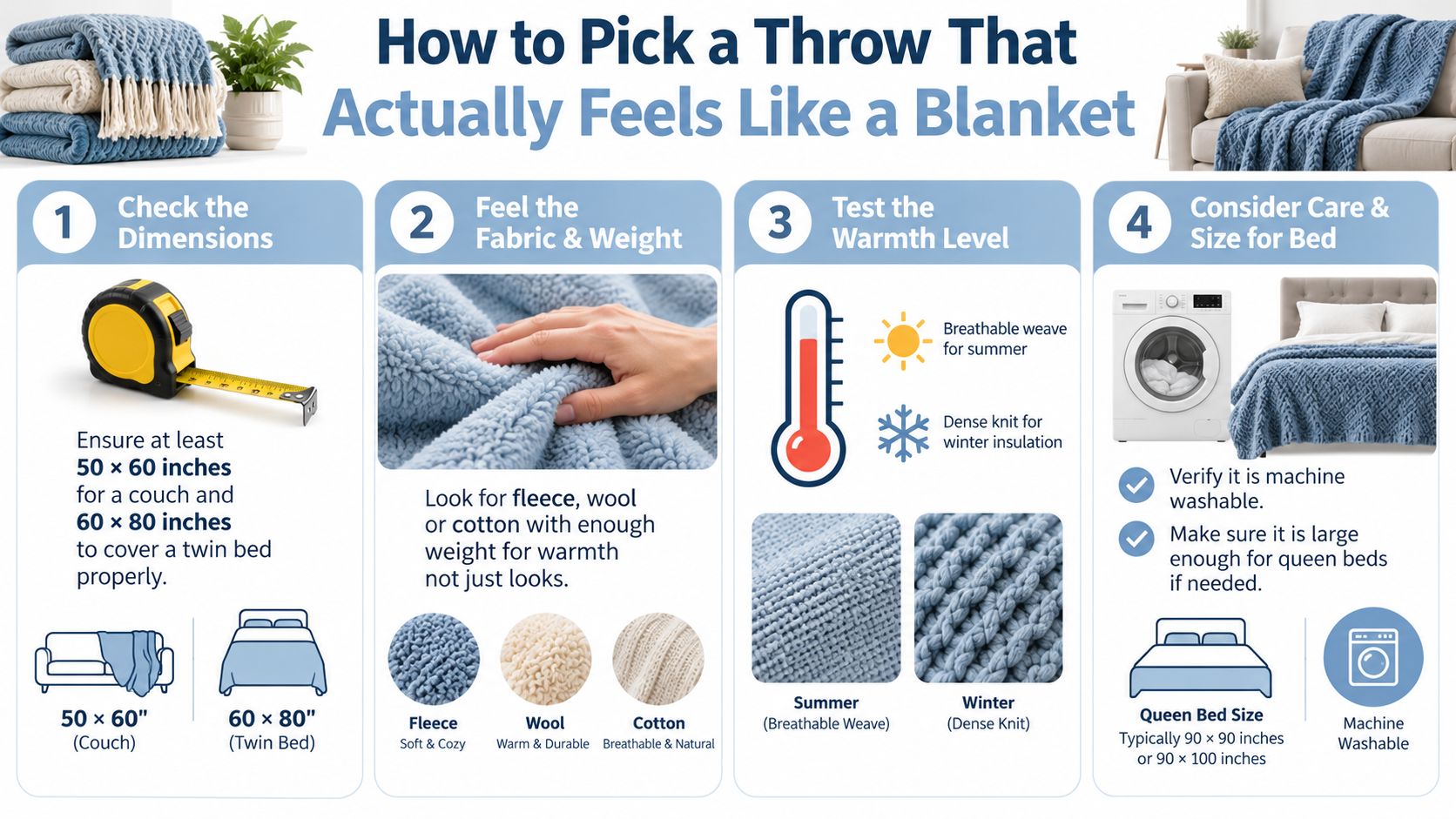
A throw feels like a real blanket when its dimensions, fabric weight, breathability and edge finish suit the intended use. Judge those four points before colour, tassels or styling appeal.
1. Check the finished dimensions
A 130 x 180 cm throw can work for a lap, chair or narrow sofa nap, but it falls short as dependable full-body sleeping coverage for many adults. For a bed, compare the product's finished size with the mattress and the sleeper's height. For a couch, measure from the seat to the shoulders and feet, then allow enough width for the throw to stay tucked or draped.
Don't rely on phrases such as “oversized” without a measurement. A tape measure gives you a more useful answer than a product photograph.
2. Read the fabric weight
Fabric weight, often shown in GSM, helps distinguish a substantial warmth layer from a thin decorative textile. A wool throw rated at 400 GSM or more is a sensible winter-oriented option when you want meaningful insulation, while lighter cotton or linen works better for breathability and layering.
Skip a product if the seller gives no useful information about weight, thickness or construction and expects the photograph to do all the selling. For cruelty-free shoppers, a resource such as this guide to a perfect cruelty-free throw blanket may help you compare material choices more carefully.
3. Test breathability
Dense fleece and heavy wool can feel cosy in a cold room, but breathable cotton, linen and open weaves are more comfortable during humid Australian nights or for sleepers prone to overheating. Choose insulation for the room, not merely for the season printed on the label.
4. Inspect the edge finish
Bound or overlocked hems generally tolerate repeated washing better than fragile fringe. Decorative fringing is fine for a styling throw, but a family blanket needs secure stitching and edges that won't unravel when pulled, washed or tucked under feet.
Use this guide to choosing the perfect throw blanket when you want to compare size, texture and care details in one buying process.
A short demonstration can also help you judge how a throw behaves on furniture and in layered use.
Washing, Care and Storage the Australian Way
A throw used as a blanket needs a care routine that suits humidity, pet hair and repeated washing. Check the sewn-in care information before purchase, then follow the method rather than guessing from the fibre name.
Australia's mandatory care-labelling regime is the Consumer Goods (Care Labelling) Information Standard 2023, which covers household textiles and furnishings. It took effect on 5 September 2023, and the transition period ended on 5 March 2024. Suppliers can provide English instructions, ISO 3758:2012 symbols, or both, as outlined by Product Safety Australia.
The care information must be adequate, legible and sufficient to prevent damage when followed. The technical reference for Australian and New Zealand textile care communication is AS/NZS 1957:1998, which addresses wording, symbols and the information supplied on permanent labels or separately where a permanent label isn't practical.
| Fabric | Wash method | Drying | Storage tip |
|---|---|---|---|
| Cotton | Machine wash only at the labelled temperature | Line dry when conditions allow, or use a suitable low-heat cycle | Fold fully dry in a breathable bag |
| Wool | Follow the label, often gentle washing or professional cleaning | Dry flat if permitted, away from direct heat | Store clean and dry with airflow |
| Linen | Gentle machine wash where the label allows | Dry promptly to reduce prolonged dampness | Avoid compressed plastic storage |
| Fleece or synthetic knit | Machine wash according to the label | Low heat is safer than excessive heat | Keep away from rough fasteners that cause pulls |
Humid weather can make outdoor drying unreliable. Use an indoor rack with airflow, or a low-heat tumble cycle only when the label permits it. Never store a throw while damp, and choose breathable cotton storage rather than sealed plastic for off-season protection.
For regular sofa use, shake or vacuum pet hair before washing, treat marks promptly and remove pills with a fabric shaver. A throw used heavily by children, pets or daily loungers may need washing every two to three weeks, while a decorative piece used occasionally can go longer. Further practical guidance on caring for linens at home can help with related household textiles, and these machine-washable throw blanket considerations are useful when washability is your main filter.
Keep ordinary throws separate from heated throws. A heated throw has electrical safety requirements, and Australian safety reporting warns that heated blankets and throws shouldn't be folded or left unattended because creases and hot spots can increase fire risk. An ordinary wool, cotton or fleece throw doesn't contain heating elements, so don't apply heated-throw instructions to it, but do follow its own care label.
The Australian Tradition Behind Throws as Warmth Layers
Using a throw as a blanket fits Australia's textile history, not just contemporary styling. Waverley Mills was founded in Tasmania in 1874, and the mill identifies itself as Australia's oldest continuously operating textile mill. Its early production centred on woollen products including blankets, and the mill says blankets helped make the business famous.
Waverley Mills also reports that it once held about 80% of the Australian blanket market and employed more than 300 people at its peak, details preserved in the account summarised by Sattva World. Those figures show why woven coverings have long been understood as practical warmth layers in Australian homes, rather than purely decorative accessories.
The market still reflects that functional relationship. Industry reporting says Australia consumed around 742,000 wool blanket and travelling-rug units in 2024, while domestic production reached 661,000 units and imports fell to 100,000 units. The market had peaked at about 1 million units in 2019, so demand remains substantial even as households choose different formats and fibres, according to Australian Wool Innovation's Waverley report.
Modern homes create strong reasons to keep using flexible layers. Coastal households may need breathable textiles through humid weather, while inland homes can face sharp cold. Renters often have limited linen storage, and families commonly want one movable layer for the shared sofa rather than a separate blanket in every room.
The practical conclusion is simple. Choose a throw as a blanket when its size and warmth match the person and conditions, then use the care label to decide whether it can withstand the routine your household will give it.
Your Quick Buying Checklist Before You Choose
Use this checklist before ordering, and make the decision from the room outward.
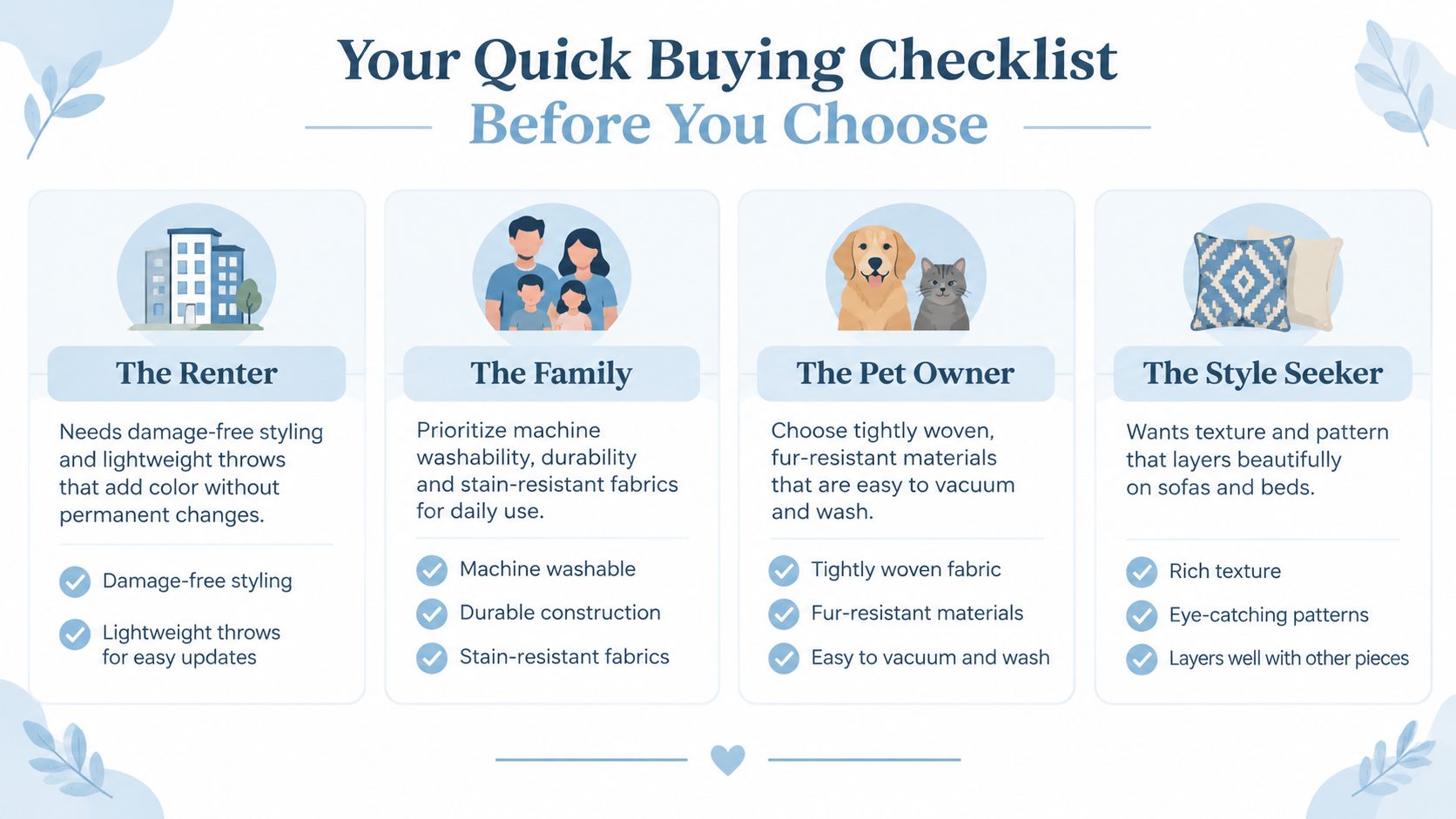
- Renters: Measure the sofa arm, seat depth and back height before buying. Choose a movable throw that adds colour without wall fixings or permanent changes, and check whether the edge finish will survive regular folding.
- Families: Prioritise a clearly labelled, machine-washable fabric with secure stitching. Confirm the care label's washing temperature rather than assuming every cotton or synthetic throw can be washed in the same way.
- Pet owners: Choose a tightly woven surface that releases fur during vacuuming and washing. Avoid loose fringe where claws can catch, and consider a darker or visually textured weave if pale upholstery shows every hair.
- Airbnb hosts: Select a durable, easy-care layer that looks tidy when folded and feels comfortable for guests. Check the finished dimensions, fabric weight and drying instructions before placing it on a bed or lounge.
Check fibre information separately from care instructions. Australia doesn't have a national mandatory fibre-content labelling standard for textiles, so a throw may carry required care advice without compulsory fibre-composition disclosure, as explained in the Australian Fashion Council labelling guide. If the fibre, GSM, dimensions or washing method isn't clear, don't buy on appearance alone.
A throw works as a blanket when the dimensions, weight and care routine match the room, not when it matches the cushion.
Casamé Home offers machine-washable sofa covers and throw blankets for renters, families, pet owners and hosts who want practical layers without replacing furniture. Visit Casamé Home to compare protective covers and throws that can refresh an Australian living room while adding everyday comfort.


