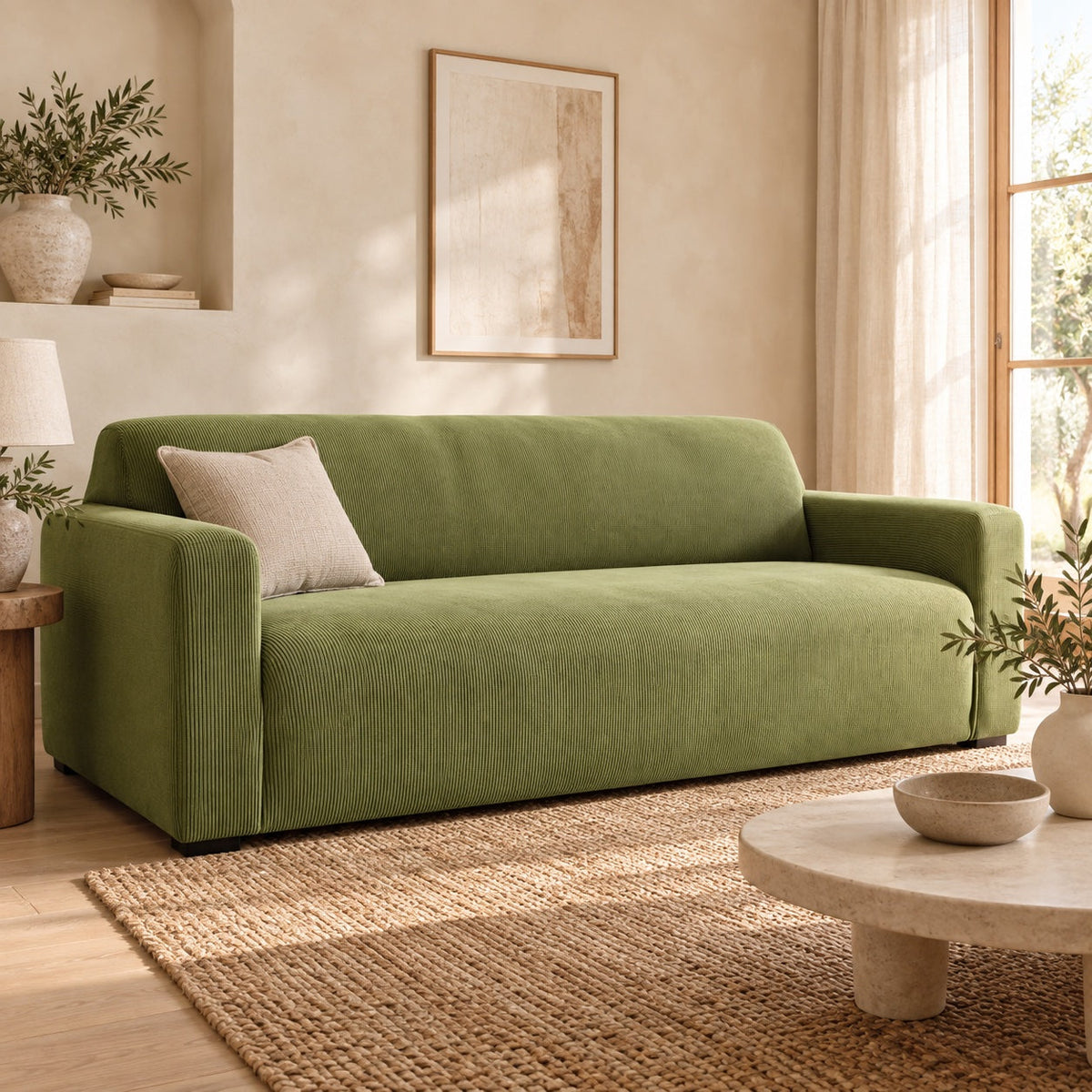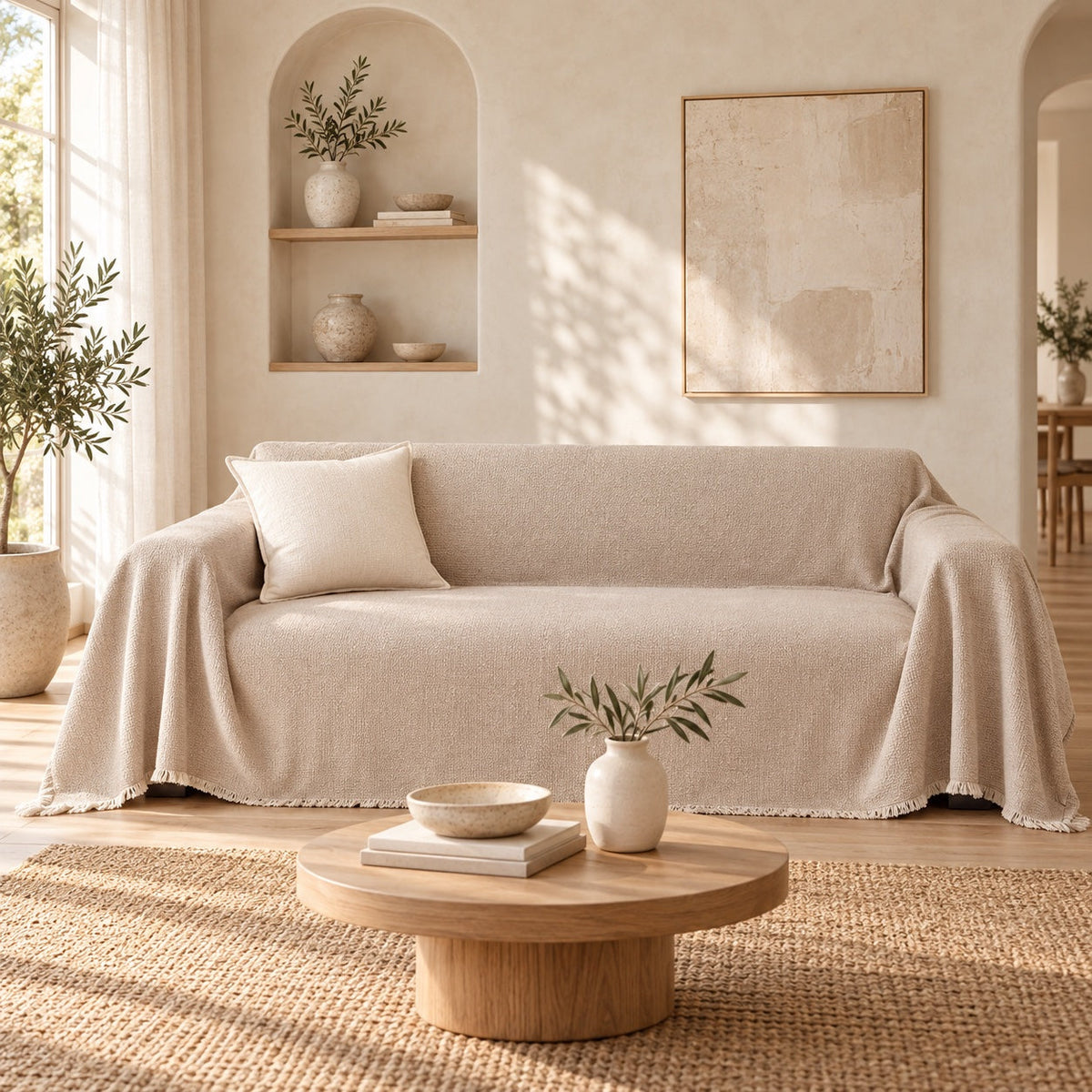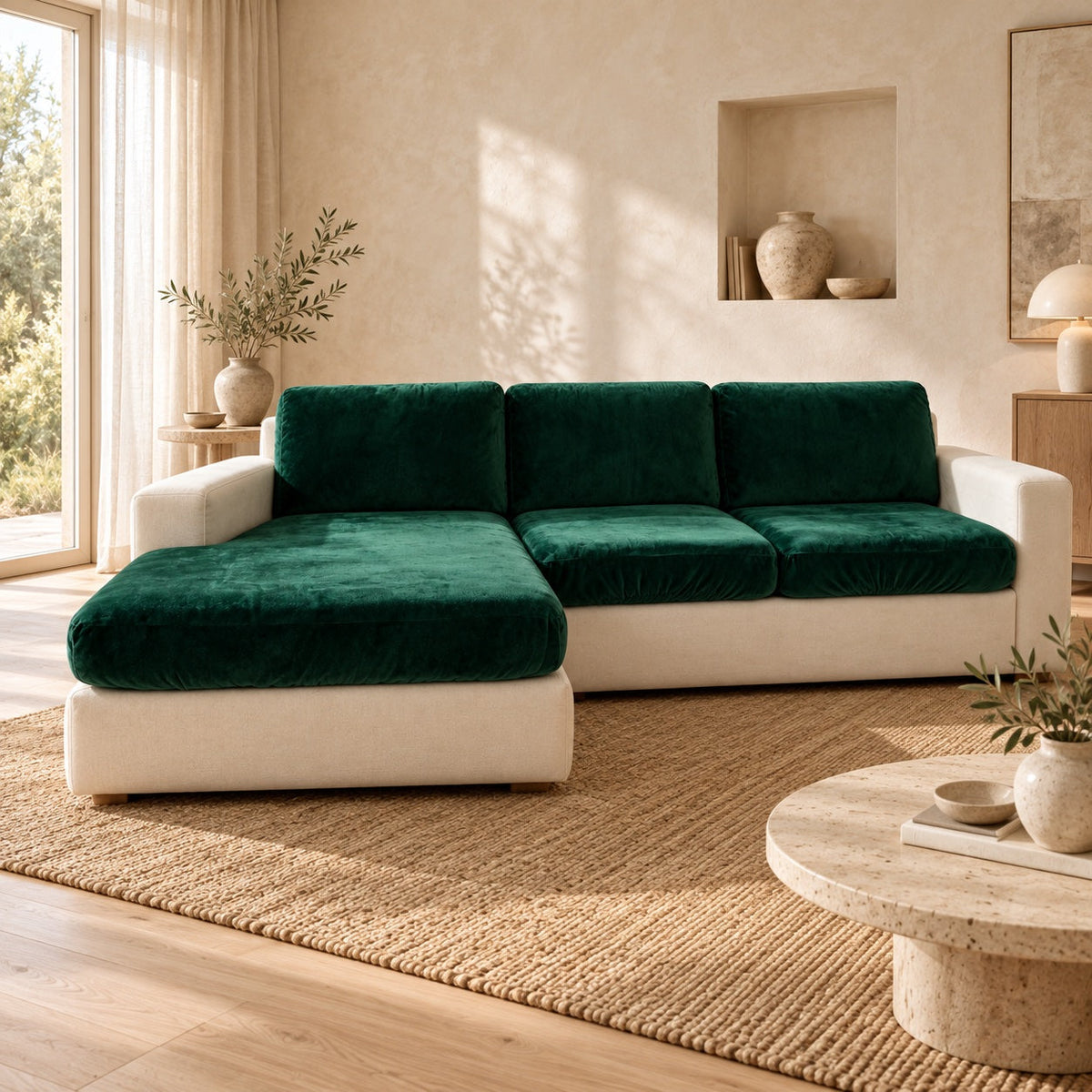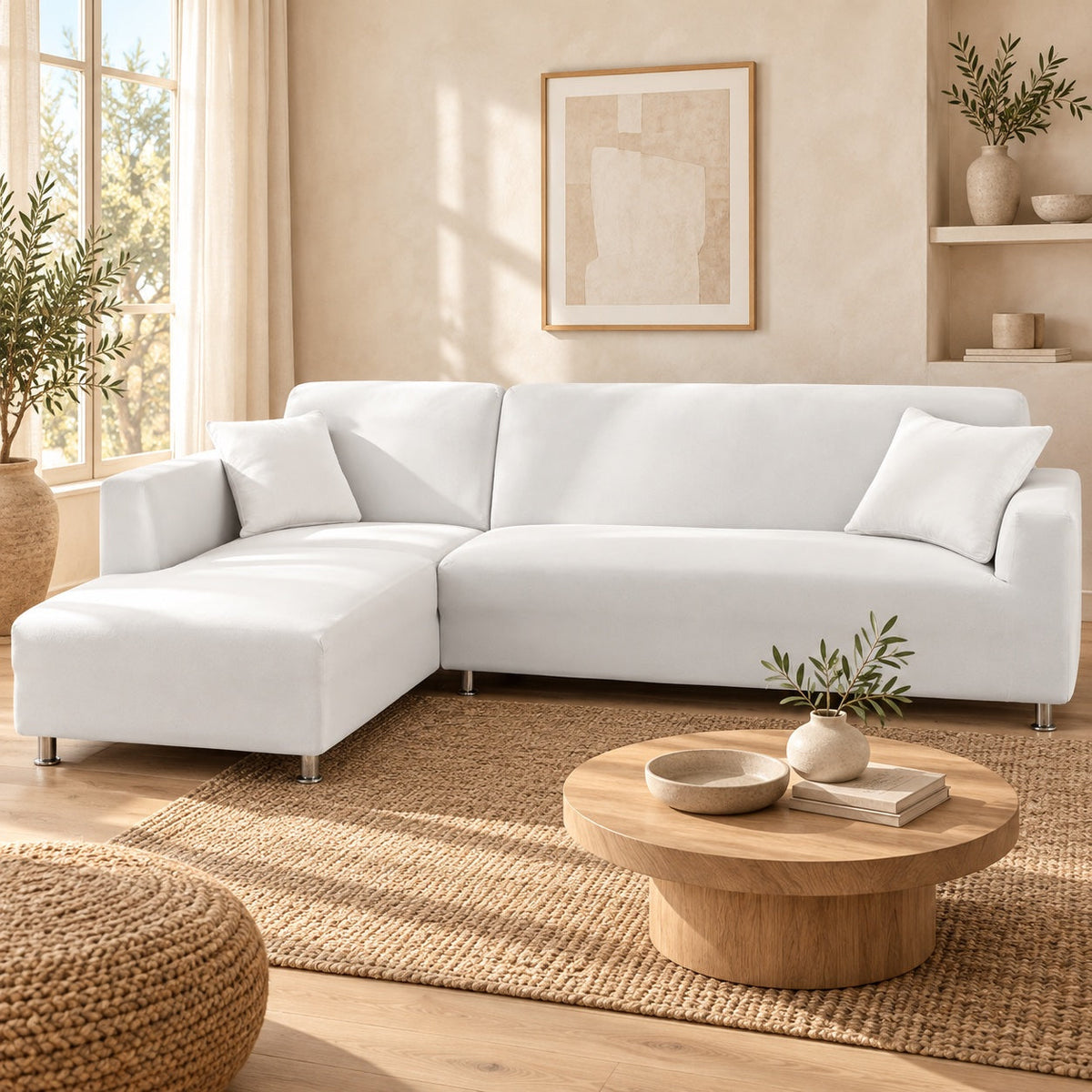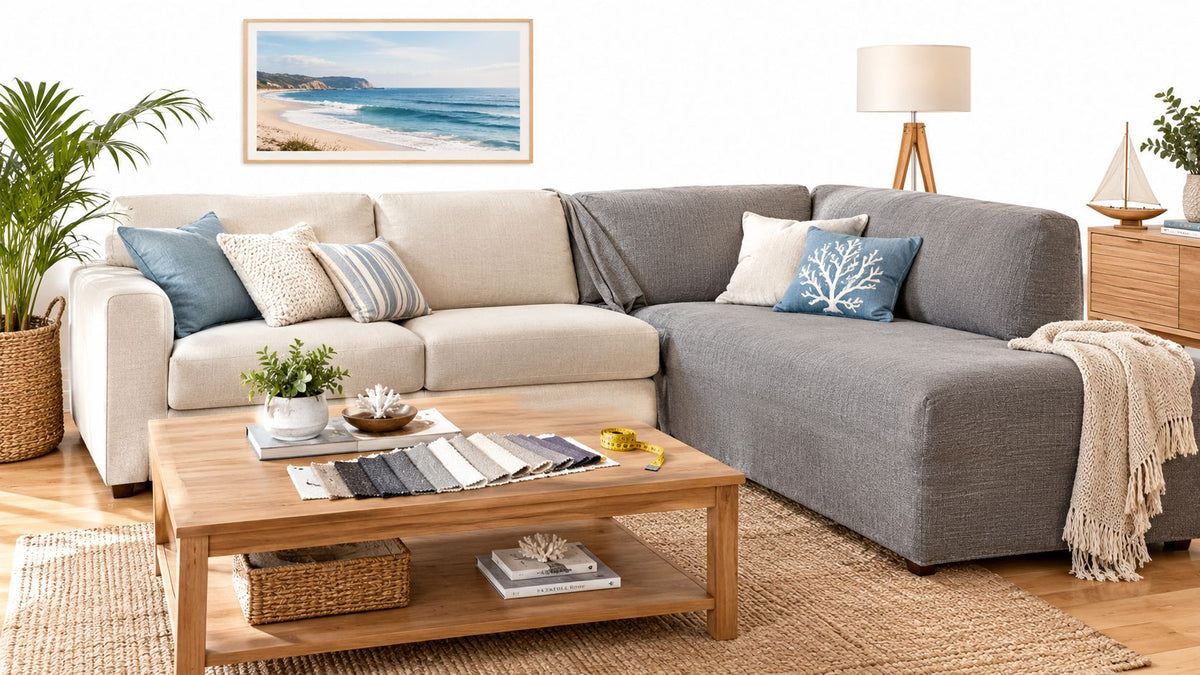
Yes, stretch-fit corner sofa covers exist for Australian L-shaped lounges, and the right way to buy one is to order a pair of seater bands, one for each run of the L, measured arm-to-arm across the outside of both arms. If you're staring at a corner lounge and wondering whether a cover exists for your shape, the answer is usually yes, but most buying mistakes happen because people order by guesswork instead of sizing the two runs properly first.
Key Takeaways Corner Sofa Covers
Shop by Seater Pairs: Order an L-shaped cover as two seater bands, e.g. 2 + 3.
Measure Both Runs: Measure the long run and the return run separately.
Know the Limits: Very unusual corner shapes may not suit a stretch cover.
That sizing step matters more than colour, fabric, or pattern. Get the pair right and a stretch cover has a fair chance of sitting neatly. Get it wrong and even the nicest fabric will fight the shape, pull at the arms, or sit short over one side.
Table of Contents
- What an L-Shaped Sofa Cover Is in Australia
- How to Measure Your Corner Lounge Without Getting It Wrong
- L-Shaped Cover Families, Colours and Price Bands
- Which Colour and Pattern Are Australians Buying
- Does a Stretch Cover Fit an Awkward or Non-Standard Corner
- Australian Buying Considerations Before You Order
- Your Pre-Order Checklist for a Corner Sofa Cover
What an L-Shaped Sofa Cover Is in Australia
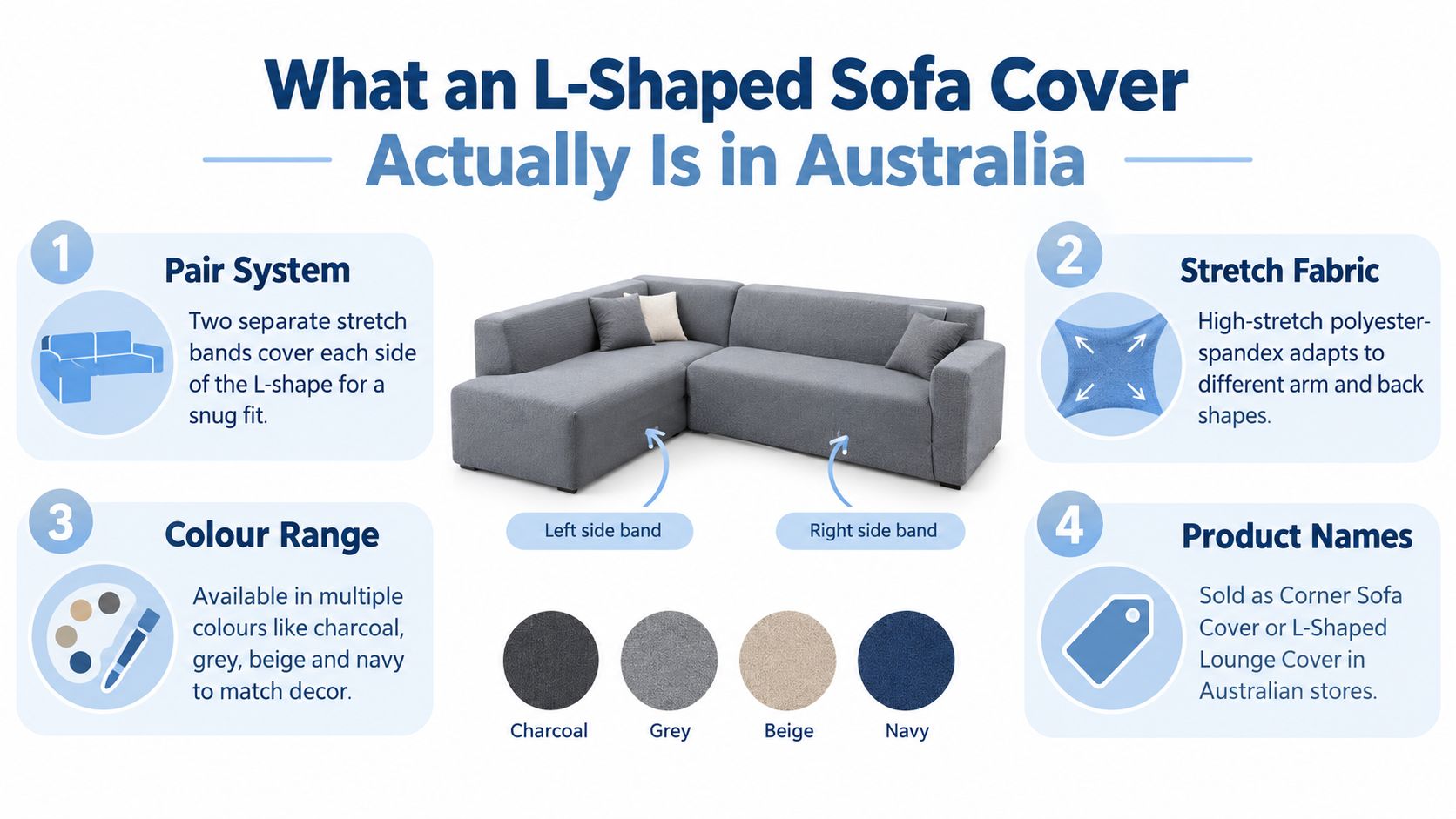
You're looking at a corner lounge, the dog hair is winning, and you want one cover that fixes the whole thing. In Australia, that is not how this product is sold. Our corner covers are sold as L-shaped sofa covers. Each cover is ordered as a pair of seater bands, one for each run of the L.
This is the core concept: a corner lounge is treated as two joined sofa lengths. One cover goes on the long run. The second goes on the return or chaise run. If you start with that sizing grid, the rest of the decision gets much easier.
What the pair system means in practice
Australian shoppers should shop by pair-of-seater bands, not by vague corner labels. Available combinations are:
- One-and-two seater
- One-and-three seater
- One-and-four seater
- Two-and-two seater
- Two-and-three seater
- Two-and-four seater
- Three-and-three seater
- Three-and-four seater
- Four-and-four seater
Each side of the pair matches one measured run of the sofa. That is the spine of the buying decision. Colour, texture and print come after the pair size is locked in.
Practical rule: If you cannot describe your lounge as a pair of seater bands, do not order yet.
The names are loose. The sizing grid is what matters.
Australian stores use several names for the same product type. You will see corner sofa cover, L-shaped sofa cover, and L-shaped lounge cover. In most cases, they all refer to a stretch-fit cover built around the same two-piece format.
If you want to browse slipcovers for L-shape sofas, ignore the marketing labels first and match your lounge to the pair grid. Then match that size pair to a real product family.
At Casamé Home, that means starting with the family, then checking whether your measured pair is sold in it. The lower-priced end includes Classic Stretch L-Shaped Sofa Cover. Higher up, Velvet L-Shaped Sofa Cover gives a heavier, softer finish. Other L-shaped families include Flecked, Luma, and Crosshatch. Printed options include Esagonali, Asio, Automne, Printemps, Vintage, Azrose and Folige.
That range matters because the pair system stays the same even when the fabric and look change. A two-and-three in Classic is still a two-and-three in Velvet. A three-and-four in a plain colour follows the same sizing logic as a three-and-four in a printed design. That consistency is what lets you map your measured corner to a real, orderable cover instead of guessing from photos.
Start with the pair. Then choose the family. Then choose the colour or print.
How to Measure Your Corner Lounge Without Getting It Wrong
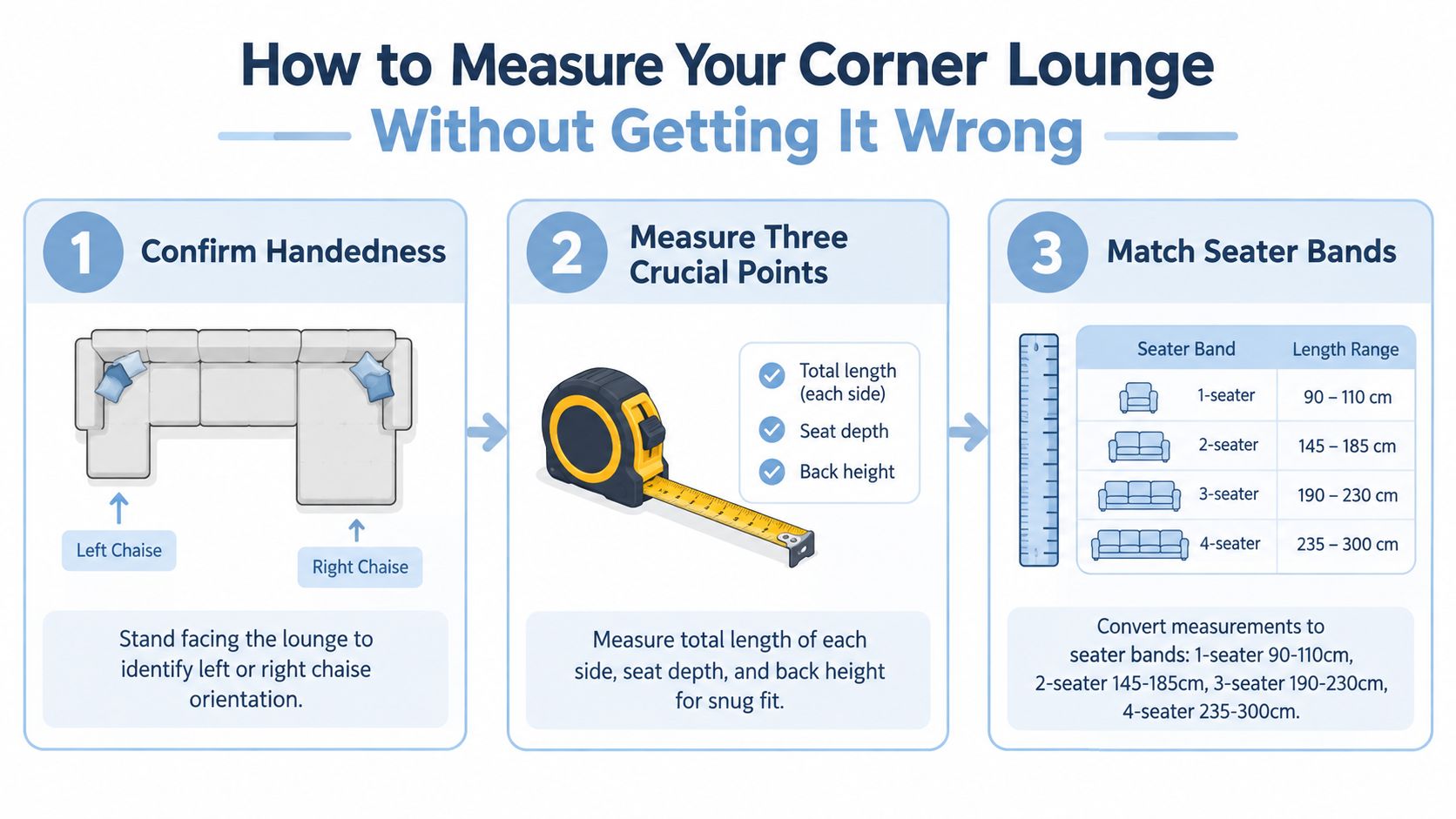
You measure a corner lounge correctly by taking three measurements: the arm-to-arm width of the long run across the outside of both arms, the arm-to-arm width of the return or chaise run the same way, and the seat depth from the back cushion to the front edge.
Most mis-orders happen because people measure the seat cushions instead of the full outside span. That shortcut sounds harmless, but the cover still has to travel over the arms.
The three-measurement routine
Use a tape measure and write the numbers down as you go.
-
Measure the long run
Measure arm-to-arm across the outside of both arms at the widest point. -
Measure the return or chaise run
Measure the second run the same way. Don't switch method halfway through. -
Measure the seat depth
Measure from the back cushion to the front edge of the seat.
The width tells you what to order. The seat depth helps you judge whether your lounge is broadly in the comfort zone for a stretch cover or whether the shape is pushing into awkward territory.
For a visual walkthrough, check sizing your slipcovers at Casamé Home.
The band ranges you actually order from
The available width bands are:
- 1 seater: 90 - 130 cm
- 2 seater: 135 - 175 cm
- 3 seater: 180 - 220 cm
- 4 seater: 225 - 300 cm
If your long side measures 168 cm and your return measures 214 cm, you'd write that down as 2 seater + 3 seater. That's the buying language you need.
Two rules that prevent most mistakes
Here are the two rules worth following without exceptions:
-
Measure over the outside of the arms
Don't measure cushion-edge to cushion-edge. The fabric has to wrap the arms too. -
If a run falls between bands, choose the larger band
A stretch cover can pull in to fit a smaller frame, but it won't stretch past the top of its stated range.
Write your result as Long side: ___ seater. Return side: ___ seater. That one line saves a lot of confusion later.
One thing to say plainly. There is no left- or right-hand version — the cover is sized to the two runs rather than made as a handed pattern. We do not offer made-to-measure covers or sell covers by individual module, so the pair has to suit the lounge you already own.
L-Shaped Cover Families, Colours and Price Bands
Once you've written your corner down as a seater pair, such as 2 seater + 3 seater or 3 seater + 3 seater, the buying job gets much simpler. Every Casamé Home L-shaped family sits on that same band system. The choice is the finish, the colour range, and how much visual change you want in the room.
Start with the pair size. Then match it to the family that suits your lounge and budget.
Casamé Home L-Shaped Cover Families at a Glance
| Family | Typical Colours | Price Band (L-Shaped Pair) | Best Suited To |
|---|---|---|---|
| Classic Stretch | Alabaster White, Ocher, Cherry Red, Malachite Green, Night Blue, Linen Beige, Clay Grey, Plum, Mouse Grey, Garnet Red, Black | AUD 107.90 - 146.90 | Buyers who want the lowest-risk starting point and straightforward everyday use |
| Velvet | Nine colours | AUD 176.90 - 268.90 | Homes that want a softer, plusher finish and are happy to pay more for it |
| Flecked | Five colours | AUD 111.90 - 146.90 | Buyers who want light texture to break up a large block of plain colour |
| Luma | Five colours | AUD 157.90 - 242.90 | Shoppers after a cleaner, matte woven look |
| Crosshatch | Four colours | AUD 111.90 - 146.90 | Buyers who prefer a slightly more textured or structured surface pattern |
| Printed designs | Esagonali, Asio, Automne, Printemps, Vintage, Azrose, Folige | AUD 107.90 - 218.90 | People who want the cover to change the room, not just protect the sofa |
Classic Stretch is the practical default. It gives you the broadest colour spread and the most forgiving look across different corner lounge shapes, and it sits at the lowest price band of the range.
Velvet is a style decision first. It looks richer and feels softer, but it also shows pull lines, tension and unevenness more clearly than simpler textures. Get your pair size right before you spend more here.
Flecked, Luma and Crosshatch sit between plain and printed, for buyers who don't want a flat plain finish. Flecked adds visual variation. Luma looks calmer and more understated. Crosshatch gives a more structured surface, which can help a large sectional look less bulky.
Where the printed options fit on the grid
The printed range still follows the same seater-pair logic. You are not switching to a different fit system just because you prefer Esagonali, Asio, Automne, Printemps, Vintage, Azrose or Folige. Measure first, then choose the print.
Printed covers are a stronger design move. They work best when the goal is a visible room reset, not just covering wear. For a tired lounge in a neutral room, that can work well. For a busy room with patterned rugs, cushions or curtains, solids are usually the safer call.
Best buying order: pair size first, fabric family second, colour or print third.
For the wider range beyond corner formats, you can browse couch covers.
Which Colour and Pattern Are Australians Buying
We do not record a colour split for corner covers alone, so the available figure is the whole-store picture from the last year of orders: grey was the most-ordered colour at 20% of all units, followed by green at 16%. L-shaped sofa covers represented 12% of all units ordered.
That's useful, but only if you stay honest about what the data can and can't tell you. Pattern is not a field we record, so there is no reliable pattern ranking to give, and any more detailed breakdown would be guesswork.
Australian Sofa Cover Buying Trends Recorded Store Data
| Category | Share of Units Ordered | What It Means for Buyers |
|---|---|---|
| Grey | 20% of all units | Grey is the safest broad-appeal choice if you want a cover that plays well with existing décor and doesn't demand attention |
| Green | 16% of all units | Green has real traction, which points to a stronger appetite for earthy or richer tones than many buyers assume |
| L-shaped sofa covers | 12% of all units ordered | Corner lounges are a meaningful part of demand, so you're not shopping a fringe format |
What I'd take from those numbers
Grey leads because it's easy to live with. It tends to sit unobtrusively in the room, and it usually looks more forgiving than very light shades when the lounge sees daily use.
Green being next matters too. It tells you buyers aren't only playing it safe. A colour like Malachite Green can work if you want warmth without going all the way to a print.
Pattern is where the data stops. There's no pattern ranking, no corner-only pattern ranking, and no honest way to pretend otherwise. If you choose a printed L-shaped sofa cover, you're choosing based on taste, not store pattern data.
Does a Stretch Cover Fit an Awkward or Non-Standard Corner
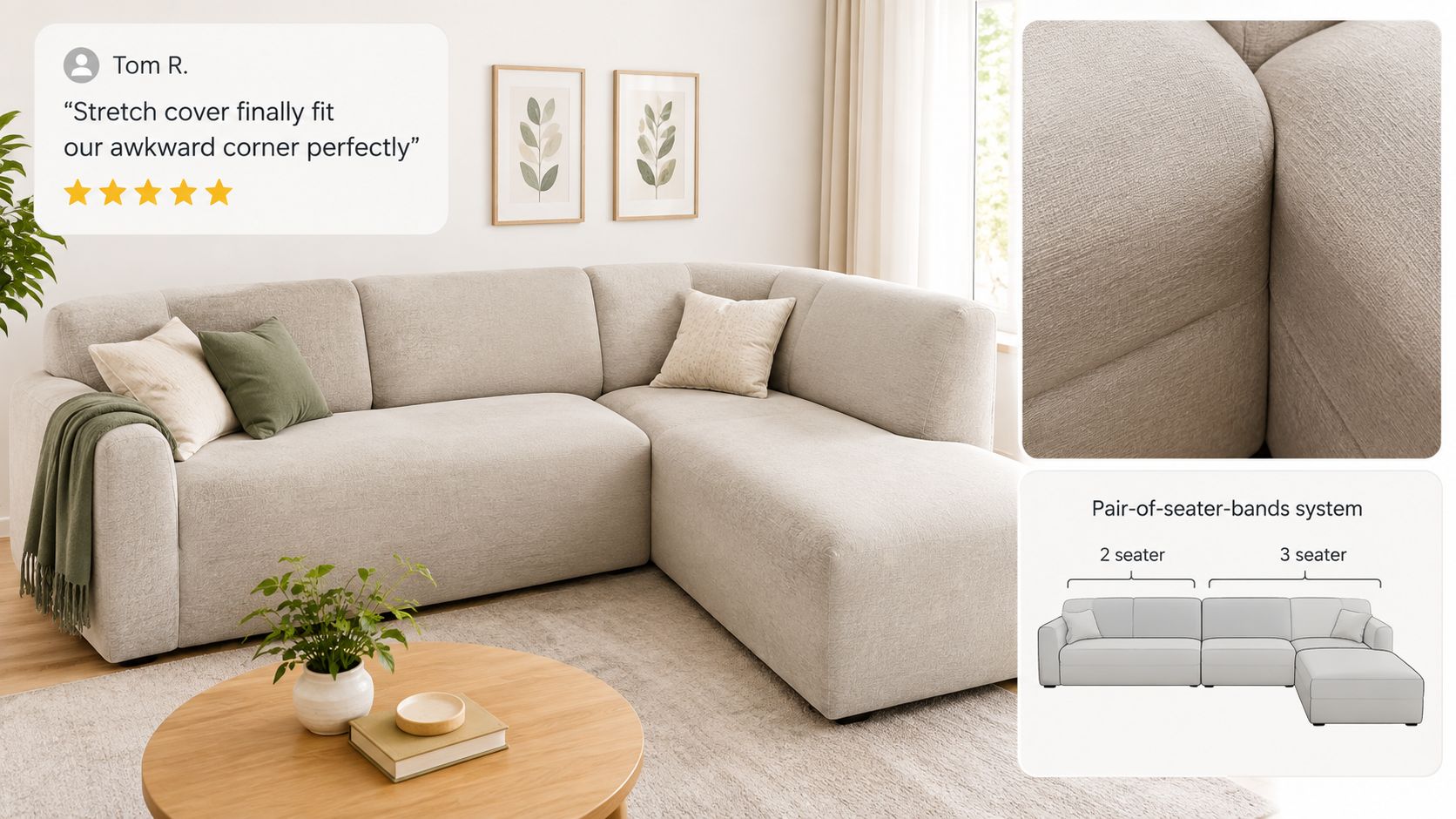
Yes, a stretch L-shaped sofa cover can fit some awkward corner lounges, but a stretch L-shaped sofa cover cannot change the underlying footprint of the lounge, so unusual layouts still have hard limits.
Tom R., on the Classic Stretch L-Shaped Sofa Cover in Alabaster White, put it well: "It fits our big sectional perfectly; there's some adjustability that really helps if you've got a bit of an awkward shape like ours."
That's the right expectation. Some adjustability is real. Unlimited adaptability isn't.
What the stretch system can handle
A stretch pair-of-bands system usually copes with:
- Minor variation in arm shape
- Slight differences in back profile
- Some extra fullness in cushions
- A longer side on either orientation, because there is no handed option to worry about
That last point surprises people. Because the system is sized by the two measured runs rather than left-facing or right-facing pattern pieces, a buyer doesn't need separate handed variants.
Where the limits show up fast
A stretch corner cover is a poor choice for some lounge shapes. Say that upfront and save yourself the hassle.
Watch out for these:
- Extra-deep chaise ends that sit well outside the normal stretch profile
- Very wide corner seats that distort the join between the two runs
- Modular lounges with loose sections that separate visibly
- U-shaped lounges
- Curved corner pieces
- Recliner or console sections built into the corner layout
If the lounge stops being recognisably L-shaped, the stretch system stops being a clean fit solution.
The test is simple. If you can describe the sofa as two measurable runs of an L, a pair system may work. If the lounge has a third active section or a curved footprint, it probably won't.
There's also no custom threshold to rescue a difficult shape. No made-to-measure service means what you see is the full system. There's no individual-module cover, and there's no custom cut for unusual footprints.
Australian Buying Considerations Before You Order
Australian buyers should check care labelling, delivery expectations, household use, and cleaning reality before ordering a corner sofa cover, because those factors affect satisfaction more than many expect.
Start with care. In Australia, care labelling for textiles applies to furnishings and upholstered furniture, so a sofa cover sold here must carry care instructions telling you how to clean it. The standard allows care symbols alone, English instructions alone, or both (Australian mandatory care-labelling standard).
Care labels matter more than shoppers think
If you plan to wash a cover regularly, don't rely on vague wording. Read the label.
The Australian guide to care symbols says the washtub symbol covers washing instructions, and the number inside the tub gives the maximum wash temperature in Celsius. The same symbol family also covers washing, bleaching, drying, ironing, and professional care (ACCC care labelling guide).
Another practical point is that where a label uses written wording rather than symbols, it can combine temperature and method into one short phrase, such as cold hand wash only or warm machine wash (care label wording guidance).
Pets, renters, and real cleaning jobs
For pets and kids, removable covers make sense because they reduce how often the original upholstery takes the hit. But don't confuse removable with consequence-free.
In Western Australia, a landlord who agrees to a pet can attach reasonable conditions, and Consumer Protection gives cleaning as one example: carpets professionally cleaned every twelve months and at the end of the tenancy (WA renting with pets). That is a condition a landlord may impose rather than an automatic rule, so read your own agreement. It matters for renters using sofa covers as a bond-protection strategy: a washable cover helps, but it doesn't automatically replace whatever end-of-lease cleaning your agreement requires, especially on large sectionals that are harder and more expensive to clean piece by piece.
Delivery and consumer guarantees
For online orders from an Australian seller, consumer guidance says the product must arrive in good condition and within a reasonable timeframe or an agreed timeframe. If it doesn't arrive as expected, the consumer can seek a written explanation and may be entitled to a refund (WA missing or damaged products guidance).
Services have standards too. If a business provides delivery help, installation help, or care guidance, Australian consumer guarantees require those services to be supplied with reasonable care and skill, fit the service for a stated purpose, and be supplied within a reasonable time where no other timeframe is agreed (ACCC consumer guarantees for services context).
One last practical note. Australia had 10.9 million households in June 2025 as cited in the market summary linked below, and furnishing spend has stayed a material household category over time, which is one reason neutral, washable, replaceable textiles keep finding buyers in this market (Australian furniture market summary).
Your Pre-Order Checklist for a Corner Sofa Cover
A good pre-order check for an L-shaped sofa cover is simple: confirm the two outside arm-to-arm widths, match each run to its seater band, choose the fabric family, then read the care and delivery details before paying.
That order works because it keeps the fit decision in front. A lot of people do the opposite. They choose a colour first, then try to make the lounge fit the product they already fell in love with.
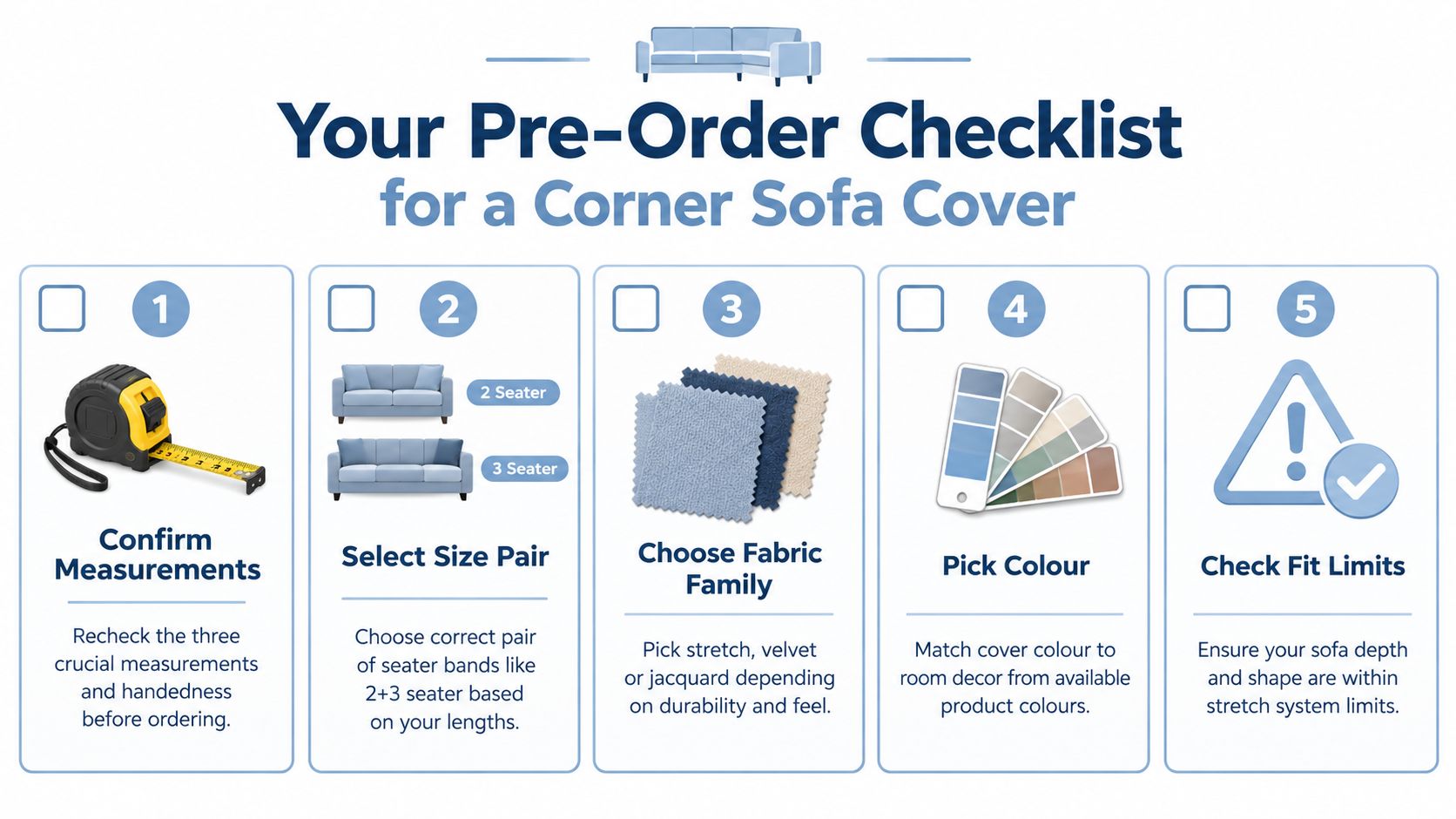
Use this checklist before checkout
-
Recheck both run widths
Measure the long run and return run again across the outside of both arms. If the second result differs from the first, measure a third time. -
Write the pair in seater language
Turn the measurements into a pair such as 1+3, 2+3, or 3+4. If you can't do that cleanly, stop there and check the measurements again. -
Round up when a run sits on a boundary
If one run lands between bands, choose the larger band. A stretch cover can pull in. It can't exceed the top of its range. -
Choose the family for the job
Pick Classic Stretch for the most forgiving everyday option, Velvet for a softer finish, Flecked for texture, Luma or Crosshatch for a more structured look, or a printed design if you want the cover to become a feature. -
Choose colour after fit
If you want the safest option, start with grey. If you want something richer without going to a print, green is the obvious second look based on recorded whole-store ordering. -
Check the product details carefully
Read the care instructions, confirm what's included, and make sure you're ordering the pair system rather than assuming a modular-by-piece setup.
Final check: The correct order is size pair, fabric family, colour, then care and delivery terms.
If you want a concrete example to compare against while checking colours, the Classic Stretch L-Shaped Sofa Cover, Mouse Grey is a useful reference point. If your lounge also needs separate seat refreshes, Couch Cushion Covers can help tidy up the parts a full stretch cover doesn't solve on their own.
Casamé Home offers L-shaped sofa covers in the actual pair-of-seater-bands system Australian corner-lounge buyers need, with families including Classic Stretch, Velvet, Flecked, Luma, Crosshatch, and printed options. If you've measured your two runs and want to match them to a real product range instead of guessing, visit Casamé Home and start with the size pair first.