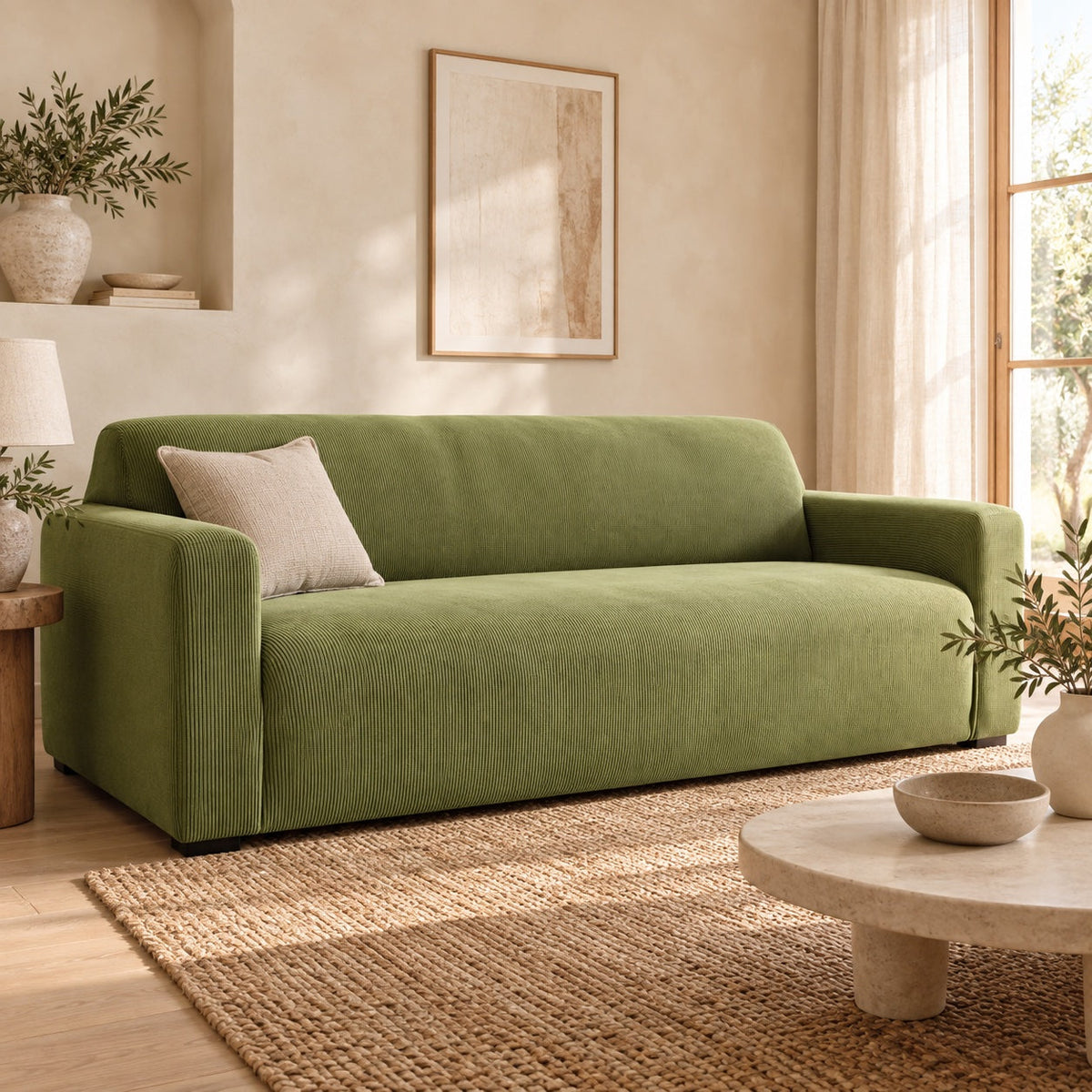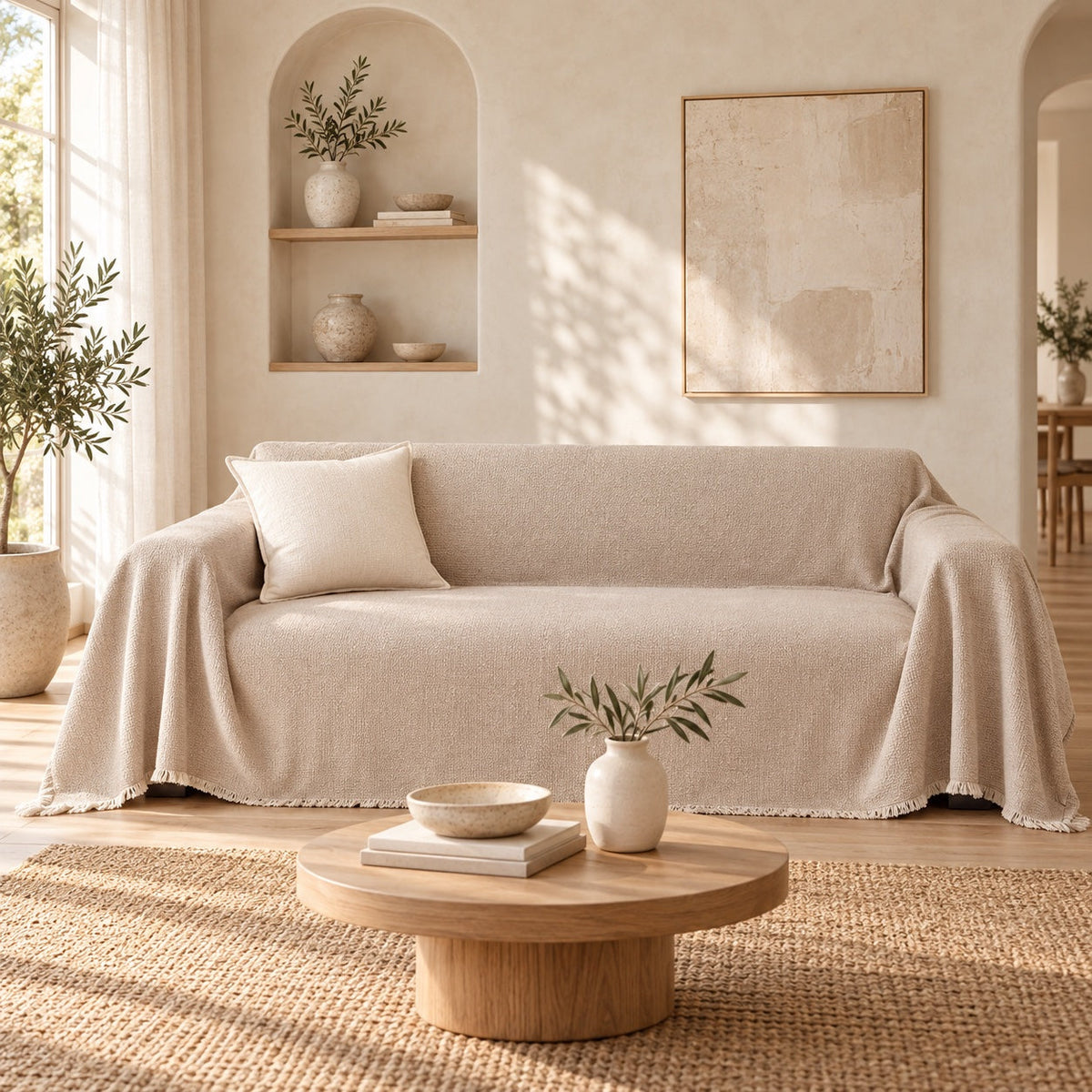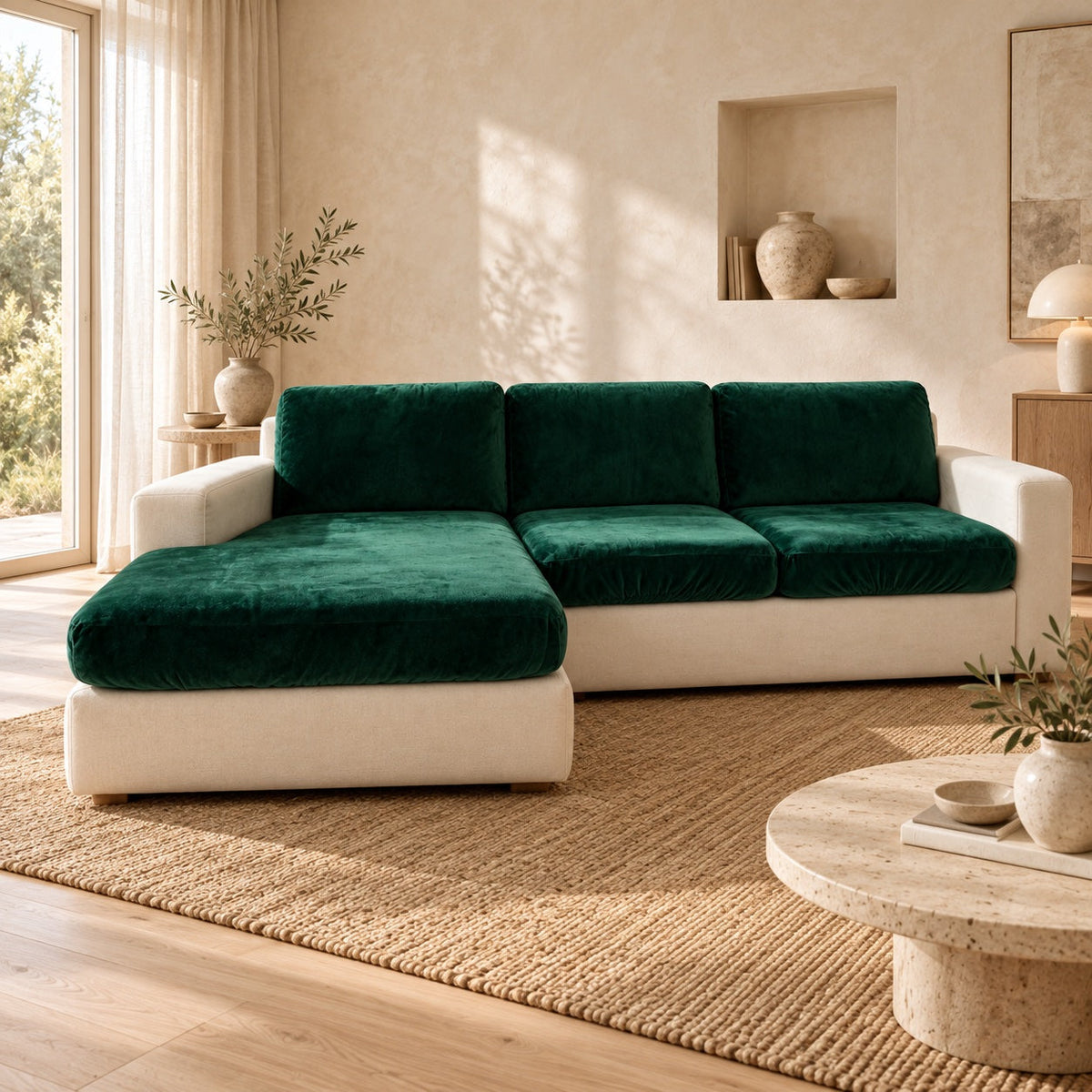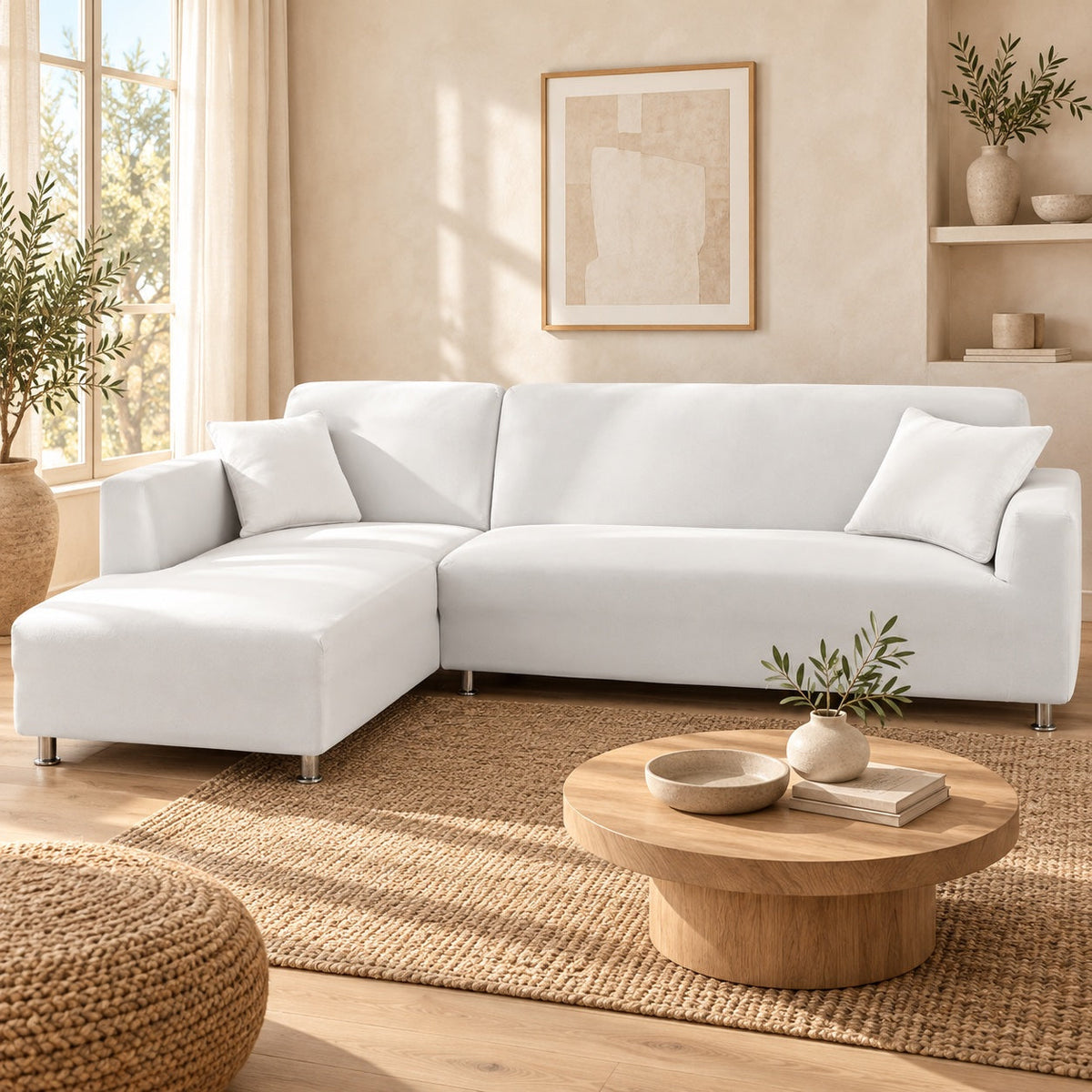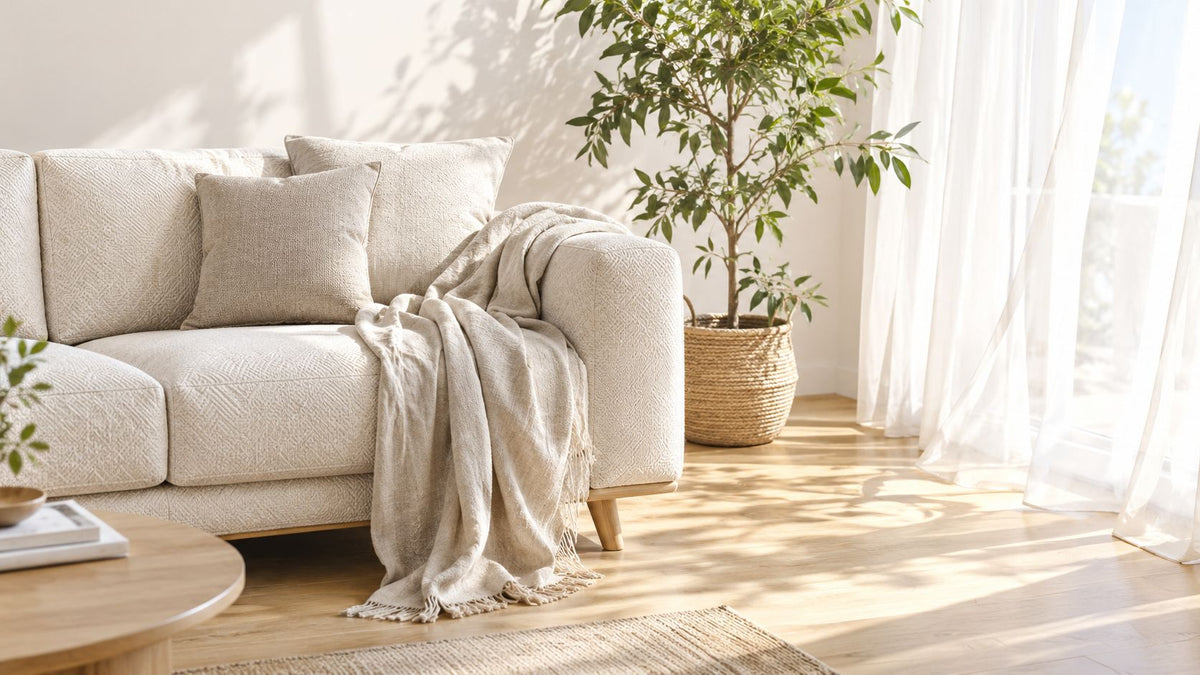
Jacquard can be fine in summer, but jacquard itself doesn't answer the question. Jacquard is a weave, not a fibre, so whether a jacquard sofa cover feels bearable in an Australian summer depends far more on the yarn, the fabric weight, the room, and the upholstery underneath than on the word “jacquard” on a label.
Key Takeaways Jacquard in Summer
Sits in the Middle: Jacquard is cooler than velvet but warmer than flat weaves.
Don't Over-Tighten: A slightly looser fit lets the seat breathe in summer.
Dry in Shade: Line dry out of direct sun to protect the fabric.
That's where most advice goes wrong. People talk about jacquard as if it's automatically heavy or automatically airy, when the honest answer is narrower: some jacquards work in heat, some don't, and a slipcover can only change the surface you touch, not the heat stored in a warm leather seat or dense foam base underneath.
Table of Contents
- Why the Word Jacquard Does Not Answer the Summer Question
- The Three Mechanisms That Actually Govern Summer Comfort
- How Jacquard Compares to Velvet and Flat Weaves in Heat
- Fitting a Jacquard Slipcover So It Breathes in Summer
- Caring for a Jacquard Cover Through an Australian Summer
- The Casamé Jacquard Range and How the Two Figures Differ
- When Jacquard Is the Right Summer Choice and When It Is Not
Why the Word Jacquard Does Not Answer the Summer Question
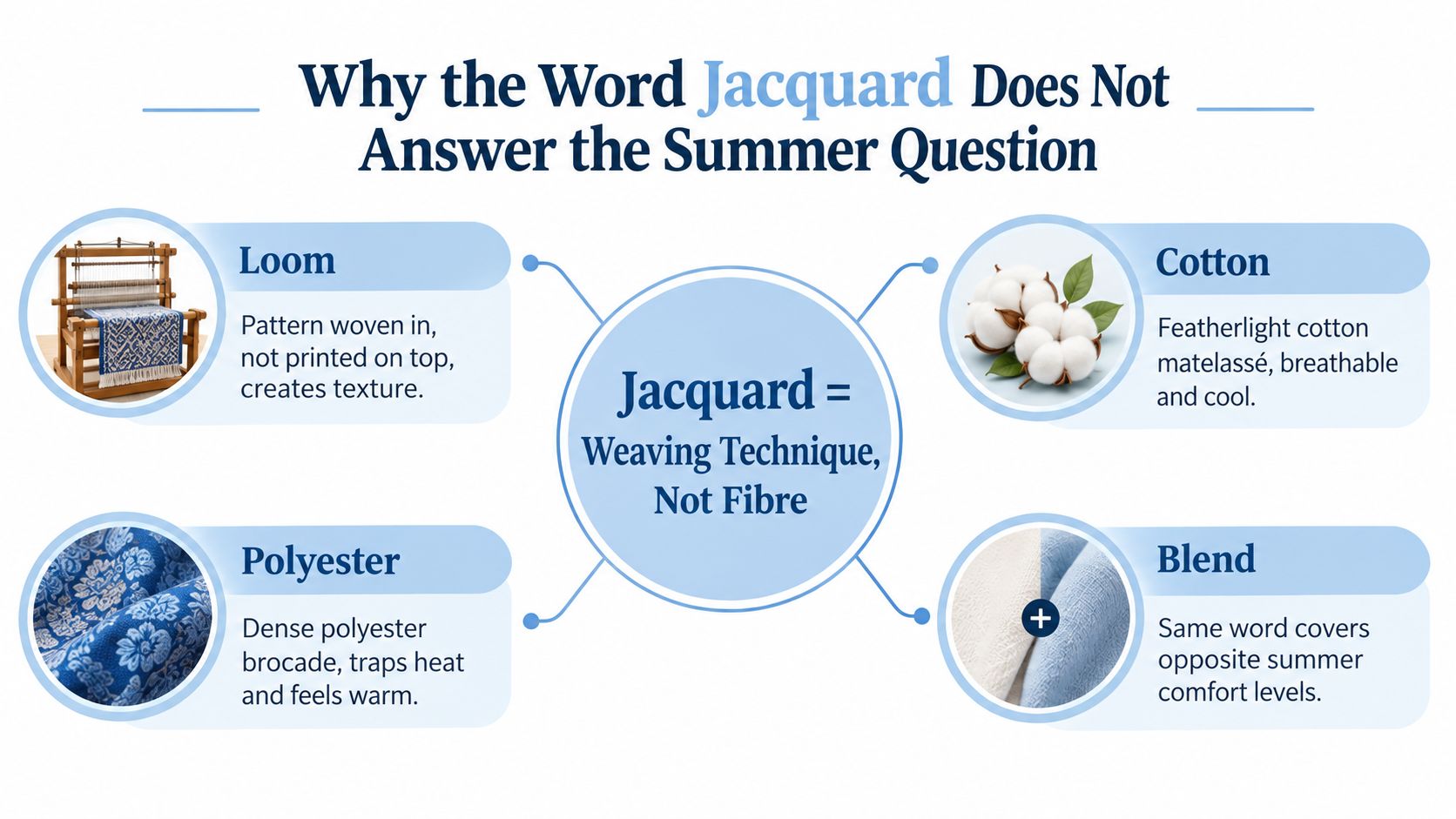
No, the word jacquard on its own does not tell you whether jacquard fabric is good for summer. Jacquard describes a way a pattern is woven into cloth, not a single fibre, finish, or season.
A lot of shoppers hear “jacquard” and picture one thing: thick, formal, slightly heavy fabric. Sometimes that picture is right. Sometimes it isn't. The same weaving method can produce something light and summer-friendly or something dense and heat-holding.
What jacquard tells you and what it doesn't
Jacquard tells you that the figure is woven into the fabric rather than printed on top. That usually gives the surface some texture, relief, or pattern depth. If you want the longer explanation of the construction side, Sofa Cover Ideas Jacquard covers that background.
What jacquard does not tell you is the part your skin cares about most in summer:
- Which fibre is doing the work
- How dense the cloth is
- How open or closed the structure feels
- Whether the fabric is sitting over cool cotton upholstery or warm leather and foam
That's why two jacquards can behave completely differently in heat.
Why some jacquards work and others feel stifling
Textile guidance makes this distinction plainly. Jacquard's summer suitability depends heavily on fibre choice and fabric weight rather than the weave alone: lighter jacquards tend to feel airier, while dense brocade-style jacquards trap more heat (textile guidance on jacquard summer suitability).
That doesn't mean every light jacquard is pleasant, or every heavier jacquard is unbearable. It means you can't answer the summer question from the weave name alone.
Practical rule: Ask about the specific jacquard in front of you, not jacquard as a category.
The better summer question
A more useful question is: is this specific jacquard, in this specific build, likely to trap heat or let a seat feel less sticky?
For clothing or home textiles in hot weather, Australian guidance keeps coming back to the same priorities: breathable fibres and fabrics that help air move rather than sealing it off. One Australian textile brand describes its 100% cotton jacquard as breathable and lightweight, and suited to warm nights (fabric guidance from Magnolia Lounge).
For sofa covers, there's one more complication. A cover is only the top layer. The base sofa still matters, often more than people expect.
The Three Mechanisms That Actually Govern Summer Comfort
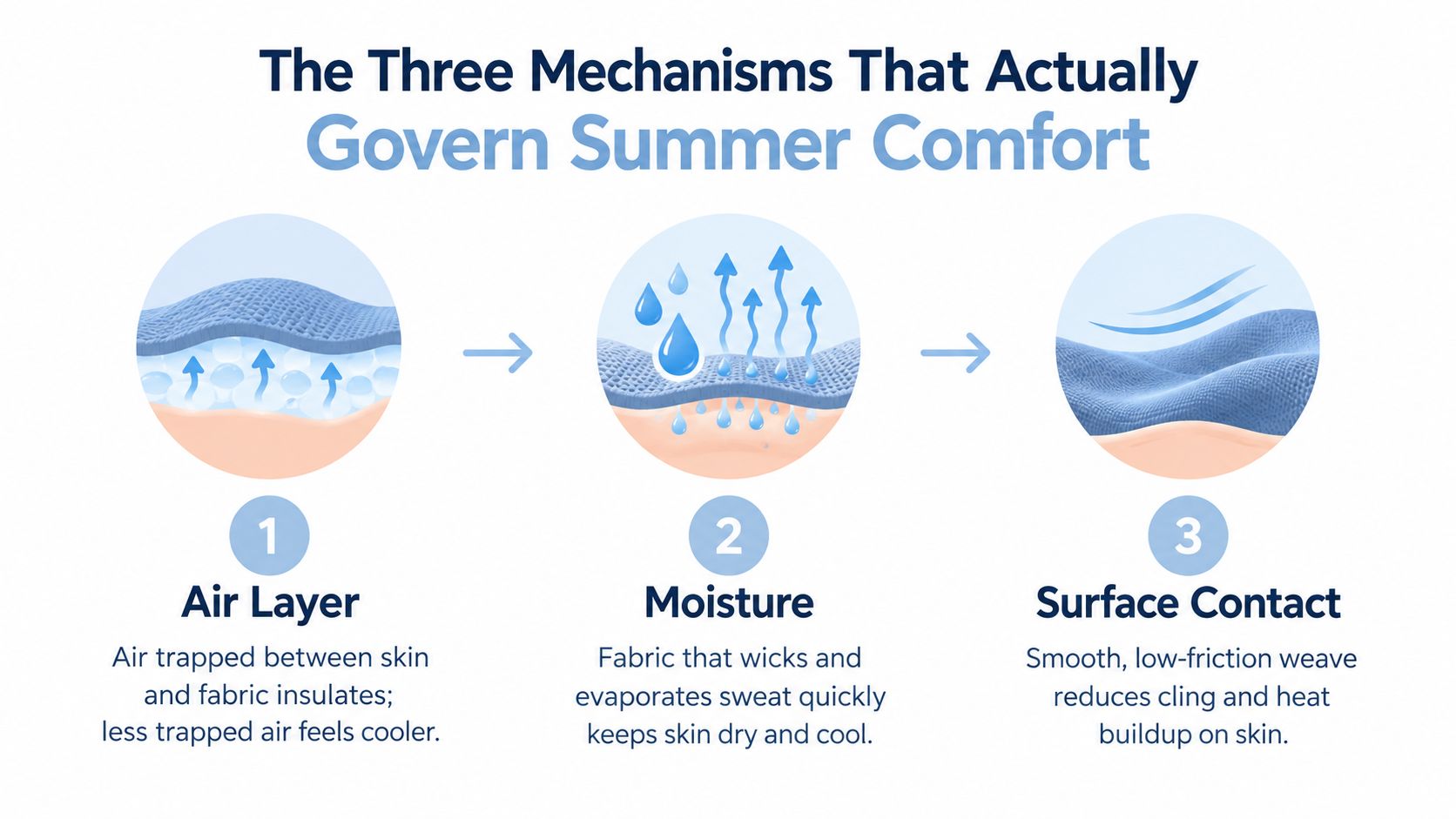
Yes, summer comfort with a jacquard sofa cover depends mainly on three things: the layer underneath, the contact area against your skin, and how easily moisture can evaporate. Those three mechanisms matter more than any broad claim that jacquard is “summer” or “winter” fabric.
Start with the least glamorous point, because it's the one that saves people from disappointment.
Does the sofa underneath matter more than the cover
Yes, the upholstery underneath a slipcover usually matters more than the slipcover in heat. A slipcover is an added layer over the upholstery already there, so the dominant variable in heat is usually what sits underneath.
If your sofa has leather, dense foam, or a seat that already holds heat, a jacquard cover won't erase that. The jacquard slipcover changes the surface feel your skin touches. It does not rebuild the thermal behaviour of the sofa underneath.
A cover can soften the feel of a hot seat. It can't stop a heat-holding base from behaving like a heat-holding base.
That's why two similar-looking covers can end up with opposite verdicts. One is on a cooler fabric sofa with some airflow in the room. The other is on dense foam in still, humid air.
Does texture change how warm a seat feels
Yes, a figured jacquard surface can feel less sticky than a flat smooth surface because less cloth sits flush against skin. That's the contact-area part.
A figured jacquard face has raised and recessed areas, so less cloth touches the skin than with a flat, smooth weave. Your leg or arm mostly touches the raised parts. The hollows in between create tiny breaks in the contact patch. A flat weave sits more evenly against skin, so you get one continuous patch of cloth touching you.
A simple comparison helps. Think of the difference between a waffle towel and a flat sheet. The sheet lies right across the skin. The waffle texture leaves tiny channels and gaps.
Why humidity changes everything
Yes, evaporation is the part people notice most on humid evenings. A seat feels clammy when moisture can't escape from the place where skin and fabric meet.
A raised weave helps by breaking that damp contact patch into ridges and hollows. That gives air a chance to reach the surface and lets moisture leave more easily. A flat face keeps a broader patch sealed. Once that patch warms up, the whole seat can feel sticky even if the room itself isn't brutally hot.
Here's a short visual explanation before the next point:
Where fibre still matters
None of that cancels fibre choice. Natural fibres such as cotton and linen behave differently in warm, humid air from dense polyester-heavy constructions, which is why the fibre doing the work matters as much as the figure woven into it.
For a sofa cover, that still isn't a magic promise. It just means that if you're asking whether is jacquard fabric good for summer, the honest answer is built from mechanism. First the base seat. Then the contact pattern. Then the room's ability to let moisture escape.
How Jacquard Compares to Velvet and Flat Weaves in Heat
Yes, figured jacquard usually sits between velvet and flat weaves in summer comfort. Figured jacquard is often less clingy than velvet and less sealed against skin than a flat smooth weave, but it usually won't feel as instantly crisp as a very plain, light cloth.
The comparison only makes sense if you judge all three fabrics by the same standards. Surface feel alone can fool you in a showroom.
Which fabric feels warmest in hot weather
Velvet upholstery or a velvet slipcover usually feels warmest in heat because velvet pile holds a layer of warmth close to the body. Its pile holds a warm layer of air against the body, which is why it tends to feel more suited to cooler weather.
That doesn't make velvet bad. If your living room already runs warm, a velvet seat tends to announce that faster than a figured jacquard does. Readers looking at upkeep as well as feel may also find dark velvet sofa maintenance useful, because pile fabrics behave differently from woven figures.
Where flat weaves win and where they lose
A flat weave can feel cleaner and cooler at first touch, but a flat weave also sits more fully against skin once you settle in. That's the trade-off.
Flat cotton or linen surfaces often feel straightforward and light. But because the face is smooth, your leg or arm can lie flush against it. On a humid afternoon, that broad contact patch can turn sticky faster than people expect.
A smooth fabric can feel cooler on first contact and clammy later. A textured fabric can feel less cool at first and more comfortable after ten minutes.
How figured jacquard fits between them
Figured jacquard usually feels more comfortable than cool. The raised motif reduces full-surface cling, but the fabric can still feel more substantial than a very plain weave.
Here's the side-by-side view:
| Factor | Figured Jacquard | Velvet | Flat Weave (cotton/linen) |
|---|---|---|---|
| Skin contact | Partial contact on raised areas | Broad contact through dense pile | Broad, even contact |
| Air movement at surface | Some micro-gaps from texture | Limited at the surface | Depends on weave, but face sits flatter |
| Humidity feel | Often less sticky than smooth cloth | Can feel close and warm | Can turn clammy once skin seals to surface |
| First touch | Textured, not especially crisp | Soft, warm-leaning | Often coolest at first touch |
| Best summer use | Shaded rooms, everyday seating | Cooler seasons or air-conditioned rooms | Hot rooms if the cloth itself is light |
If you want the shortest verdict, it's this: jacquard often makes sense when you want a sofa cover that feels less sticky than velvet and more forgiving than a completely flat face, but it won't turn a sun-baked sofa into a cool seat.
Fitting a Jacquard Slipcover So It Breathes in Summer
Yes, the way a jacquard slipcover is fitted changes how bearable the seat feels in summer. A stretch cover pulled drum-tight can remove the small air gaps that make a textured surface feel less sticky.
That point matters more than people think. A good fit for appearance isn't always the best fit for warm-weather comfort.
Should a summer slipcover be stretched tight
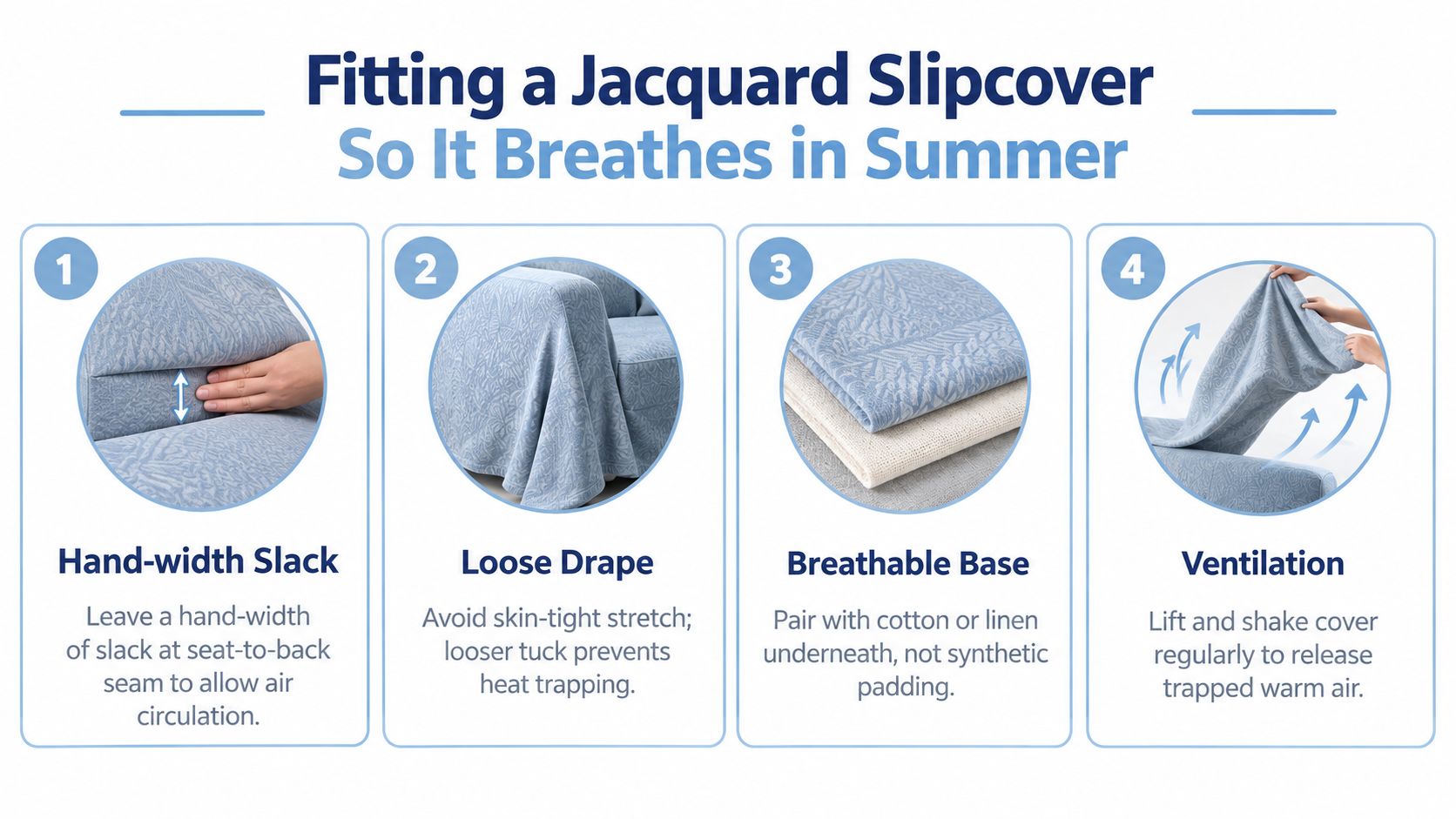
No, a jacquard slipcover for summer shouldn't be stretched as tightly as possible everywhere. A little controlled slack helps the cover behave more like a breathable layer and less like cling film over upholstery.
The most useful place to leave that slack is the seat-to-back join. If you tuck the fabric aggressively into that crease and pull everything hard across the seat, you flatten the texture and seal the cover more tightly to the frame.
Try this instead:
- Leave the centre tuck slightly looser so the seat and back join isn't sealed flat.
- Smooth the cover with your hands rather than yanking every edge hard.
- Check where your legs rest most often because that's where over-tension matters most.
What parts of the fit make the biggest difference
Arm tension, deep tucking, and cushion bulk make the biggest difference to summer feel. Those aren't styling details. They change surface behaviour.
A few practical adjustments help:
-
Arm caps
If the arms are pulled very tight, the jacquard figure flattens and feels more closed. A slightly softer drape keeps more texture at the surface. -
Seat-back join
Leave the tuck a little looser than you would in winter. That small looseness gives warm air somewhere to move instead of trapping it right where your lower back sits. -
Loose cushions
Thicker, heavily filled seat cushions release heat slowly. Slimmer seat pads under a cover often feel less clammy in a warm room.
The goal isn't a sloppy fit. The goal is to avoid turning a textured cover into a sealed, stretched membrane.
Can fitting fix a genuinely hot sofa
No, fitting tricks can improve a jacquard slipcover, but fitting tricks can't override a hot room or a heat-holding sofa base. If a sofa sits in direct western sun or stores warmth in dense foam, a better tuck only takes the edge off.
That's the honest limit of any cover. It can improve surface comfort. It can't act like a cooling system.
Caring for a Jacquard Cover Through an Australian Summer
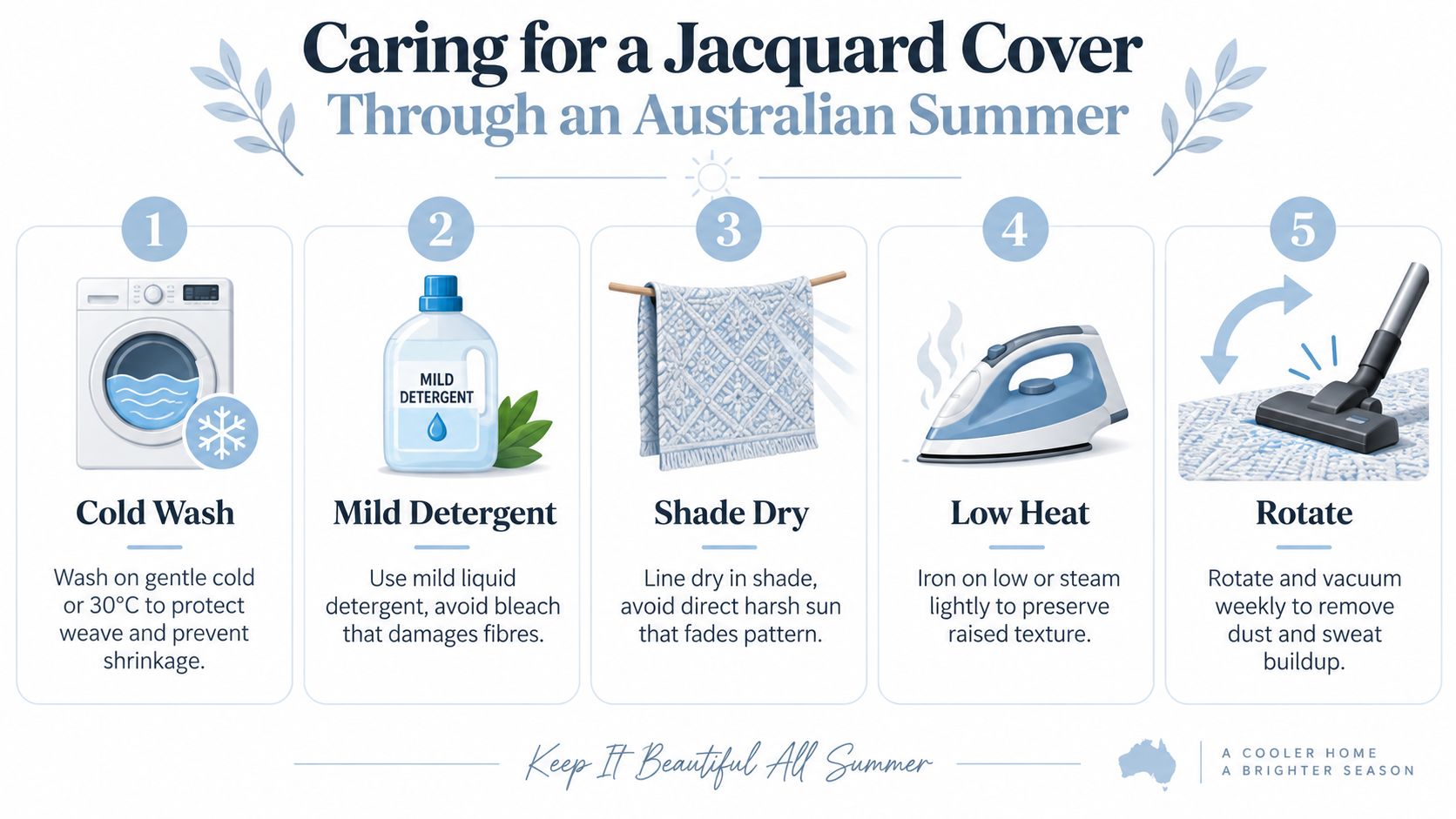
Yes, a jacquard cover can be cared for safely through summer if you keep washing gentle, avoid harsh heat, and dry it out of direct sun. Summer care is mostly about protecting the woven figure from sweat, sun, and overheating during cleaning.
Raised woven surfaces don't usually love rough treatment. The pattern is part of the structure, so once the face is dulled or stressed, you don't really wash your way back to the original finish.
How should a jacquard cover be washed in hot months
As general guidance, a jacquard cover is usually washed on a gentle cold or warm cycle, with bleach and high heat avoided — always follow the care label on your own cover. That is a cautious default rather than a rule for every cover, so where the label and the general advice differ, the label wins.
That gives you a safe baseline:
- Use a gentle cycle rather than a hard wash.
- Choose cold or warm water rather than hot.
- Skip bleach because strong chemicals can dull or stress the raised yarns.
- Iron on the reverse if needed and keep heat moderate.
Is line drying better than direct sun
Yes, line drying in the shade is safer for a jacquard cover than drying in harsh direct sun. Summer sun doesn't just dry fabric. It also puts contrast and colour under pressure.
If the jacquard figure has a visible raised motif, direct sun can make the surface age unevenly. Shade drying on a covered line or an indoor rack with airflow is gentler.
A simple summer routine works well:
| Care step | What to do |
|---|---|
| After heavy use | Shake out the cover and let trapped moisture air off |
| When washing | Use a gentle cold or warm wash |
| For drying | Line dry in the shade or indoors with airflow |
| For ironing | Warm iron on the reverse if the care label allows |
| For weekly upkeep | Rotate loose cushions so one patch doesn't take all the wear |
What care can't fix
Care can't remove the heat load of a hot room. If a dark cover sits in a west-facing room with trapped afternoon heat, washing technique won't change the room's temperature.
That's why maintenance matters, but expectations matter too. Good care preserves the cover. It doesn't turn a warm environment into a cool one.
The Casamé Jacquard Range and How the Two Figures Differ
Yes, the two jacquard figures differ mostly in look and scale, not in any proven summer-performance ranking. The choice between them is mainly visual.
At Casamé Home, the jacquard line includes the Jacquard Couch Cover with a narrower repeat and the Diamond Jacquard Couch Cover with a broader diamond figure. The couch-cover sizes run in seat-width bands of 1 seater 90 - 130 CM, 2 seater 135 - 175 CM, 3 seater 180 - 220 CM, and 4 seater 225 - 300 CM. The range also includes the Jacquard Sofa Bed Cover, Jacquard Couch Cushion Cover, Jacquard Cushion Cover, and Diamond Jacquard Cushion Cover.
Our jacquard pieces carry a figure woven into the cloth, and on the couch and couch-cushion covers that jacquard sits on a stretch base.
How does the narrow repeat read in a room
The Jacquard Couch Cover with the narrow repeat reads as the quieter, denser figure. The motif sits in a tighter rhythm, so it tends to look more settled on smaller sofas or in rooms that already have pattern elsewhere.
That narrower figure often suits:
- Compact seating where a broad motif would look oversized
- Sofa beds and cushion covers that need texture without a strong geometric statement
- Layered rooms with throws, art, or patterned rugs already in view
A concrete example is the Jacquard Couch Cover, Light Grey. Light grey tends to sit easily with both cool and warm interiors because it doesn't pull strongly toward either blue or beige.
What changes with the wide diamond figure
The Diamond Jacquard Couch Cover reads as broader and more graphic. The spacing between motifs gives the eye a little more rest, so the pattern can feel calmer even though the figure itself is larger.
Here's the range at a glance:
| Figure | Visual character | Best suited to | Available formats |
|---|---|---|---|
| Narrow repeat jacquard | Tighter rhythm, more understated texture | Smaller sofas, mixed-pattern rooms, subtle styling | Couch covers, sofa bed cover, couch cushion cover, cushion cover |
| Wide diamond jacquard | Broader geometric figure, more visible spacing | Larger sofas, cleaner rooms, more graphic styling | Couch covers, cushion cover |
For cushion covers, the same principle applies. A quieter jacquard cushion cover usually blends in. A wider diamond pattern reads more decorative. Neither figure is more breathable by design. Summer comfort still comes back to the room, the base seat, and how tightly the cover is fitted.
When Jacquard Is the Right Summer Choice and When It Is Not
Yes, jacquard can be the right summer choice in some rooms and the wrong one in others. Jacquard works best when you want a textured surface that feels less sticky than pile, and when the room itself isn't fighting you.
Jacquard usually makes sense for occasional seating, decorative covers, and sofas in shaded rooms with fans or air conditioning. It also makes sense when your main complaint is that a smooth seat feels clammy against bare skin, because a figured surface can reduce that sealed contact.
When does jacquard make sense in summer
Jacquard makes sense in summer when the room and the furniture base are already reasonably forgiving. Good examples include:
- Shaded living rooms where the sofa doesn't sit in direct harsh sun
- Homes with air movement from ceiling fans or air conditioning
- Occasional-use seating that isn't absorbing body heat all day
- People who dislike the sticky feel of flat smooth covers
Australian summer-bedding advice leans the same way, toward naturally breathable materials and away from heat-trapping synthetics such as polyester and microfibre (summer home textile guidance). Applied to a sofa cover, that points toward lighter, more breathable jacquard constructions rather than thick polyester-heavy ones when summer comfort matters.
When should you choose something else
Jacquard is not the best choice for every hot room. If the sofa is deep, heavily padded, used for hours at a time, and sitting in an unairconditioned room, the cover can only do so much.
Jacquard is a weaker choice when you have:
- A sun trap room that stores afternoon heat
- Dense foam or leather underneath that stays warm
- Heavy pet shedding that settles into textured surfaces
- A goal of maximum cool feel rather than balanced comfort
The one habit that matters most is simple: shake out or rotate the cover regularly so body moisture doesn't sit and turn into a damp patch later. That habit won't change the weather, but it does stop yesterday's humidity from becoming today's discomfort.
If you're weighing texture against summer comfort, Casamé Home offers jacquard couch covers, diamond jacquard options, sofa bed covers, couch cushion covers, and matching cushion covers, with the couch covers sized in clear seat-width bands. If your sofa runs warm, look at jacquard as a surface change, not a miracle fix, and choose the figure and fit that suit the room you live in.