


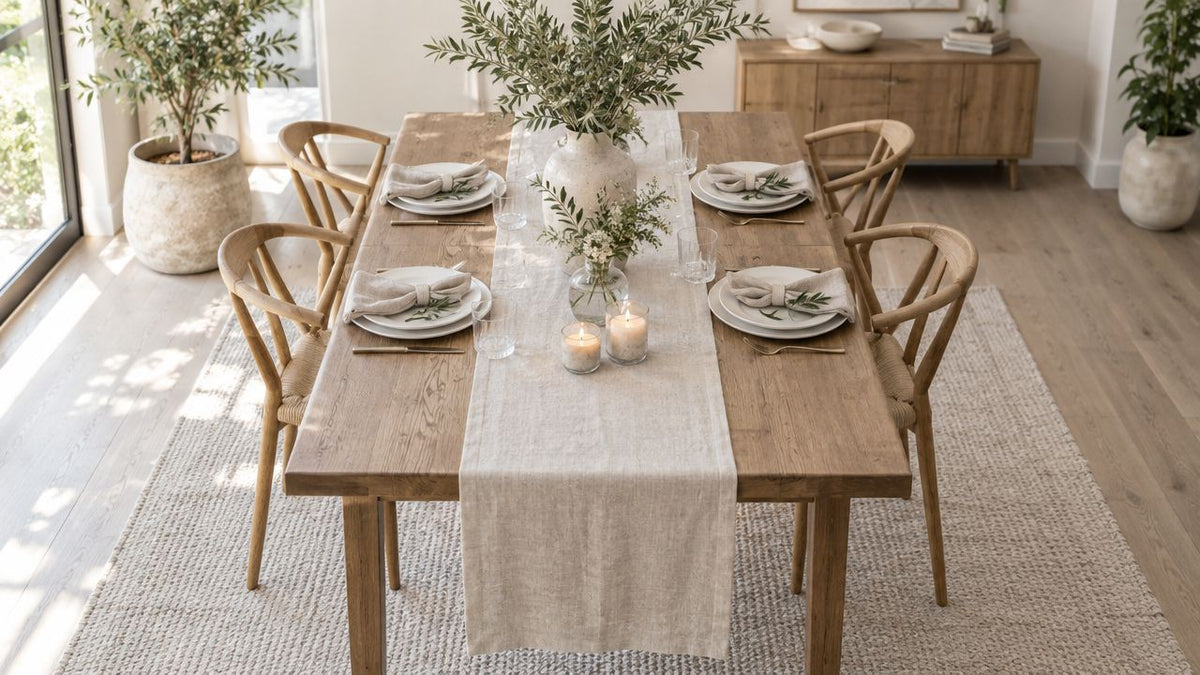
You're probably standing in front of your dining table wondering why the room still feels unfinished, even though the chairs are sorted and the dishes look fine. A dining table runner fixes that gap fast, because it gives the table a centre line, adds texture, and makes everyday meals feel considered without covering the whole surface. In Australian homes, that matters just as much for weeknight dinners as it does for entertaining, especially when you want something practical, easy to wash, and simple to style.
A runner is also one of the easiest textile choices to get wrong, because sizing, fabric, and overhang all affect how tidy the table looks. This guide breaks those decisions down step by step, so you can choose a runner that suits your table shape, your cleaning routine, and the way you use the room.
For shoppers comparing table textiles across the home, the same practical mindset applies to a table cover for Australian homes, where fit and care matter more than decoration alone. A runner is smaller, but the thinking is similar, measure first, then choose for use, not just for looks.
Table of Contents
- Introduction
- What Is a Dining Table Runner and What Does It Do
- What Size Dining Table Runner Do You Need
- Which Material and Finish Should You Choose
- How Do You Style a Dining Table Runner for Every Season
- How Do You Wash and Care for a Dining Table Runner
- How to Coordinate Your Runner With Sofa Covers and Throws
Introduction
A dining table runner is a long, narrow textile that sits down the centre of a dining table, like a scarf for the table. It can make a plain table feel finished, help organise the setting, and add a layer of softness without hiding the grain, colour, or shape of the table itself. For a first-time decorator, that's the main appeal, the runner changes the mood of the room without asking you to commit to a full tablecloth.
In Australian households, the category isn't just decorative in theory. The ABS places household textiles within the broader Furnishings and household equipment spending group, and it tracks that spending through national benchmark estimates plus quarterly indicators drawn from bank transactions and Retail and Wholesale Industries Survey weights. The ABS also recorded average weekly expenditure on Furnishings, household equipment and services at $149.62, with Household textiles at $7.87 in that expenditure framework, which shows the category has long been part of formal household spending records in Australia. ABS household final consumption expenditure concepts and methods
That matters because a runner is not a one-off styling extra. It sits inside a recognised household-textile universe, and Australian shoppers usually end up balancing three things at once, size, material, and care. A good runner should suit the table's length, leave enough visible surface around it, and handle the way the home is used, whether that means school-night pasta, weekend grazing plates, or a more formal meal.
The category also has a clear market footprint in Australia. Trade data for HS 6302, which covers bed linen, table linen, toilet linen, and kitchen linen, shows imports of US$598,835,001.42 in 2023 and exports of US$15,984,001.99, which signals a substantial net import position for the broader table-linen type of household textile. Australia HS 6302 trade data For buyers, that usually means the choice isn't about finding a single standard answer, it's about selecting the right runner for the table and the household.
What makes a runner worth choosing
A runner works best when it solves a visual problem and a practical one at the same time. If a dining table feels bare, a runner adds a clear line for the eye to follow. If a table always looks cluttered, a runner helps define the centre so place settings, candles, and serving pieces don't feel scattered.
Practical rule: a runner should frame the table, not fight it. If the runner is so long, wide, or patterned that the table itself disappears, the setting usually feels heavier instead of cleaner.
That balance is why shoppers often keep a runner in the same family of decisions as throws and covers. A dining table runner can echo the soft texture of a sofa throw or cushion cover in a nearby living space, which helps an open-plan room feel intentional rather than pieced together. The trick is to keep the visual language simple, repeat one or two ideas, then stop before the room starts to feel overworked.
What Is a Dining Table Runner and What Does It Do
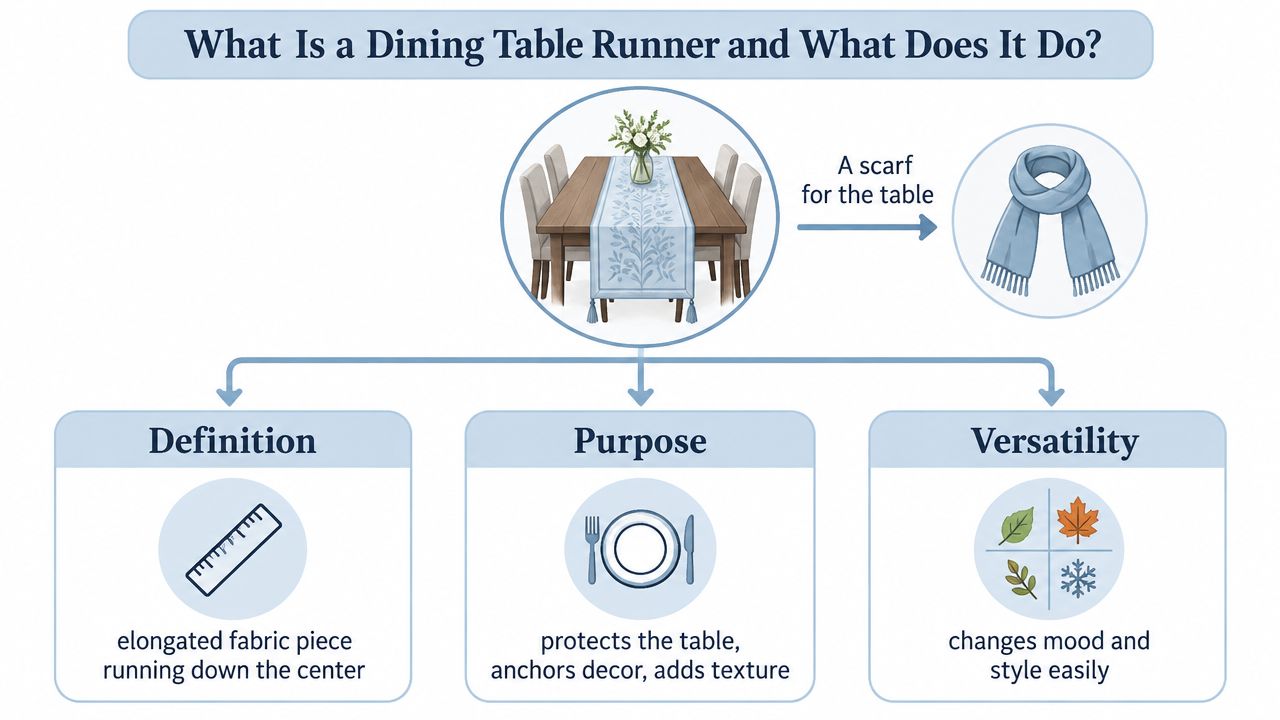
A dining table runner is a long, narrow strip of fabric placed lengthwise down the centre of a table, and it behaves like a scarf for the table. It adds a clear central line, gives the table a finished look, and provides light surface protection where serving dishes or decorative items sit. That combination makes the runner more useful than a plain decorative strip, but less covering than a full tablecloth.
Three jobs a runner performs
The first job is decoration. A runner adds colour, texture, and sometimes pattern, so a dining area feels styled rather than bare. A linen runner can soften a timber table, while a patterned weave can give a plain room more personality without overwhelming it.
The second job is structure. The runner creates a centre line, which helps your eye understand where the table setting begins and ends. That's useful when you're pairing placemats, candles, bowls, or a vase, because the runner acts as the visual anchor.
The third job is light protection. A runner can help shield the centre of the table from warm serving dishes, small marks, and day-to-day contact, although it isn't the same as full spill protection. If a household needs stronger protection, a runner can still be layered with placemats or paired with a more protective table textile.
A good way to think about the decision is simple, if the dining table already looks complete on its own, the runner can stay minimal. If the table feels too empty, too dark, or too flat, the runner gives it shape without locking you into a permanent style. That's why runners suit both everyday use and entertaining, they're easy to change when the room needs a different mood.
For a casual home, a runner alone may be enough, especially if the table is beautiful and the rest of the room is already textured. For family meals or hosting, the runner works better as part of a layered setting with placemats, napkins, and a centrepiece. The runner doesn't need to do everything, it only needs to give the table a clear foundation.
When a runner is enough and when to layer it
A runner by itself suits a table that already has strong shape or grain. It also suits homes that prefer a cleaner look, because the fabric sits and lets the table do the talking. On the other hand, a runner plus placemats suits tables that need more definition at each seat, especially when the dining area doubles as a work or family zone.
A runner is the simplest way to make a table feel dressed without making it feel covered.
If you're also choosing broader home textiles, the same logic shows up in products like the Pomelle Throw Blanket · Space Grey, which layers a sofa or bed with soft chenille ribs and bobble-trimmed edges, comes in four sizes from 180 × 130 cm up to 180 × 420 cm, and is machine washable on a gentle cycle. That sort of tactile layer is useful in a room where the dining table runner and the lounge textiles need to feel visually related, not identical.
What Size Dining Table Runner Do You Need
A dining table runner should be sized as an overhang decision, not as a fixed standard. In practical terms, the runner usually needs to be about 30 to 45 cm wide and long enough to extend 15 to 30 cm past each end of the dining table. That gives the runner enough presence to look deliberate while still leaving the table ends readable.
Start with the table length
If your dining table is 180 cm long, an Australian retailer guide says a runner of 210 to 240 cm works best. Shorter 150 cm runners suit small dining tables or coffee tables, where a long drop would look bulky. Manchester Collection table runners guide
Another Australian buying guide frames length as an overhang choice, recommending roughly 30 to 40 cm total for both ends, while a formal setting can use 15 to 25 cm of overhang at each end and a casual setting can use 5 to 10 cm. NestPath table runner guide The important part is not the exact number on the package, it's whether the runner hangs with enough balance to match the way the table is used.
Match the shape, not just the length
Rectangular tables are the easiest case, because the runner can follow the long axis cleanly. Round tables need more care, since a runner across a round top can look more decorative than structural. Extendable tables are the hardest, because the finished length changes, so the safest choice is usually a runner that works with the table in its everyday length first.
A wide runner can feel too dominant on a slim table, while a narrow runner can disappear on a long one. Think of the runner like a belt on an outfit, the width should support the shape, not squeeze it or drift out of proportion.
Measuring shortcut: measure the table, then add the overhang you want on both ends before you shop. That keeps the runner from ending up too short for formal use or too long for everyday meals.
| Dining Table Runner Sizing Quick Reference | ||
|---|---|---|
| Table Length | Recommended Runner Length | Overhang Per End |
| Small table | About 150 cm | Shorter overhang, suited to compact settings |
| 180 cm table | 210 to 240 cm | 15 to 30 cm |
| Longer table | Add your preferred overhang to the table length | 15 to 30 cm, or 5 to 10 cm for a casual look |
Before you buy, check three things. First, measure the table without the chairs crowding your tape measure. Second, decide whether the runner is for everyday use or occasional entertaining. Third, look at how the runner will sit with plates, serving bowls, and centrepieces, because the right length is the one that leaves the setting balanced, not crowded.
Which Material and Finish Should You Choose
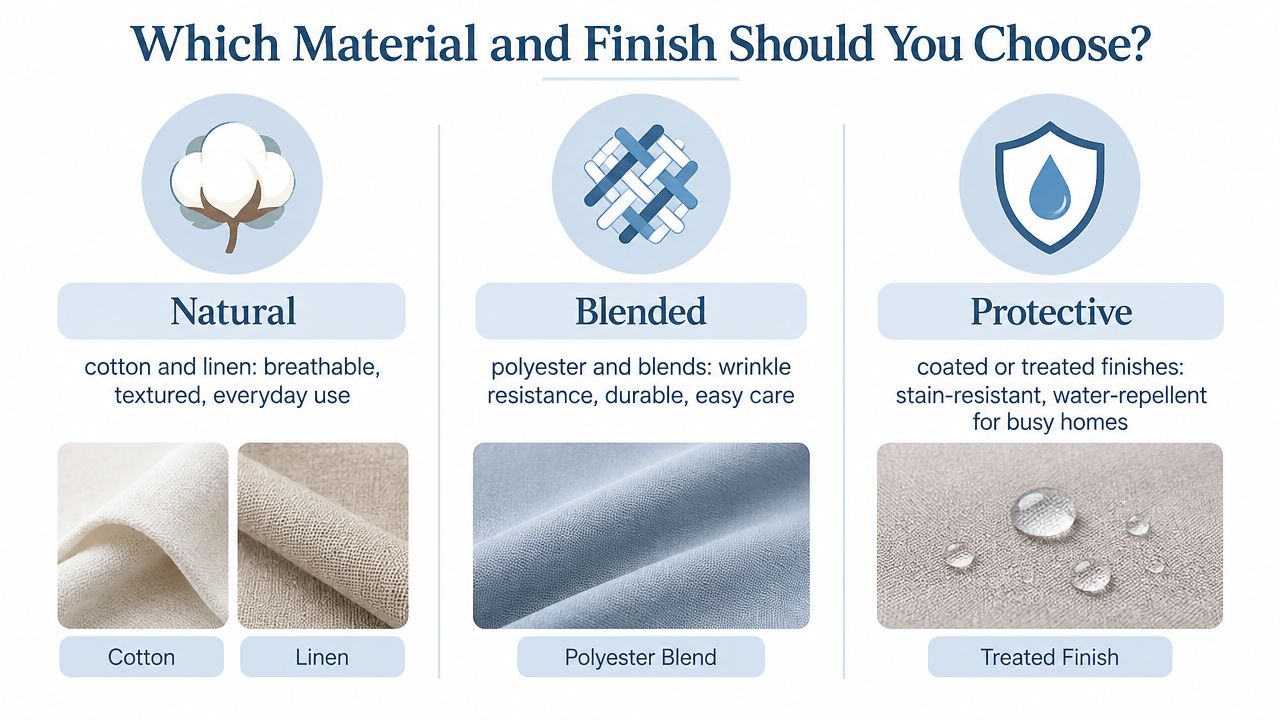
A dining table runner works best when its material matches the way your table is used. Cotton and linen bring a soft, relaxed look. Polyester and blends are easier to keep neat. Treated finishes help when spills are part of ordinary family life. The right choice comes down to how the runner handles a normal weekday meal, not just how it looks on the day you buy it.
Natural fabrics for relaxed everyday tables
Cotton and linen suit homes that want a softer, more tactile finish. Cotton feels familiar and easygoing. Linen has a crisp, airy texture that sits nicely with timber tables and simple place settings. These fabrics work well for everyday dining and for casual entertaining, where warmth matters more than a polished surface.
There is a trade-off. Natural fabrics crease more easily, and they usually need more careful washing and drying. If you like a lived-in look, that can be part of the charm. If you want a smooth finish that stays tidy with little effort, another fibre may suit you better.
Blended fabrics for easier care
Polyester and blended runners are useful when you want a tidier surface with less fuss. They usually resist wrinkling better than many natural fabrics and tend to hold their shape after washing. That makes them practical for households that use the dining table often, then want it looking ready again without much ironing.
Patterned weaves and textured finishes also help. A jacquard-style or textured runner can hide small marks and light creasing better than a flat weave, which is handy when the runner stays on the table through family meals. If your runner needs to look dressed but not delicate, this middle ground is often the easiest to live with.
Protective finishes for busy homes
Coated or treated finishes suit busy households, because they offer more resistance to spills and moisture than untreated fabric. That does not make a runner indestructible, but it does make cleanup less stressful when children, pets, or frequent entertaining are part of daily life. In that setting, the finish matters as much as the colour.
For shoppers comparing practical table textiles, the durable patio linens category shows a similar idea in a different setting, where fabric has to cope with more exposure and mess. The same thinking helps at the dining table. Choose the finish that matches how often the runner will be used, not just how it looks on day one.
| Material or finish | Look | Feel | Care effort | Best for |
|---|---|---|---|---|
| Cotton | Soft and familiar | Comfortable, relaxed | Moderate | Everyday dining |
| Linen | Crisp and textured | Natural, airy | Moderate to higher | Casual entertaining |
| Polyester blend | Neater, less fussy | Smoother, practical | Lower | Busy households |
| Treated finish | Functional and clean-looking | Slightly more structured | Lowest for spill management | Family meals |
A simple rule helps here. If you like natural texture and do not mind a little upkeep, cotton or linen makes sense. If you want a runner that asks for less attention, choose a blend or a treated finish. For a table that gets heavy use, pick the option that lets you wipe, wash, and get on with dinner.
How Do You Style a Dining Table Runner for Every Season
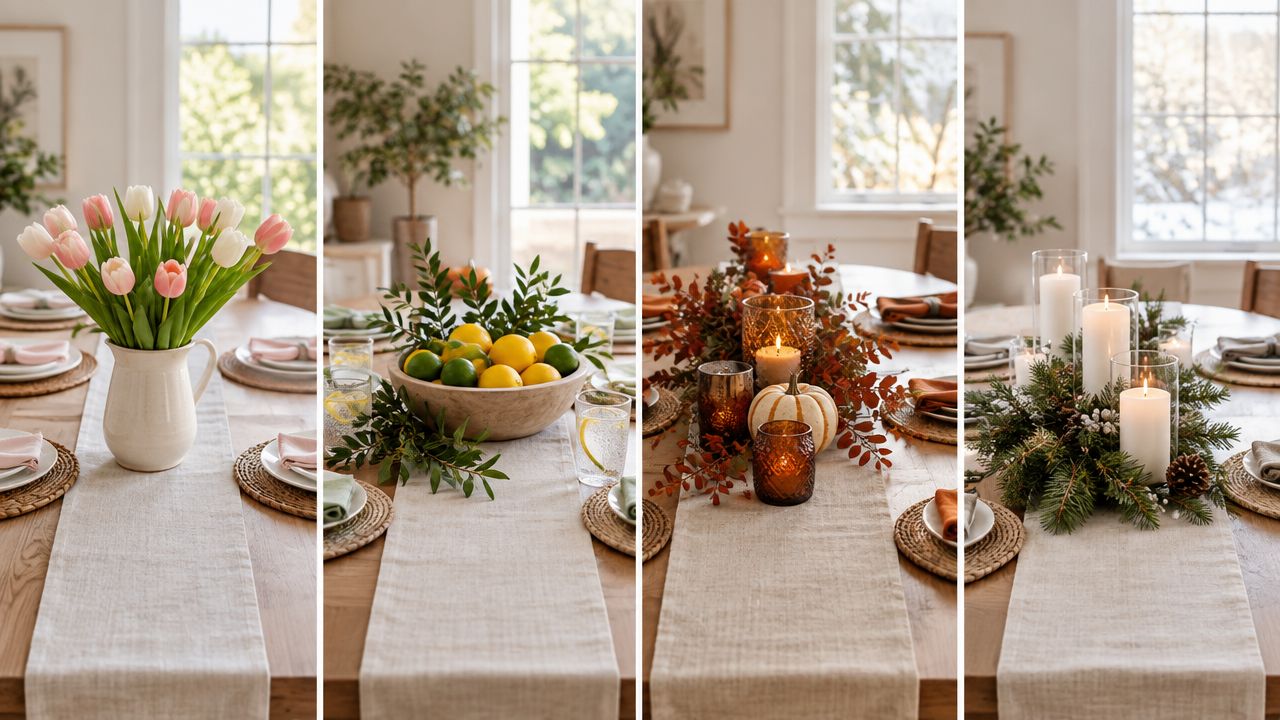
A dining table runner styles best when it acts as the base layer, then the rest of the table builds around it. That means the runner should give shape to the table, while placemats, candles, bowls, and flowers provide the mood. The cleanest tables usually leave some tabletop visible, so the runner frames the setting instead of crowding it.
Build the table from the runner upward
Start with the runner, then add one or two supporting elements. A narrow vase, a pair of candles, or a bowl of fruit can be enough for everyday use. For entertaining, add placemats or cloth napkins, but keep enough room around each place setting so the table can still breathe.
If the runner has pattern, keep the other pieces calmer. If the runner is plain, the centrepiece can take on more texture. That balance stops the table from becoming visually noisy, which is a common mistake when people decorate in layers for the first time.
For a summer look, a light coastal palette works well with natural textures and glassware. For autumn, earthy colours and warmer candlelight feel grounded. Spring suits crisp neutrals, fresh flowers, and simple shapes that look clean rather than heavy.
Keep the room style connected
The dining table doesn't sit alone in most Australian homes, especially in open-plan layouts and smaller rentals. A runner can echo the tones in nearby seating, throws, or cushion covers so the dining zone feels like part of the same room. That doesn't mean repeating the same fabric everywhere, only repeating a colour family or texture family in a softer way.
One easy approach is to choose a runner with a quiet pattern, then repeat that pattern's mood somewhere else in the space through a solid throw or a textured sofa cover. The room reads as coordinated without looking matched too hard. That matters in homes where the dining area and lounge area are close together, because the eye travels across both spaces at once.
Seasonal styling also gets easier when you think in layers, not themes. A runner can stay in place all year, while the centrepiece changes. Candles one month, fruit the next, flowers after that. The runner becomes the constant, and the rest of the table adjusts to the season without needing a full re-style.
How Do You Wash and Care for a Dining Table Runner
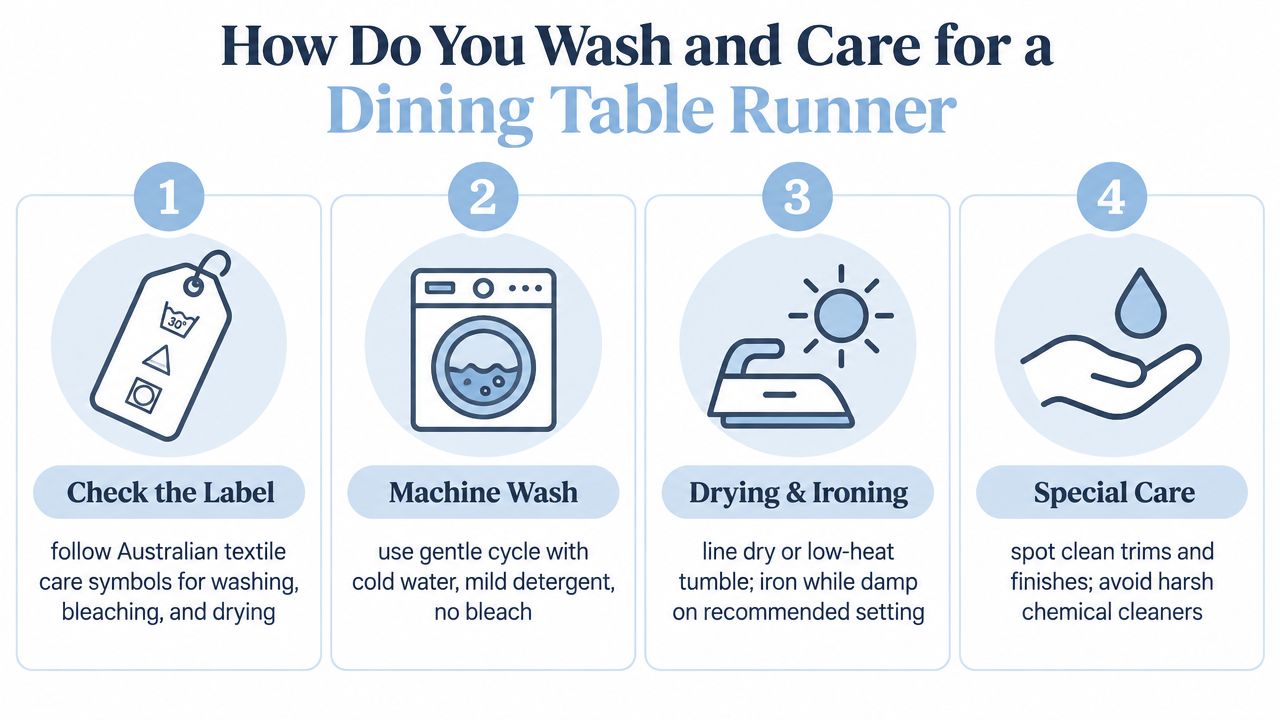
A dining table runner should be washed according to its fibre content, finish, construction, and any trims, because those details change the care it needs. In Australia, suppliers can use English care instructions, international care symbols, or both, and the label should reflect how the runner needs to be treated so shrinkage, distortion, and dye transfer are less likely. Product Safety Australia care labelling guide
Follow the label first
Start with the care label, then treat the runner according to the fabric. A cotton or blended runner may be fine in a home machine, while a runner with decorative trims or more delicate finishing can need gentler handling. If the label says hand wash or dry clean, that instruction matters because the finish is part of the product, not an afterthought.
For linen runners, one Melbourne-based retailer advises machine washing in a standard home machine, at or below 40°C, and avoiding bleach, dry cleaning, and high-heat tumble drying. It also recommends line drying in the shade and ironing on the reverse with a protective cloth. Pepper Whites table runner care advice
Deal with marks before they settle
If food lands on the runner, blot first rather than rubbing. Rubbing pushes stains deeper into the weave and can distort the fibres, especially on textured fabric. For everyday runners, a quick pre-treat and a normal wash is usually easier than letting a mark sit and then trying to rescue it later.
Storage matters too. Fold the runner loosely, keep it clean and dry, and avoid cramming it into a tight drawer where hard creases can set in. For occasional-use runners, that small habit makes a big difference to how polished the fabric looks when you bring it back out.
A runner that is used every day may need more frequent washing than one that only comes out for gatherings. The important thing is to respect the fabric, not fight it. A little routine care keeps the colours steadier, the weave flatter, and the table setting easier to reset next time.
How to Coordinate Your Runner With Sofa Covers and Throws
A dining table runner coordinates well with sofa covers and throws when you repeat the same colour family, texture, or pattern mood across the room. The goal isn't perfect matching. It's visual rhythm, so the dining zone and the lounge zone feel like parts of one home instead of separate styling decisions.
Use one palette across both zones
If the runner is soft neutral, keep nearby upholstery in a similar range and add contrast through one accent cushion or throw. If the runner is patterned, let the sofa cover or throw stay plain so the eye has somewhere to rest. That keeps the room balanced, especially in open-plan homes where the dining table and couch are visible at the same time.
A textured runner can also pair nicely with a smooth sofa cover, because the contrast makes both pieces stand out. You don't need every textile to be busy. A single woven runner, a solid slipcover, and one soft throw can do more for the room than several competing patterns.
Coordinate by purpose, not just by colour
Think about what each textile is doing. The runner handles the table's centre. A sofa cover protects upholstery. A throw adds warmth, softness, or an easy visual change. Once those roles are clear, styling becomes simpler, because each item can support the room without repeating the same job.
The stretch-fit couch throw options at Casamé Home fit that approach well, because throws sit naturally alongside dining textiles when you want the room to feel pulled together without feeling formal. For families, renters, and hosts, that kind of layering is often more useful than chasing a single perfect style.
Styling takeaway: choose one shared thread, then let each textile do a different job. That keeps the room coordinated, practical, and easy to update.
In small rentals or homes with kids and pets, washable and protective textiles usually make the most sense. A runner that's easy to clean, a sofa cover that can be removed, and a throw that can be folded away when needed give you flexibility without permanent changes. That's the value of coordinating textiles, they help the home look planned, even when life is busy.
Casamé Home offers stretch-fit sofa covers, throws, and other practical textiles that work well alongside a dining table runner when you want the whole room to feel coordinated. If you're ready to choose pieces that balance fit, washability, and everyday style for Australian homes, visit Casamé Home and start with the textiles that suit the way you live.


