


A cover egg chair needs to protect the whole outdoor setup, not just the pretty woven pod in the product photo. If your cover slips in coastal wind, traps dampness around the cushions, or leaves the stand and hanging rope exposed, the problem usually starts with the wrong measurements or the wrong cover construction.
Australian conditions are particularly unforgiving. UV, sudden rain, salt air and wind uplift all test the fabric, seams and fastening points. A practical cover should shed water, allow moisture to escape, fit the actual chair variant and come off easily enough that you'll maintain it rather than abandon it.
Table of Contents
- Why Most Egg Chair Covers Fail Before They Even Get Fitted
- Measuring an Egg Chair the Way an Outdoor Cover Actually Needs
- Stretch Cover vs Custom-Made Cover for an Egg Chair
- Fitting the Cover on an Egg Chair Without Losing Seams or Drainage
- Water-Resistant vs Waterproof on an Outdoor Egg Chair
- Caring for an Egg Chair Cover So It Lasts More Than One Summer
- Your Egg Chair Cover Routine in One Pass
Why Most Egg Chair Covers Fail Before They Even Get Fitted
A cover that slips, holds rain on the top curve or stops short of the stand has usually failed at the buying stage. The common mistake is choosing by a styled product image, then discovering that a hanging pod, a freestanding basket and a stand-mounted chair have completely different coverage needs.
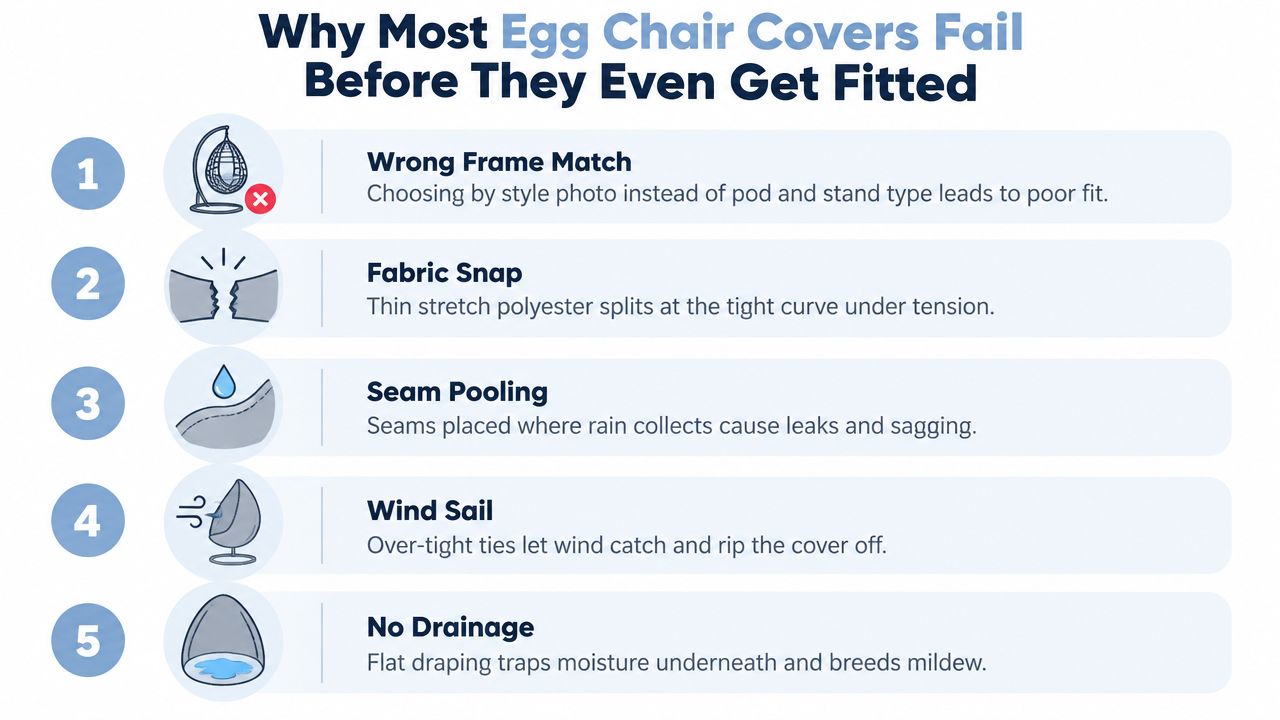
A thin stretch polyester can look neat on a gentle curve but pull hard across the tightest part of the shell. Once the fabric is under constant tension, the curve becomes the first place to split. A seam positioned across the upper bowl can also become a tiny gutter, especially when the cover has no useful slope or venting.
Wind creates the opposite problem. Tie a cover too tightly and the fabric has no room to move, so gusts load the seams and attachment points. Leave it loose and the excess fabric catches air like a sail, flapping against the frame until the coating and stitching suffer.
Practical rule: Match the cover to the frame type first, then judge the fabric and appearance.
The stand is part of the furniture
Buyers often measure only the pod. That leaves the base, chain or rope outside the protection zone, where exposed metal can face rain and salt air. A cover for a hanging egg chair must account for the suspension assembly if the chair stays outdoors, while a freestanding cover needs to handle the footprint and legs without creating a low, water-trapping skirt.
The material matters too. Independent Australian retailer guidance warns that stitched covers can let water through needle holes, while weather treatments can weaken under sun and exposure. Egg-chair cover guidance from Coverworld also highlights the practical difference between a cover that resists a shower and one that keeps cushions dry through sustained weather.
Start by identifying whether you've got a hanging pod, a pod on its own stand, or a freestanding chair with a fixed base. Then inspect the seam layout, coating, vents and fastening system. A cover can only protect the chair it was cut and secured to fit.
Measuring an Egg Chair the Way an Outdoor Cover Actually Needs
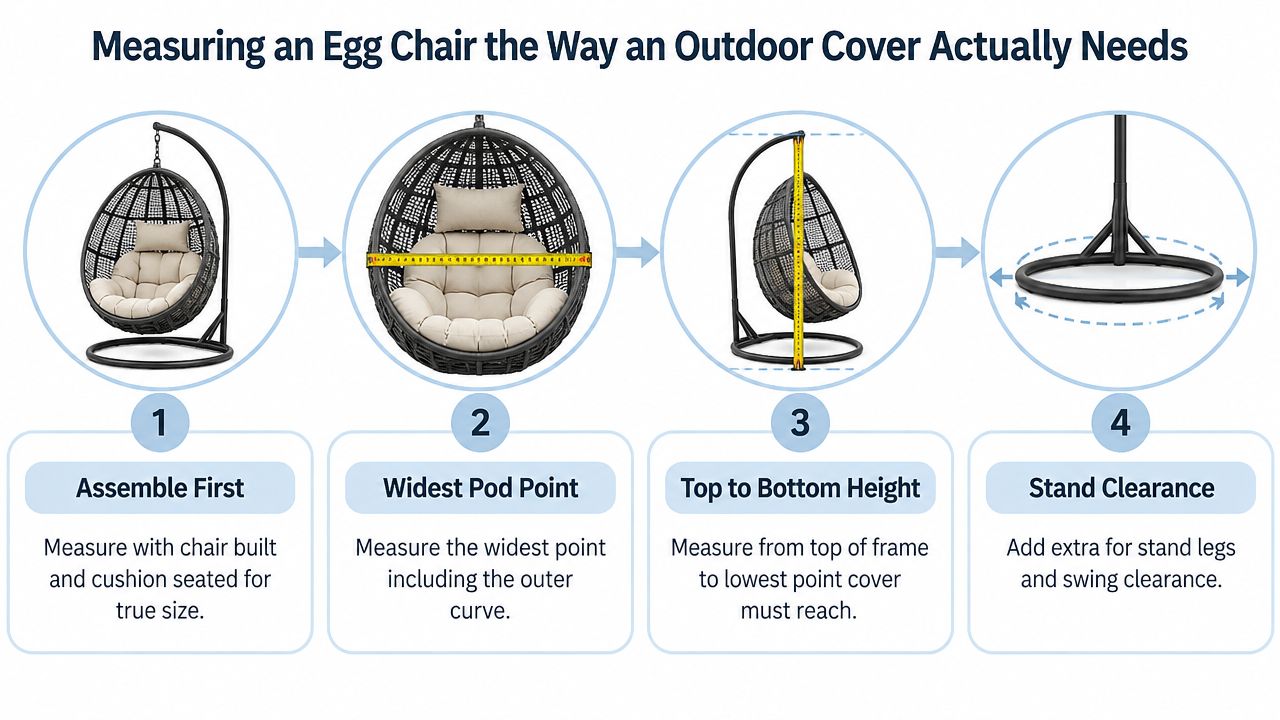
Measure the assembled egg chair with the cushion seated, then measure the pod, cushion profile and stand or hanging assembly separately, adding room for a relaxed fit rather than stretching the cover over the frame.
Step 1, measure the pod first
Use a flexible tape around the widest point of the shell, including the outer curve. Don't measure a straight line across the opening and assume that represents the cover's circumference. Curved furniture needs the tape to follow the shape that the fabric will travel over.
Add 5 to 10 cm around the widest pod measurement so the cover can drop over the curve without forcing the seams. That allowance is a practical fitting buffer, not wasted fabric. A cover pulled tight over the crown has less room to settle, and wind stress will concentrate at the curve.
Step 2, record the full height
Measure from the top of the frame to the lowest point the cover must reach. For a stand-mounted or freestanding chair, include the stand height and the clearance around its feet. For a hanging pod, measure the rope or chain length and decide whether the cover needs to shield the suspension point or only the basket.
Use a similar top-to-bottom buffer where the cover needs to move in wind. The hem shouldn't be so short that gusts lift it above the lower frame, but it also shouldn't drag across wet ground.
Step 3, measure the cushion separately
Record cushion thickness, width and any headrest or side bolster that changes the silhouette. A thick seat pad can push the cover outward and create a different profile from the empty pod. If the cushion remains inside during storms, the cover needs to clear that bulk without pressing hard against damp foam.
Take a photo of every measurement with the tape visible. It makes comparing listings far easier and exposes the usual trap, a standard size that sounds close but doesn't account for your stand or cushion.
The sequence is frame, cushion, then stand or hanging assembly. For a useful comparison with fitted furniture measuring, keep the fitted sofa slipcover measuring guide as a reference, but don't transfer sofa dimensions directly to a curved egg chair.
Use the video below as a visual reminder of how to measure the assembled furniture rather than relying on a catalogue photograph.
Stretch Cover vs Custom-Made Cover for an Egg Chair
A stretch egg chair cover suits sheltered, temporary setups, while a custom-made cover is the safer choice for a fixed chair exposed to full Australian sun, rain and wind.
| Factor | Stretch Cover | Custom-Made Cover |
|---|---|---|
| Fit | Elastic fabric adapts across a range of pod shapes, but irregular shells and stands remain difficult | Cut around the measured pod, stand and suspension arrangement |
| Fabric | Usually lighter and easier to remove | Can be specified in heavier outdoor fabric with more deliberate seam construction |
| Weather performance | Works better under cover or in a protected patio | Better suited to exposed yards, balconies and coastal locations |
| Price | Lower initial outlay | Higher initial outlay |
| Best use | Renters, changing furniture layouts and temporary protection | Permanent outdoor furniture that must stay covered through harsh weather |
A stretch cover is the sensible pick when the chair sits beneath a pergola, you expect to move house or replace the furniture, or budget matters more than a custom finish. Elastic gives you flexibility, but it also places pressure on the most pronounced curves. Strong sun can leave the elastic tired, and loose fabric can still collect water if the top doesn't shed cleanly.
A custom-made cover earns its keep when the chair is a permanent fixture. It can follow the pod and stand rather than forcing one generic shape across both. Ask how the maker handles seams, attachment points, drainage and the suspension hardware. A heavier hand alone doesn't prove better construction.
A cover that fits the full assembly will usually outperform a thicker cover that only fits the pod.
For broader Australian slipcover comparisons, the stretch couch covers Australia guide is useful for understanding how elasticated textiles behave, but an outdoor egg chair still needs outdoor-specific fastening and drainage.
Fitting the Cover on an Egg Chair Without Losing Seams or Drainage
Fit an egg chair cover from the top of the pod downward, align the rear seam before pulling, then secure the lower skirt and ties last so the fabric stays even and water can run away.
Start with the chair assembled and the cushion in its normal position. Place the cover over the crown, find the back seam and line it up with the chair's structural spine. Only then pull the side panels down. If you start at one side, the cover twists around the shell and the lower fastening points end up fighting the frame.
Ease the cover over the curve
Work from the top down with both hands. Smooth the fabric over the shell instead of yanking it across the tightest point. If a second person can support the rim while you settle the cover, use them. That stops the cover catching on the frame and keeps the cushion pocket in the correct position.
For stand-mounted and freestanding chairs, settle the lower skirt around the base before tightening the side ties. Secure the hem or drawcord around the stand footprint first, then use side fasteners to remove movement. For a hanging pod, keep the rope, chain and suspension hardware from bunching under the cover.
A small amount of ventilation at the base is useful. Don't reef the hem against the ground. A 25 mm gap can improve airflow and give runoff somewhere to escape, provided the cover still shields the cushion and the fastening system holds it in place.
Check the trouble spots
Before leaving the chair outside, inspect three areas:
- Wind-facing Velcro: Turn the fastening away from the prevailing gust where possible, and make sure the hook and loop sit flat rather than lifting at the edge.
- Drainage eyelet: Check that the eyelet sits below the lowest section of the cover, not higher than a fold where water can collect.
- Zip and stitched folds: Run the zip without forcing it through a loaded seam. If the fold is pulling, release the tension and reposition the cover.
Keep recliner-style controls, handles and moving hardware clear wherever the chair includes them. Australian fitting guidance recommends aligning seams, pulling down evenly and fastening under-seat flaps or ties at the end. The same Australian cover-fitting instructions warn against obstructing controls and show why snug, not overstretched, installation matters.
Water-Resistant vs Waterproof on an Outdoor Egg Chair
A water-resistant egg chair cover can handle ordinary showers, while a waterproof cover needs sealed seams and suitable backing, not just a waterproof-sounding fabric label.
| Feature | Water-Resistant | Waterproof |
|---|---|---|
| Fabric panel | Repels or slows rain | Designed to block water more completely |
| Stitched seams | May allow seepage through needle holes | Should be taped, welded or otherwise sealed |
| Ventilation | Often easier to combine with vents | Needs careful venting to avoid trapped humidity |
| Best condition | Angled cover, intermittent showers and sheltered patios | More demanding exposure, provided construction claims are clear |
| Main limitation | Coating can wear with UV and weather | Sealed construction can trap moisture underneath |
The seam usually fails before the middle of the fabric panel. Every stitched hole gives water a route in, and curved egg-chair covers create folds where rain can sit. Australian retailer guidance notes that treatments can wear with sun and weather exposure, while pooling can damage the finish. That's why “waterproof” on packaging deserves a construction check.
A taut cover isn't automatically a dry cover. If the top curve is pulled flat without a useful fall, water can sit on the fabric rather than run off. A cover that has some shape, functioning vents and a sensible hem can protect better than a completely sealed bag that traps humid air around the cushions.
When a cover isn't enough
Storage is the better answer when the chair sits in an exposed coastal suburb, faces sustained summer storms or won't be used for more than a fortnight. Salt air can attack stitching and hardware, and a damp cover pressed against cushion foam can create a hidden mould problem even when the outside looks clean.
Run water over a seam before trusting the label. Watch where it travels, inspect the inside for dampness and check whether the fabric beads, absorbs or channels water towards a fold. For more on the balance between rain protection and airflow, see this guide to waterproof breathable fabric.
Caring for an Egg Chair Cover So It Lasts More Than One Summer
An egg chair cover lasts longer when you remove the whole cover set for gentle cleaning, dry every seam fully and store the fabric in a breathable place rather than leaving damp material against the chair.
Start with a regular brush-down and rinse, especially where the chair collects pollen, dust or salt film. Clean the complete cover set together so separate pieces don't develop obvious colour variation. Australian upholstery-care guidance recommends low suction for vacuuming, immediate blotting instead of rubbing and avoiding harsh detergents or soaking.
Clean gently, then dry completely
Remove the cover and inspect the seams before washing. Use cold water and mild soap, with low agitation or careful hand washing. Don't add bleach, fabric softener, laundry detergent or dishwashing detergent to upholstery textiles. Strong products can affect the coating, colour and surface finish.
The drying stage matters more than people expect. Air-dry the cover fully in shade, with the seam side exposed where possible, before putting it back on the chair. Never refit a cover that feels cool or damp at the folds, around the skirt or near the fastening points. Australian care guidance warns against saturating fabric and cushioning, storing damp covers and leaving moisture trapped inside.
Damp fabric under a fitted cover is a mould setup, not a cleaning success.
Check the cover after each serious weather event rather than relying only on a calendar. Look for:
- Fading or stiffness: UV exposure may have weakened the surface treatment.
- Frayed seam thread: Loose stitching can spread when the cover catches wind.
- Flattened or loose elastic: The hem may no longer hold the frame securely.
- Persistent wetting: If water stops beading and the fabric begins to absorb it, investigate re-proofing or replacement.
- Hidden dampness: Feel underneath the skirt and around the cushion contact points.
When the chair comes indoors for an off-season period, fold the dry cover loosely in a breathable bag. Don't vacuum-seal it, compress it tightly or leave it in a sealed plastic container. Australian care instructions also recommend inspecting seams regularly after repeated cleaning, because mechanical stress and trapped moisture can distort the finish or cause failure.
Read the supplied label before washing. Australia's mandatory care-labelling standard covers furnishings and household textiles, and care instructions may use English, recognised care symbols or both. For products that can't be washed or dry-cleaned, the Australian care-labelling information standard requires permanent instructions explaining the correct treatment.
Your Egg Chair Cover Routine in One Pass
A cover works best as part of a repeatable outdoor routine, especially when an egg chair faces coastal rain, salt air, strong UV and wind uplift. Recheck the assembled chair at the start of each season, then again after severe weather. Cushions compress, frames shift and fasteners loosen, so compare the chair with the cover before rain arrives.
The practical loop
- Inspect the construction. Check the coating, seams, elastic, ties, drawcords, vents and drainage points. Fading, brittle fabric and frayed stitching reveal more than a clean product photograph. For a hanging pod, inspect the suspension area and upper cover clearance. For a freestanding or stand-mounted chair, check that the hem clears the base and does not catch beneath the stand.
- Dry-fit before bad weather. Put the cover on while the chair is dry. Align the rear seam, confirm that the widest section sits without strain and check that the cover reaches the intended lower edge. A cover fitted around the pod can still fail if it cannot clear the stand.
- Secure the base first. Hold the lower skirt around the frame or stand, then tension the side ties and drawcord. Keep vents and drainage paths open. The cover should resist wind without trapping a damp pocket against the cushion.
- Respond to local conditions. Spring winds test ties and anchor points, coastal rain exposes weak seams and summer UV attacks the coating. Remove pooled water promptly, and check underneath after wet weather rather than judging the outer surface alone.
- Clean only when needed. Brush away loose debris, wash with low agitation and let every panel dry completely before refitting. Damp fabric put back on the chair can leave the cushion and frame wet for longer.
Replace the cover when water passes through a panel that previously held, seams wick moisture into the chair or the elastic no longer grips the lower edge. A small isolated tear may be patchable. A poor original measurement, particularly one that ignores the stand, needs a better-sized cover instead.
Reassess the fit if the chair gains a thicker cushion, changes shape or moves from a shaded pergola into full sun and weather. Covers protect against exposure. They do not stabilise an unsafe chair or stand. Secure the furniture correctly, keep children away from unstable assemblies and inspect hanging hardware as well as the fabric.
If you are refreshing outdoor seating alongside indoor furniture, Casamé Home offers stretch-fit covers, chair covers, cushion covers and other textile options. Measure the assembled furniture first, check the care instructions and choose a removable cover suited to the space's sun, rain and daily wear. Australian upholstery-cover guidance also stresses checking product suitability for the intended furniture and conditions: Australian safety material referenced through the upholstery cover guidance.


