


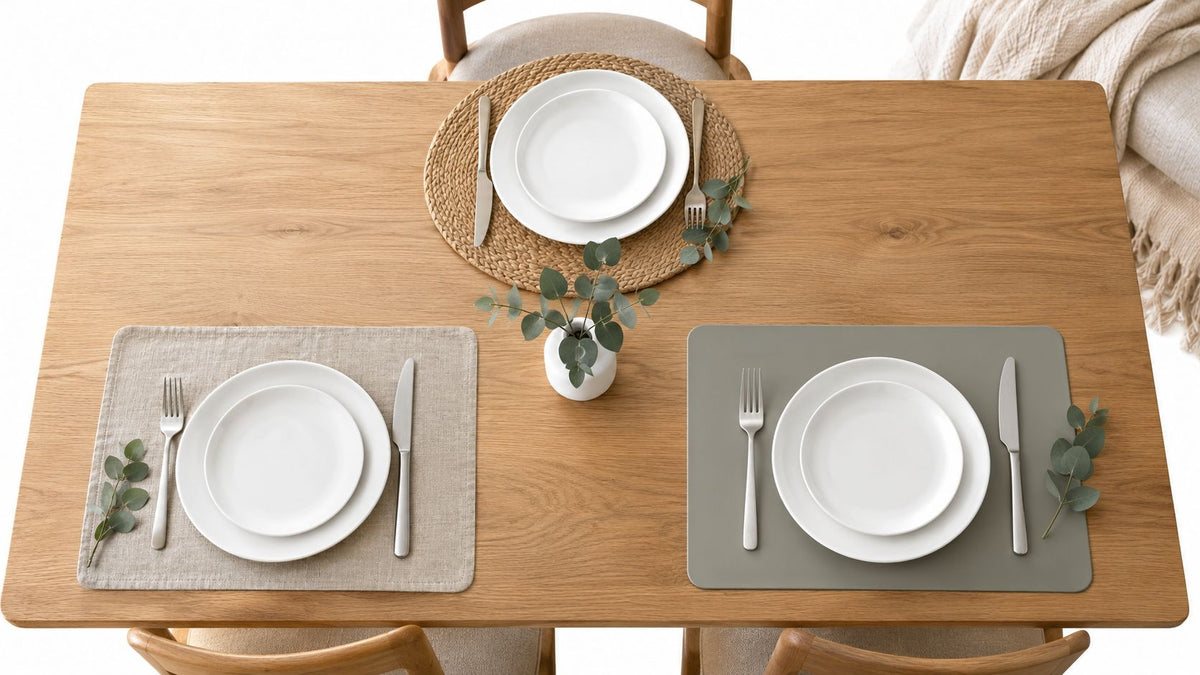
You don't need another pretty table accessory that only looks good in the product photo. In a real Australian home, a placemat set earns its keep when breakfast is rushed, kids are doing homework at the table, and weekend meals leave crumbs, sauce, and water rings behind. If a dining table has to work hard, a coordinated set makes more sense than random mats because it gives you a repeatable surface, a cleaner look, and a faster reset.
A good placemat set also solves a style problem, not just a practical one. It pulls the dining table into the rest of the room, especially if you already care about soft furnishings and want the table to feel intentional. For broader room-planning ideas, upgrade your dining space with the same thinking you'd use for cushions and throws, because the table shouldn't feel cut off from the rest of the house.
Table of Contents
- What a Placemat Set Really Does at the Dining Table
- Which Placemat Material Should You Actually Choose
- How to Measure and Pick the Right Placemat Set Size
- What Washable and Waterproof Placemats Really Mean
- Placemat Set Picks for Real Australian Households
- How to Care for Placemats So They Actually Last
- Styling a Placemat Set With Your Sofa, Throws and Cushions
- Placemat Set vs Tablecloth or Bare Table and FAQs
What a Placemat Set Really Does at the Dining Table
A placemat set gives each person a defined place, protects the table from minor heat, spills, scratches, and plate marks, and finishes the setting without the bulk of a full tablecloth. In a real home, that matters most on rushed mornings, after-school snacks, and casual dinners that leave crumbs behind.
The first call is material and finish, because that decides how the set feels, how easily it wipes down, and how it wears over time. The second is size and fit, because a mat that crowds cutlery or hangs awkwardly off the edge gets annoying fast. Third, judge durability with your own household in mind, especially if children, pets, or frequent guests use the table.
Practical rule: if your table handles rushed breakfasts, homework, or casual dinners more often than formal entertaining, buy a coordinated placemat set instead of cobbling together mismatched mats.
Fourth, sort out the care routine before you buy. A set can look great in a product shot and still be useless in a busy kitchen if it needs delicate handling. Fifth, check how the set fits the rest of the room, because the dining table usually sits inside an open-plan space, not apart from everything else.
That styling point matters in Australian homes, where the table often becomes a landing zone for bags, keys, and half-finished cups of tea. A placemat set should echo the same visual language as your seating, cushions, and throws, not fight it. If you want a room that feels pulled together, elevate your dining space with accessories that work together instead of competing for attention.
My blunt rule is simple. If two of these three situations apply to you, rushed breakfasts, kids or pets, and weekend entertaining, a coordinated placemat set is the better buy. If none of them apply, you probably want something more decorative than practical.
Which Placemat Material Should You Actually Choose
Choose the placemat set material that matches the way your table is used, not the one that looks prettiest in a styled photo. In a busy Australian home, that usually means one material for rushed breakfasts, another for pets and kids, and a different one again if the table is mostly for weekend dinners. Cotton and linen feel softer, jute and seagrass add texture, PVC and vinyl wipe clean fast, cork has a warmer natural look, silicone handles mess best, and woven synthetics hold up well where colour and fade resistance matter.
Compare the materials by real household use
Cotton suits people who want a soft, washable placemat and can live with a slower dry time. Linen gives a relaxed, textured finish and improves with age, but it wrinkles quickly and suits households that do not need a polished look every day.
Jute and seagrass bring strong natural texture, but they shed fibre and stain more easily, so I would reserve them for low-mess settings. PVC and vinyl are the straightforward wipe-clean choice, though they can feel cheaper and may slide on smooth tables. Cork looks warm, feels natural, and handles heat well, but it dislikes standing water. Silicone is the practical pick for busy families because it stays in place and copes with spills without fuss. Woven polyester or blended synthetics make sense outdoors and in bright rooms because they keep their colour better than many natural fibres.
My take: for toddlers, choose silicone or bonded PVC. For renters who want a softer look, choose linen-blend or cotton. For entertainers, choose woven synthetics or cork if the table gets handled gently.
| Placemat materials compared for Australian homes | |||
|---|---|---|---|
| Material | Absorbency | Durability | Best for |
| Cotton | Medium to high | Medium | Soft everyday dining, washable family use |
| Linen | Medium | Medium | Relaxed dining rooms, layered styling |
| Jute | High | Lower | Decorative use, low-mess homes |
| PVC | Very low | Medium | Wipe-clean family tables, quick resets |
| Cork | Low | Medium | Natural look, heat resistance |
| Silicone | Very low | High | Toddlers, spill-heavy households |
| Woven synthetics | Low | High | Outdoor dining, busy entertaining |
If I were buying one set for a typical Australian family table, I would start with silicone, then woven synthetics, then cotton only if washing comfort matters more than speed. That order suits real mess, not showroom styling. If you are also refreshing the seating around the table, Casamé Home covers the same soft-furnishings material families in its broader range.
How to Measure and Pick the Right Placemat Set Size
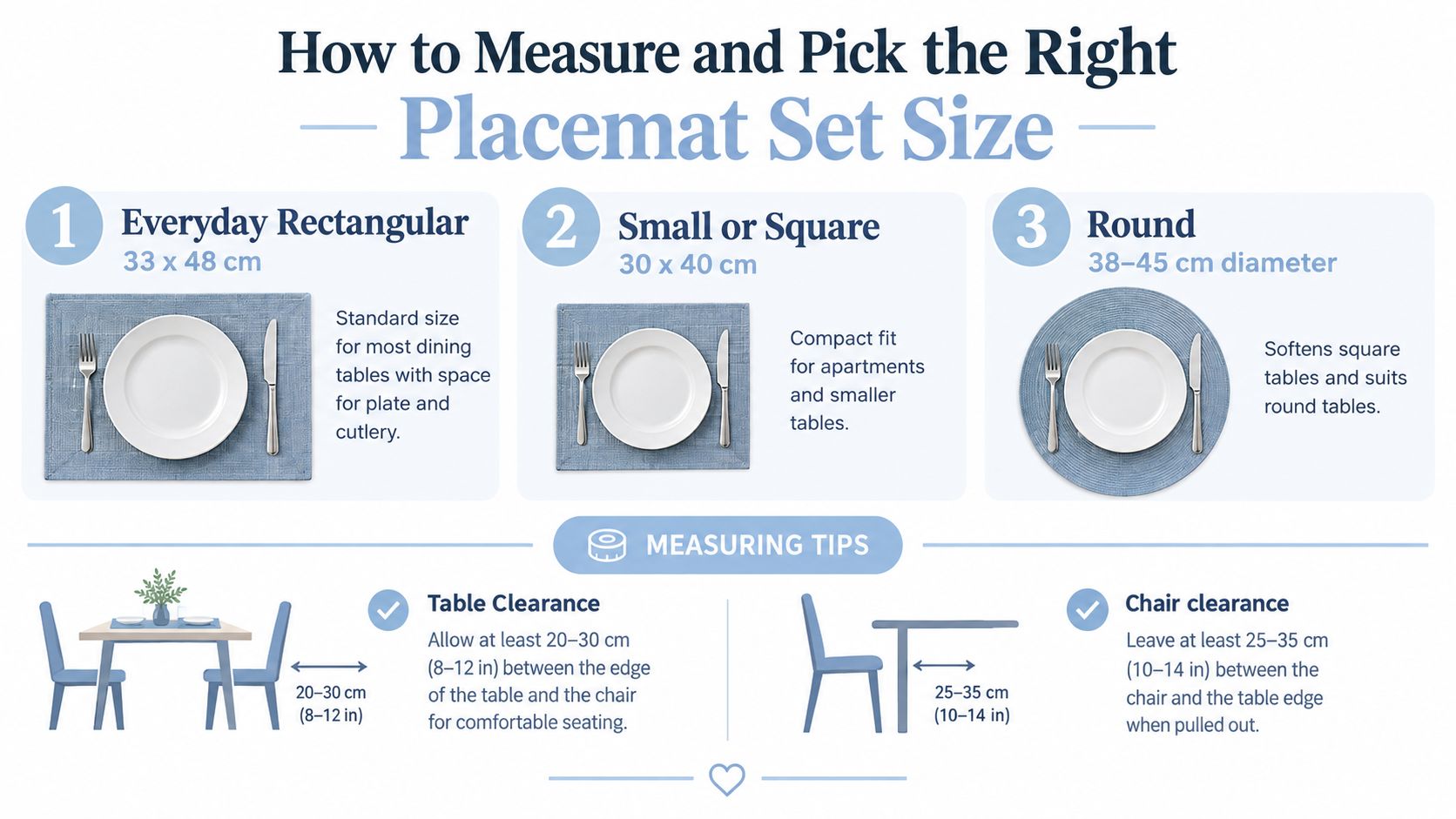
The right placemat size is the one that leaves enough room for plates, cutlery, and elbows without making the table feel crowded. In Australian homes, the usual footprints are roughly 33 by 48 centimetres for everyday rectangular mats, 30 by 40 centimetres for smaller or square mats, and 38 to 45-centimetre rounds for round tables and outdoor settings.
Measure the table, not just the empty surface
Start by measuring the usable centre of the table, then subtract the space each place setting needs and leave at least 15 centimetres of breathing room at each edge. That keeps placemats from hanging awkwardly off the side or clashing in the middle when everyone sits down.
Rectangular tables usually look best with rectangular mats, because the lines stay tidy. Round tables work better with round or square mats, since rectangular mats on a round top often look forced. Outdoor tables can handle slightly larger mats because the setting is usually looser, but the same rule still applies, don't let the mats crowd the centre.
Practical rule: if placemats overlap in the middle, the set is too large. Elbow room matters more than a dramatic table image.
The mistake I see most often is oversized mats that steal space from actual dining. That gets worse on weeknights, when plates arrive hot, glasses spread out, and someone always needs room for a laptop or schoolbook. A placemat set should make the table easier to use, not turn dinner into a balancing act.
If you're replacing old mats, the internal guide at https://casamehome.com/blogs/sofa-cover-ideas/cover-for-dining-table is useful for thinking through scale, because the same sizing logic applies across table textiles. I'd still choose the size based on your actual chairs and serving habits, not the product photo.
What Washable and Waterproof Placemats Really Mean
A placemat set that looks easy-care on the shelf can behave very differently once breakfast spills, curry, coffee, and sticky fingers hit the table. Washable usually means the mat can be cleaned under the care instructions on the label, but that does not stop absorbent fabrics from holding onto stains before you get them into the wash. Waterproof is narrower still. It usually depends on a backing or surface that blocks liquid, and that only works while the material stays intact.
Read the label, not the marketing
Soft textiles like the Veloura Cushion Cover · Beige can handle a gentle cycle, but a daily-use placemat needs a tougher build than that. Treated linen or cotton may shed spills at first, then start staining once the coating wears. Bonded PVC wipes down faster, yet it can crack or peel if you keep folding it, exposing it to heat, or scrubbing it too hard. Woven vinyl sits in the same practical zone. It resets quickly, but it is not indestructible.
Here's the plain version. Stain-resistant means you get a little more time to wipe the spill. Stain-proof is mostly marketing talk. Oil, curry, and red sauce will still beat up any placemat that depends on a coating instead of a non-absorbent surface.
| Washable vs Waterproof vs Stain-Resistant, what the label really means | |||
|---|---|---|---|
| Claim | What it Actually Means | Typical Material | Where it Fails |
| Washable | Can be cleaned by hand or machine under stated care conditions | Cotton, linen, some blends | Shrinkage, creasing, slow drying |
| Waterproof | Liquid is blocked by a backing or dense construction | PVC-backed, TPU-backed, silicone | Heat damage, cracked backing, edge wear |
| Stain-resistant | Surface slows absorption, but doesn't stop staining forever | Treated linen, coated fabric | Oil, curry, repeated abrasion |
Australian homes put placemats through rough, ordinary use. Dishwasher heat is hard on many finishes, hot cookware can ruin coatings, and oil-based dressings defeat a lot of “easy-care” claims. I would choose a placemat you can wipe fast or wash hard, because that is what survives real weeknight meals. Gentle-cycle softness belongs in cushion covers and other soft furnishings. A placemat at the dining table needs more protection and less preciousness.
Placemat Set Picks for Real Australian Households
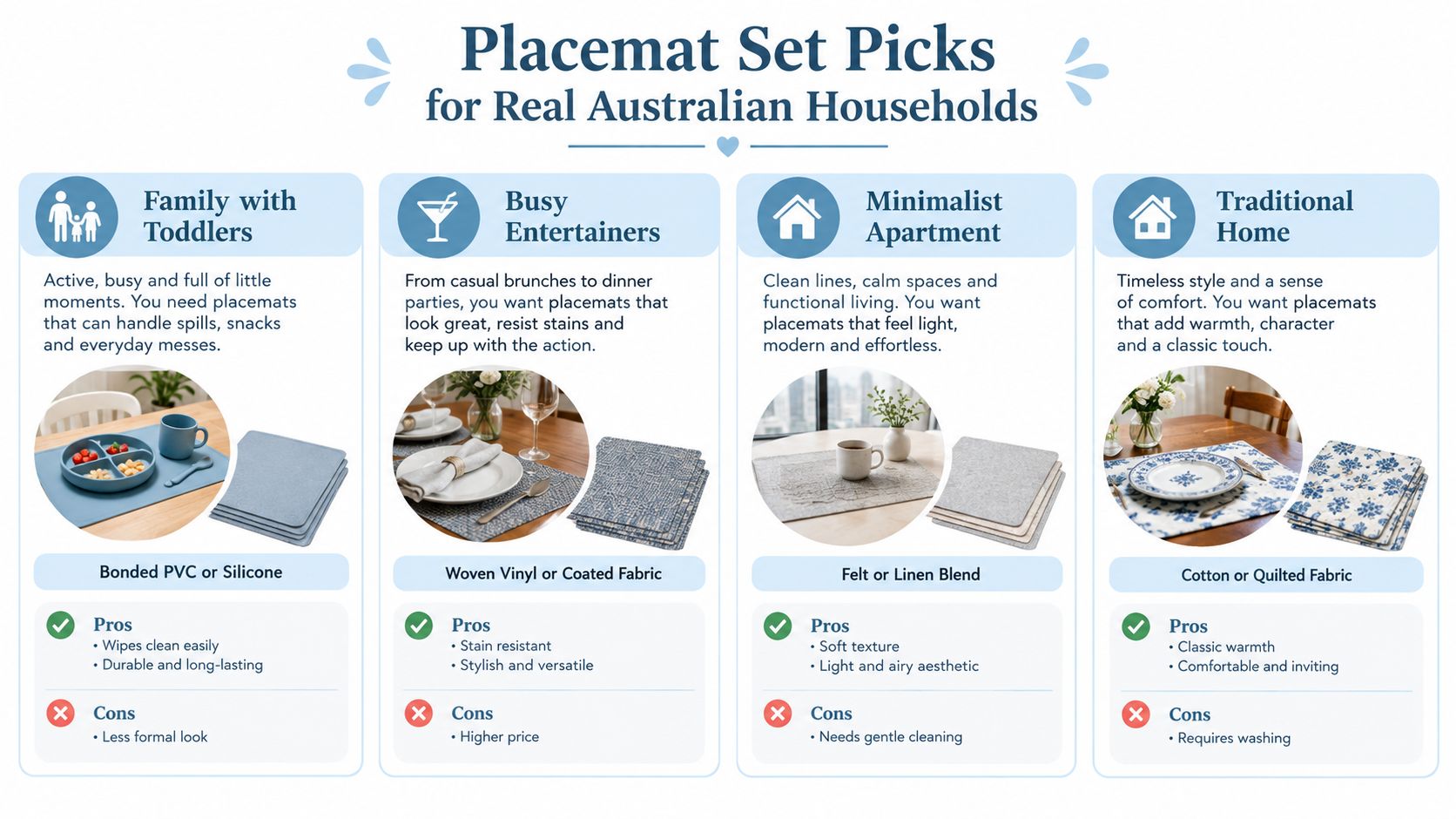
The right placemat set depends on how the table gets used, not on the label on the packet. A household with toddlers needs something that wipes clean without a fight, while a renter or regular entertainer can make different trade-offs because the table faces less daily punishment.
Four household types and the set I'd choose
A family with toddlers should buy bonded PVC or silicone. Both handle sticky hands, dropped spoons, and quick clean-ups, but silicone stays put better when a child drags a plate across it. I would skip delicate woven textures here because they trap crumbs and turn every meal into a cleanup job.
A one-person rental needs a washable linen-blend or cotton-blend set. It gives the table some personality without locking you into a bulky look, and the mats pack flat when you move. The trade-off is simple, you will launder them more often, but the table looks better than hard, shiny protection in a small space.
Use case rule: if the table is part dining zone, part work zone, choose the mat that resets fastest, not the one with the nicest description.
An Airbnb host in a coastal town should choose neutral woven vinyl. It photographs neatly, hides everyday wear better than plain cloth, and resets quickly between guests. A weekend entertainer should choose layered linen with a runner on top, because it gives the table a relaxed, hosted feel without the maintenance of a full tablecloth.
For broader tableware presentation, the guide to crockery for restaurants is a useful reminder that surface, plate, and setting need to work together.
That same logic applies at home: a placemat set should support the crockery, not compete with it.
How to Care for Placemats So They Actually Last
A placemat set only lasts if you match the care to the material. Cotton and linen usually handle a cold machine wash with mild detergent. PVC and silicone need a wipe-down with a damp cloth and mild soap. Jute and seagrass need dry brushing more than washing, because soaking them breaks down the structure fast.
The care mistakes that shorten lifespan
Never soak bonded or backed placemats. Water gets into the layers, the backing starts to separate, and the mat loses its shape for good. A hot iron on a coated surface is another easy way to ruin it. Bleach on jute does not brighten it, it leaves you with a damaged mat.
Australian textile care labels use symbols for washing, bleaching, drying, ironing, and professional care, and the wash symbol can include a temperature such as 40°C. The triangle shows whether bleach is allowed, and the square with a circle shows whether tumble drying is suitable. If the symbols are not clear at a glance, treat the placemat gently.
The biggest mistake is using fabric softener on anything with a waterproof membrane. Softener leaves residue that interferes with water resistance, so the mat stops doing the job you bought it for. I'd also avoid tumble drying placemats alongside towels, since the friction and heat are rougher on coatings than many expect.
If you want a simple reference for wash temperatures and care language, the machine-wash temperature guide is useful alongside the care labels. Once the mats are fully dry, stack them flat, keep the edges aligned, and do not press heavy items on top if you want the corners to stay crisp.
Styling a Placemat Set With Your Sofa, Throws and Cushions
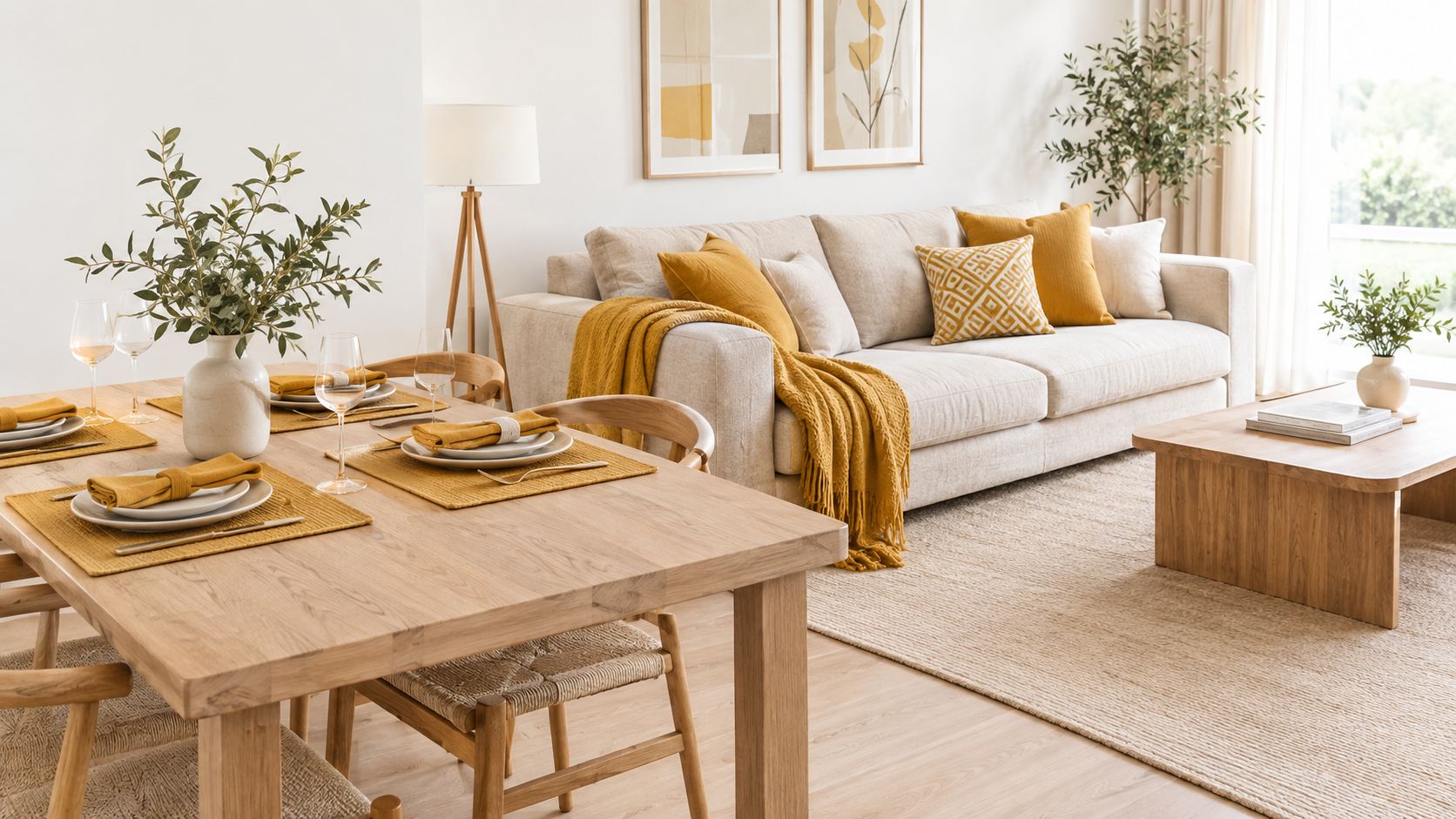
A placemat set should act like part of the room, not a separate object dropped onto the table. I would pull one accent colour from the sofa cover or throw, usually the secondary shade, and repeat it in the placemats so the dining and living zones read as one space. That matters most in open-plan rooms, where the table sits in full view of the sofa.
Match colour, texture, and finish with intent
A linen or cotton placemat softens a leather sofa because the contrast feels balanced. Jute or woven synthetics add weight against a pale linen sofa, which keeps the room from looking washed out. Matte placemats sit well with matte cushion covers, while a subtle sheen can work if your throws have a brushed or softly reflective surface.
For a coastal neutral room, I'd use white or sand-toned placemats, oatmeal throws, and cushions with a quiet textured knit. In a terracotta rental, I'd pick warm woven mats and keep the sofa textiles in one restrained tone so the table does not shout over the rest of the room. For a monochrome entertainer's setup, black or charcoal placemats paired with crisp cushions and a plain throw feels deliberate, not stiff.
Styling rule: match two of three elements, colour, texture, and finish, then break the third on purpose.
The simplest way to avoid a messy look is to keep the table and sofa in the same material family or at least the same mood. If your cushions are soft and nubby, do not choose a glossy placemat that looks like it came from another house. If your throw is brushed and cosy, the placemat should feel grounded rather than shiny.
For a worked example of treating the room as one composition, see the guide on how to style a throw blanket on a sofa.
Placemat Set vs Tablecloth or Bare Table and FAQs
A placemat set wins for most everyday Australian homes because it offers protection without turning the table into a laundry project. A tablecloth suits formal dining rooms and big hosted meals, while a bare timber table suits low-mess households that like heat-tolerant surfaces and don't want extra textiles at all.
| Placemat Set vs Tablecloth vs Bare Table | |||
|---|---|---|---|
| Factor | Placemat Set | Tablecloth | Bare Table |
| Noise reduction | Moderate | High | Low |
| Spill containment | Good at each seat | Broad coverage | Minimal |
| Styling flexibility | High | High, but more formal | Medium |
| Laundry load | Low to moderate | Highest | None |
A small apartment benefits from a placemat set because it gives you structure without visual bulk. Mixing two placemat designs at a six-seat table can work if you keep the colour family consistent. Placemats do help protect timber from everyday heat, but I'd still use a trivet for hot cookware, because a placemat isn't a substitute for proper heat protection.
A standard set is usually four mats, and renters should buy enough for daily use plus a spare pair for guests or replacements. My direct recommendation is a four-piece neutral set plus two accent mats. That gives you a flexible starter pack for weekday meals, weekend entertaining, and the inevitable stained mat that needs to be swapped out.
Casamé Home focuses on practical soft furnishings that help a room work better, not just look tidier. If you want the same kind of everyday usefulness at the table, browse the range at Casamé Home and choose pieces that fit how your household eats, hosts, and cleans up.


