


You're halfway through a Saturday barbecue, four adults are squeezed around a round table, and the children are eating cross-legged on the pavers because there's nowhere else to sit. A well-chosen outdoor bench table solves that problem by combining the table surface and seating in one compact footprint. It's a practical year-round fixture for Australian courtyards, balconies and patios, not a piece of furniture you bring out only for summer.
Table of Contents
- What Is an Outdoor Bench Table and Why Does the Format Matter
- Which Outdoor Bench Table Style Fits Your Space
- Which Material Holds Up Best Outdoors
- How to Size an Outdoor Bench Table for Your Layout
- Does a Backless Bench Table Work for Everyone
- How to Care for and Weatherproof an Outdoor Bench Table
- How to Choose and Place the Right Outdoor Bench Table
- Wrapping Up Your Outdoor Bench Table Decision
What Is an Outdoor Bench Table and Why Does the Format Matter
An outdoor bench table is a table with integrated or matching bench seating, usually arranged along one or both long sides. Unlike a standalone table surrounded by individual chairs, the format keeps the seats aligned with the table and reduces the floor area lost to chair legs and pull-out space.
That difference matters in Australian homes. Narrow side yards, compact courtyards and apartment balconies rarely have room for chairs to sit comfortably around every edge. A bench can slide beneath the tabletop when nobody's using it, creating a cleaner passage and making the whole setting easier to live with.
How does a bench table differ from other outdoor seating?
A picnic setting normally has an A-frame structure with fixed benches attached to the table. A bench-table combination uses separate pieces, so you can move the bench independently. Built-in banquette seating is fixed to a wall, deck or retaining structure, while a freestanding bench table can be repositioned if your layout changes.
The social advantage is just as important as the space saving. A bench side creates a communal perch. Children can squeeze together, extra guests can join without a furniture shuffle, and the table works equally well for meals, board games, homework or watching cricket from the patio.
Practical rule: Buy for the way people gather, not for the number of seats printed on the product page.
The format does have trade-offs. Fixed picnic benches offer stability but limit flexibility. Backless benches look clean but provide less support. Timber brings warmth but needs care, while plastic and composite materials usually ask less of you but can feel less natural. The right choice depends on your routine, available clearance, climate exposure and the people who'll use the table.
Australia's outdoor furniture category is part of a broader spending pattern around alfresco living and home improvement, with Statista's Australian outdoor furniture forecast projecting continued expansion in revenue and per-capita spending through 2025. That makes a durable bench table a sensible infrastructure purchase, rather than a passing styling decision.
Which Outdoor Bench Table Style Fits Your Space
The best style depends on whether you value fixed stability, rearrangement or visual lightness. Start with the layout you use, then compare the furniture formats.
Classic picnic benches
A classic picnic bench has fixed seats on both sides, often supported by A-frame legs. It suits family meals, children's play areas and casual entertaining because the structure stays stable when people climb on, lean across or shift along the bench.
A 1.4 to 1.8 metre picnic bench suits a family of four, based on the dimensions in the buying brief. Choose this format when the table will stay in one position and you want a familiar, dependable setting.
Bench-table combinations
Separate benches and a matching table are the better choice for households that change their setup. Move one bench away for access, turn the table for a different entertaining arrangement, or use a bench elsewhere when the table isn't needed.
This format also works well when your peak guest count changes. Keep the everyday arrangement compact, then add seating for a barbecue without replacing the whole setting.
Backless benches
Backless benches tuck fully beneath the tabletop and create the smallest visual profile. They're useful on balconies and in courtyards where a clean edge matters, including properties with strict body corporate expectations about appearance and obstruction.
Before choosing one, check the comfort and accessibility compromises covered later. For broader ideas about integrating timber seating with pergolas, decks and other outdoor timber structures, look for guidance that treats the surrounding structure and furniture as one layout rather than separate purchases.
| Style | Best Footprint | Best For | Watch Out For |
|---|---|---|---|
| Classic picnic bench | Medium rectangular patio or yard | Everyday family meals and children's use | Fixed seating limits repositioning |
| Bench-table combination | Flexible courtyard or entertaining area | Households that host different group sizes | Separate pieces can drift or become uneven |
| Backless bench table | Tight balcony or narrow courtyard | Minimal visual bulk and easy storage under the table | Less back support and potentially weaker accessibility |
| Built-in banquette style | Wall edge, deck or landscaped zone | Permanent outdoor dining areas | Difficult and costly to relocate |
A modular combination is the strongest entertaining choice. A backless setting wins where every centimetre counts. A classic picnic table remains the safest all-rounder for a family that wants a stable, informal outdoor dining zone.
Which Material Holds Up Best Outdoors
For Australian conditions, material choice matters more than colour or trend. Outdoor furniture faces strong UV exposure, heat, moisture, cleaning and, in coastal areas, salt-laden air. The cheapest option can become expensive if the surface fades, swells, cracks or needs constant refinishing.
Timber
Spotted gum, blackbutt and treated pine offer the most familiar outdoor look. Timber feels warm, resists the visual sterility some metal settings create and can be repaired or refinished rather than discarded. It still demands a maintenance routine, particularly if you want to preserve the original colour.
Apply a suitable outdoor oil or penetrating finish regularly, paying attention to exposed end grain and joints. For broader background on selecting durable wood for exterior projects, focus on species, moisture behaviour and finishing requirements rather than appearance alone.
Aluminium and steel
Powder-coated aluminium is lightweight, doesn't rust in the same way steel does and is the safest metal direction for exposed coastal locations. Choose a quality coating and inspect it after moving the table, because scratches and chips still leave weak points.
Steel offers stiffness and weight, which can help on windy decks, but damaged coating can allow spot rust to develop. Steel also absorbs heat in direct sun, so shade and surface colour affect comfort.
Plastic and composite
Plastic and resin settings are easy to clean and generally demand little maintenance. Cheap grades can fade or become brittle under Australian UV, so look for UV-stable construction. Australian furniture guidance recommends powder-coated aluminium, UV-stabilised HDPE or resin wicker, and solution-dyed acrylic for stronger sun performance, as outlined in this Australian outdoor furniture sunlight guide.
Composite and recycled-plastic lumber sit higher when durability and low upkeep lead the decision. They can reproduce timber grain without the same sanding and oiling regime, although finish quality varies between products.
| Material | UV Resistance | Moisture/Salt Performance | Maintenance Level |
|---|---|---|---|
| Hardwood | Good with suitable finish | Strong, but joints and end grain need care | High |
| Treated pine | Moderate with regular treatment | Better than untreated timber, but can weather | High |
| Powder-coated aluminium | Strong | Excellent coastal choice when coating stays intact | Low |
| Powder-coated steel | Strong | Vulnerable where coating chips or rust begins | Medium |
| Plastic or resin | Varies by grade | Good, but cheaper products may degrade | Low |
| Composite or recycled plastic | Generally strong when UV-stabilised | Strong moisture performance | Low |
My recommendation: choose powder-coated aluminium for coastal exposure, treated timber when natural character matters and you'll maintain it, and UV-stabilised composite or recycled plastic when the table must work hard with minimal attention.
How to Size an Outdoor Bench Table for Your Layout
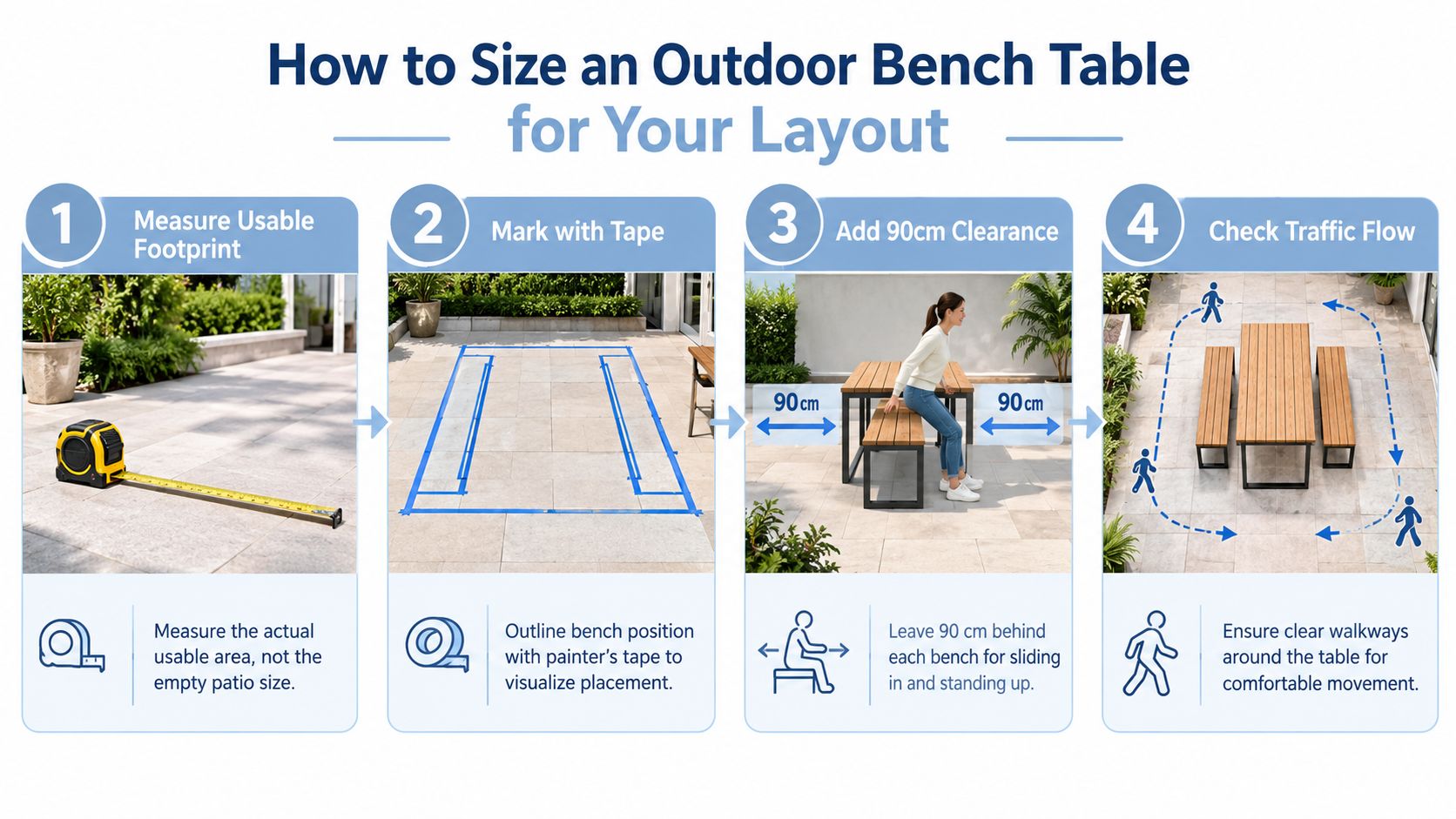
Measure the usable footprint, not the empty patio. Account for walls, posts, planter boxes, doors and the space people need to slide onto the bench before you compare table dimensions.
Mark the proposed bench positions with painter's tape. This simple test exposes awkward door swings and tight corners before delivery, and it shows whether the table interrupts the main route through the yard.
What clearances should an outdoor bench table have?
Allow 90 cm behind each bench so people can sit down, slide along and stand without pushing into a wall. Keep another 60 cm walkway around the table edges where trays, children or passing adults need to move.
Rectangular picnic-style tables commonly use widths between 140 cm and 180 cm for four to six seats, while a 160 cm length gives four adults useful elbow room. Square layouts between 120 cm and 150 cm can work in tighter courtyards. These dimensions are planning guides, so confirm the manufacturer's finished measurements before ordering.
Check the overhead space under an awning, pergola or roofline. Also verify that the ground is level within 2 cm across the footprint, because a small slope can create an irritating wobble and uneven loading.
For a useful reference on table proportions, compare your finished dimensions with this standard bench height guide.
Does a Backless Bench Table Work for Everyone
A backless outdoor bench table doesn't work equally well for everyone, especially people with limited mobility, back pain, balance concerns or a preference for longer meals. Its compact shape is useful, but the absence of lumbar support becomes noticeable when guests sit for an extended meal.
Backless benches remain excellent against a rendered wall or fence line. They look cleaner, tuck under the table and can seat people close together. That convenience shouldn't be confused with universal accessibility.
Australian guidance places accessible table heights around 750 to 850 mm, with at least 700 mm of wheelchair clearance under the table, while also requiring circulation that doesn't obstruct movement. It also warns that standalone benches without backs may not satisfy DDA-style accessibility expectations. Review the Australian outdoor dining operating guidance when the table serves a shared or public space.
Which seating arrangement is more practical?
For a mixed-age household, use a hybrid arrangement. Put a backless bench along the wall where space is tight, then place a backed bench or chairs on the access side. People who need more support can sit where getting in and out is easier, while children and casual users still benefit from the compact side.
Public-realm guidance also recommends durable, easy-to-clean construction, fixing tables to a concrete slab and providing wheelchair access to part of the table. It advises against grass because grass placement increases maintenance and can reduce accessibility performance, as explained in Australian public-realm table and seating guidance.
| Factor | Backless Bench Table | Backed Bench Table |
|---|---|---|
| Floor space | Excellent | Uses more depth |
| Visual profile | Minimal | More substantial |
| Short casual use | Very good | Good |
| Long meals | Less supportive | More comfortable |
| Mobility access | Requires careful planning | Usually easier to use |
| Flexible seating | Strong for squeezing in | More structured |
How to Care for and Weatherproof an Outdoor Bench Table
Treat an outdoor bench table as year-round infrastructure, not seasonal furniture. Cover the frame with a breathable polyester or marine-grade cover when it sits unused, and bring cushions indoors rather than leaving them trapped under damp fabric.
Clean with warm water below 40°C and a pH-neutral soap. Hot water can damage timber fibres and warp some plastic components, while harsh chemicals can strip finishes or leave residues that attract grime.
A practical maintenance routine
- Cover intelligently: Use a breathable cover rather than sealing dampness against the surface.
- Wash gently: Use a soft brush and mild soap for food residue, dust and mould.
- Treat timber: Apply a UV-resistant oil or penetrating sealer every 6 to 12 months, with extra attention to end grain.
- Inspect metal: Wipe away salt and grime, then touch up chipped powder coating with suitable outdoor enamel.
- Check the base: Keep the table stable and lift it off persistently wet ground where possible.
Australian furnishing guidance confirms that fabric care labels are legally required and that machine washing isn't automatically permitted. Bulky covers that won't fit a domestic machine should be professionally washed, while smaller removable items must follow their specific care label. Warwick's Australian fabric care guidance advises that its gentle washing instructions shouldn't exceed 40°C.
Composite and plastic pieces tolerate more neglect than timber, but an annual clean still removes grime before it becomes a permanent stain. Store cushions indoors, leave the frame outdoors under a breathable cover and don't place the entire setting directly on grass if a slab or stable paved surface is available.
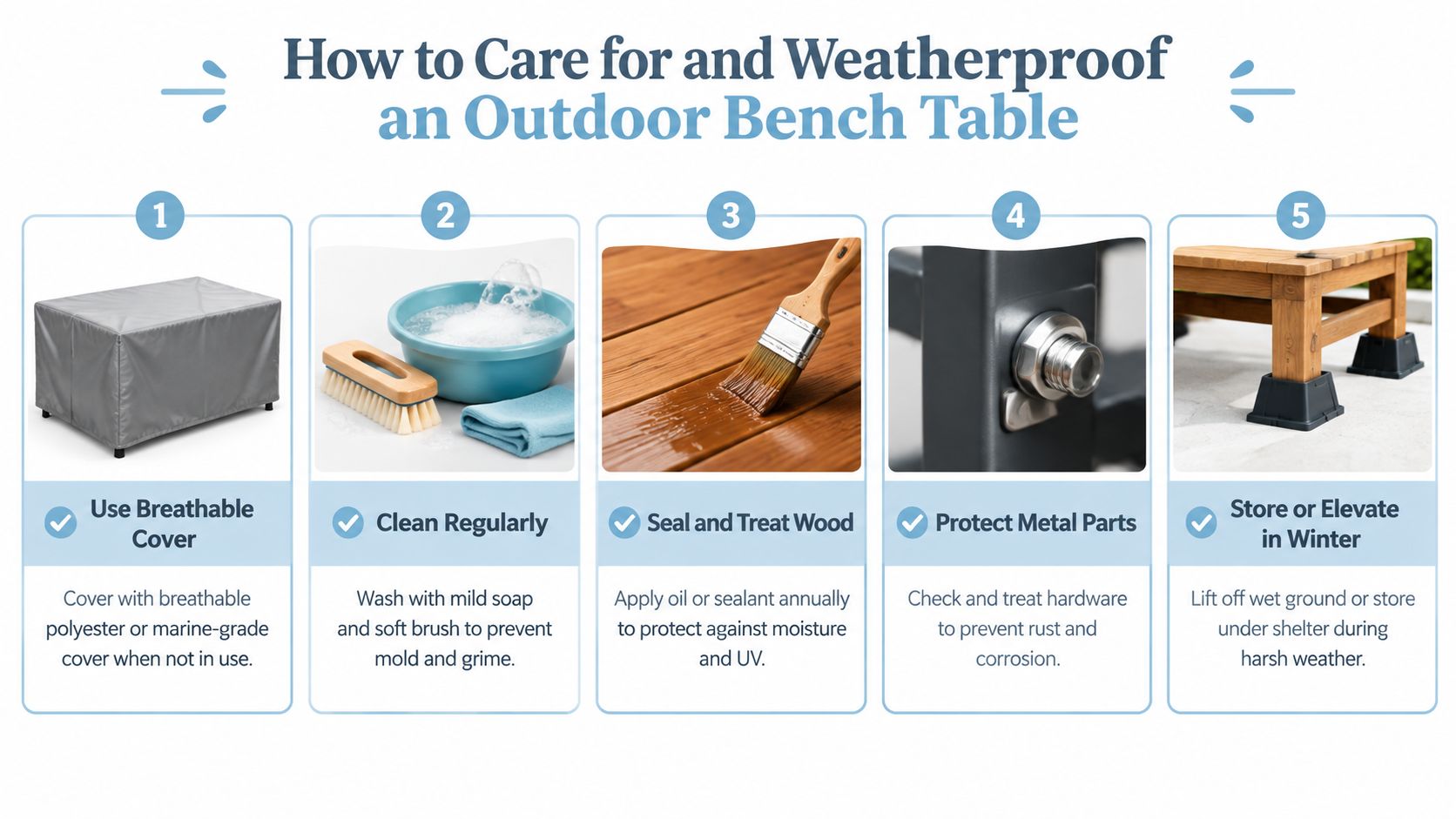
The cover should protect from dust, bird residue and weather without trapping condensation. For ideas on selecting garden furniture waterproof covers, prioritise breathability, fit and access to the furniture rather than choosing the heaviest-looking fabric.
How to Choose and Place the Right Outdoor Bench Table
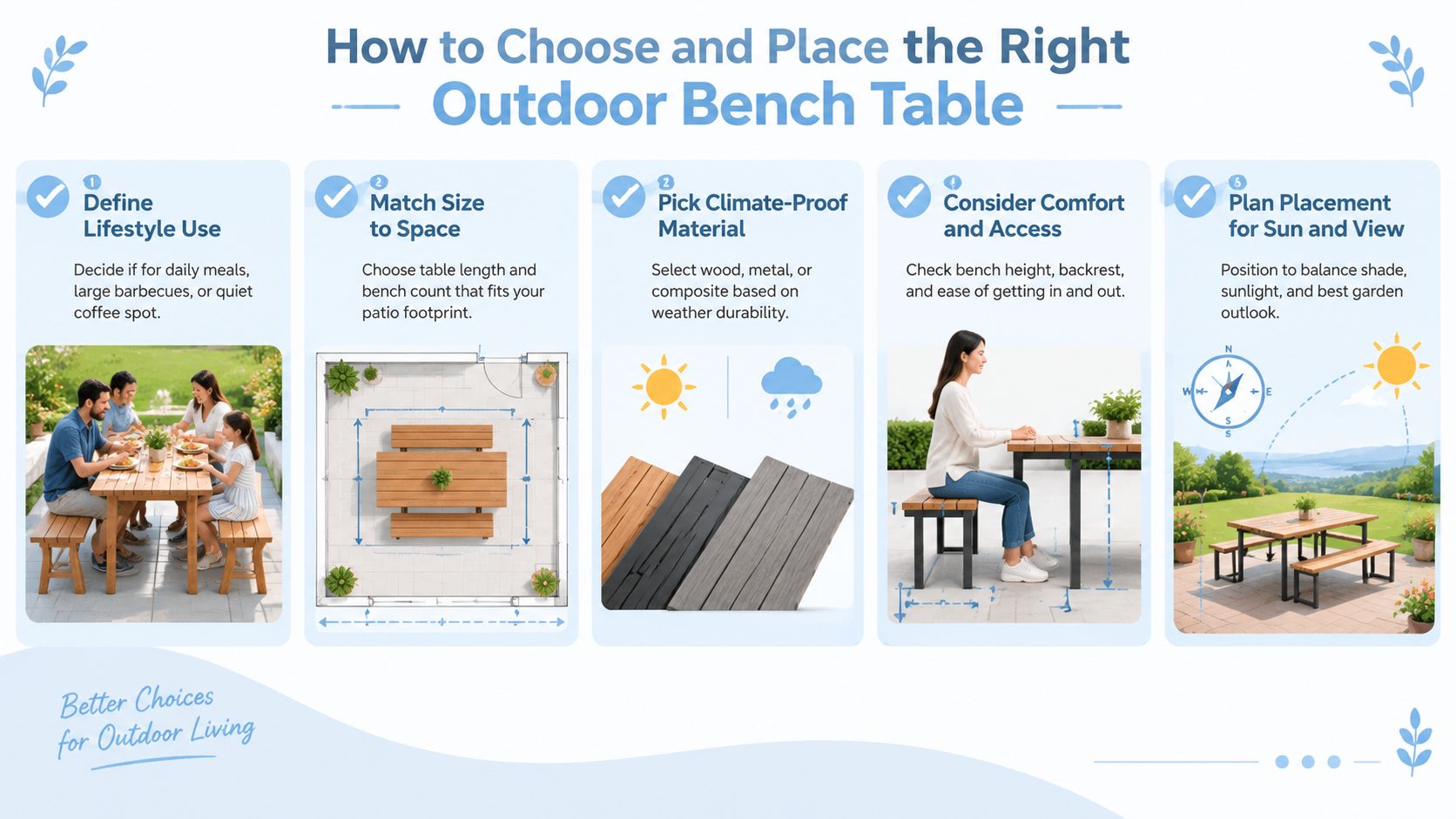
Choose the table around your lifestyle first, then let the climate and layout determine the construction. A setting used for daily family meals needs different comfort and cleaning qualities from one brought out for occasional barbecues or quiet morning coffee.
Write down the usual number of diners, the largest gathering you expect and the main activity. Eating, board games and laptop work all need a usable tabletop, but they don't demand the same seating support or access pattern.
What should you check before buying?
- Ground type: A concrete slab or stable pavers provide a better base than grass. Decking may need fixings or a heavier frame.
- Delivery access: Measure gates, stairs, lifts and balcony doors, not just the final patio.
- Sun direction: Avoid full western exposure without shade. Direct afternoon sun makes seats and tabletops uncomfortable.
- Kitchen distance: Keep the route short enough that carrying hot food doesn't become a chore.
- Seating access: Provide 90 cm clearance on seated sides and a 60 cm walking lane where traffic passes.
- Wall relationship: Leave 15 cm from walls so cushions and hands don't catch against the surface.
Orient the long edge to capture a cross-breeze, but anchor lightweight sets on exposed decks. Timber looks and performs better in a shaded position, while aluminium and UV-stabilised composite are safer bets for open exposure. A pergola, roof extension or screen can improve comfort more effectively than buying a heavier table.
Australian planning records show that outdoor bench-table arrangements are established features of civic and hospitality spaces. South Australian guidance allocates about 4 square metres for a normally dimensioned table and four chairs, using a 2000 mm by 2000 mm ensemble and specified separation between adjoining settings. Government datasets also track indoor and outdoor café and restaurant seating across Melbourne from 2002 to 2024 and South Australia from 2006 to 2014, demonstrating sustained attention to outdoor seating capacity. The Australian outdoor dining data collection reinforces the point, outdoor seating needs proper planning because it affects movement, access and daily operations.
For a more permanent or customized layout, a guide on how to transform your yard with custom seating can help you think beyond catalogue dimensions. Add table linens only after the placement works, and choose washable, outdoor-suitable options such as those discussed in outdoor table linens.
Wrapping Up Your Outdoor Bench Table Decision
A good outdoor bench table matches household rhythm, climate exposure and physical access. Pick the format that fits daily behaviour first. Then choose timber, aluminium, steel, plastic or composite according to the sun, moisture, salt and maintenance you can realistically manage.
The three filters are straightforward:
- Durability: The table must tolerate Australian UV, rain, cleaning and coastal conditions.
- Accessibility: People need enough clearance, a usable table height and seating that supports different bodies and mobility levels.
- Footprint: The finished setting must fit with the required space behind benches and around walkways.
Don't buy from a showroom photograph alone. Measure the usable zone, mark the bench positions with tape and sketch two possible arrangements on paper. Shortlist two formats from the comparison above, then reject any option that blocks a door, leaves no access route or demands more maintenance than you'll provide.
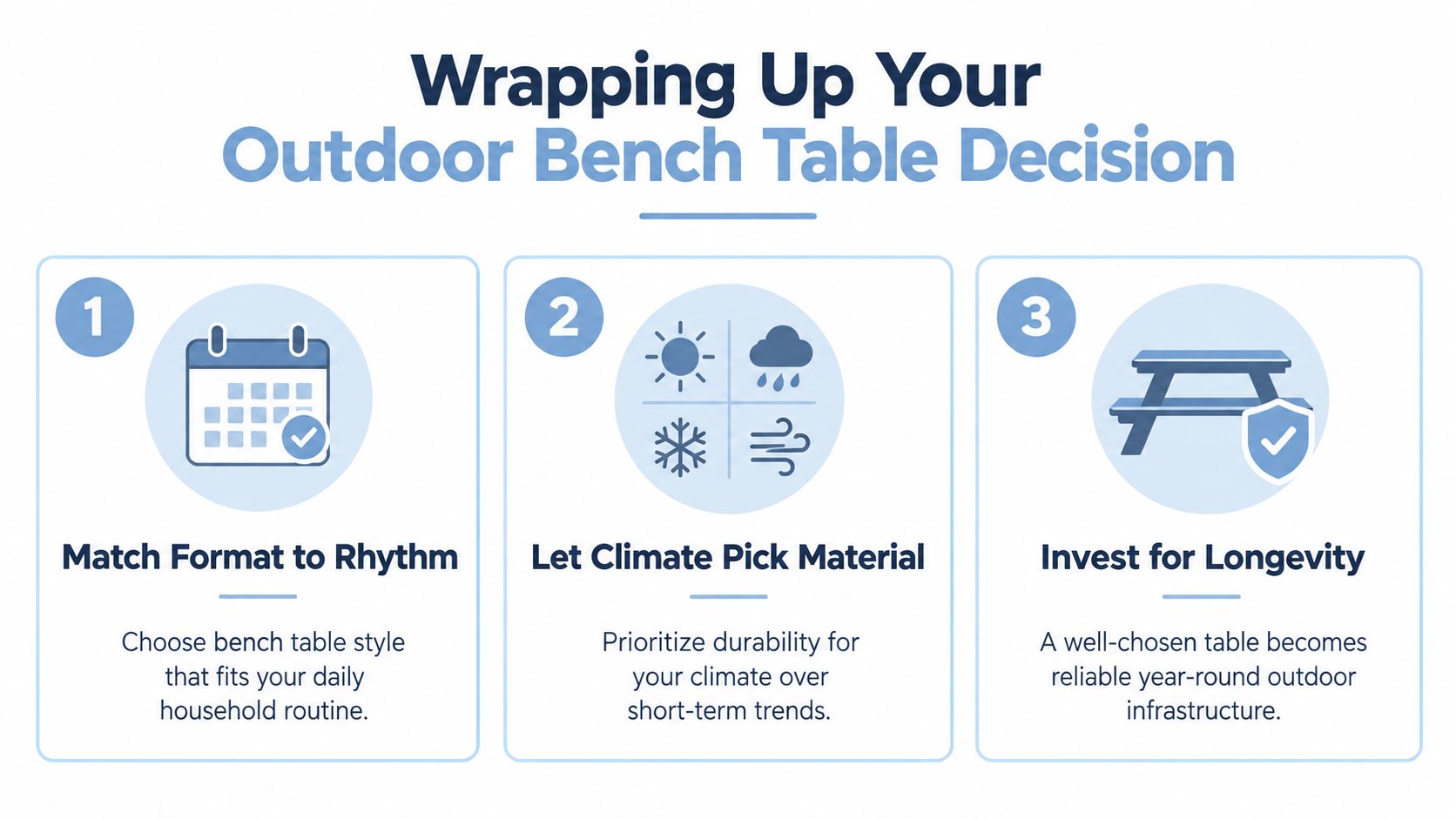
An outdoor bench table earns its place when you can use it in ordinary weather, during family meals, for spontaneous guests and across the full year. Buy the construction that supports those routines, not the finish that happens to look fashionable today.
Casamé Home offers washable, protective covers for bench seats, outdoor cushions and other furnishings that need a practical refresh between uses. Visit Casamé Home to explore protective textile options that help keep your outdoor-living spaces more comfortable and easier to maintain.


